
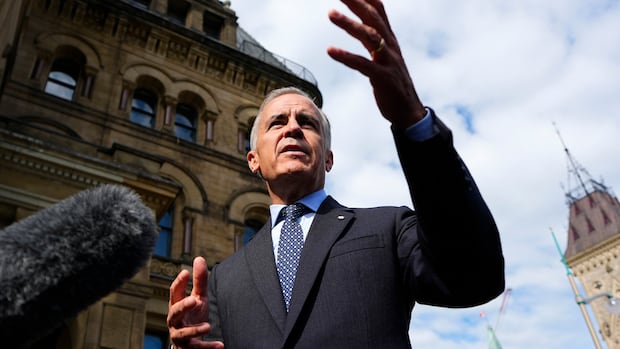
Just hours before Canada is set to hit the U.S. with counter-tariffs on $27.6 billion worth of goods, the two sides have no plans to negotiate a last-minute deal.
The Prime Minister’s Office confirmed to CBC News that there are no calls scheduled between Prime Minister Mark Carney and U.S. President Donald Trump on Monday, and no plans for Canadian trade negotiators to return to the table ahead of the 12:01 a.m. ET Tuesday deadline.
That’s when the counter-tariffs are set to hit over 700 American products.
The tariffs, which range from 15 to 50 per cent, come as a tit-for-tat response to Trump’s latest 50 per cent tariffs on Canadian goods that he imposed last month after trade talks collapsed on the cusp of a deal.
The highest tariffs target industries hit hardest by tariffs from the U.S. They include steel, dairy and wood products.
WATCH | Trump’s top trade negotiator warns against tariff retaliation: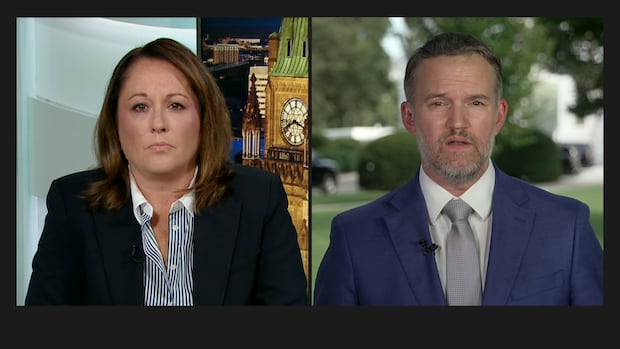
U.S. trade rep disputes why talks fell apart | Canadian exclusive
In a Canadian exclusive interview, U.S. Trade Representative Jamieson Greer disputed Canada’s explanation about why trade talks fell apart, and told CBC News chief political correspondent Rosemary Barton there’s currently no ‘open channels’ to get both sides back to the negotiating table.
In an interview with CBC News last week, U.S. Trade Representative Jamieson Greer warned about U.S. retaliation, suggesting the U.S. might consider bans on Canadian products.
“If there’s further retaliation from the Canadian side, of course, we’re not going to just sit down and take that. Our view is, ‘Don’t retaliate,'” he told CBC News chief political correspondent Rosemary Barton.
Asked by CBC News on Monday about Canada’s choice to retaliate, former prime minister Jean Chrétien said he supported the counter-tariffs and that Canada might even need to consider taking additional steps.
The U.S. has “excluded oil, gas, electricity, potash. Why? Because they need it very badly. So perhaps one day we will have to impose an export tax,” he said.
WATCH | Former PM Chrétien says he supports Canadian retaliation on U.S. tariffs: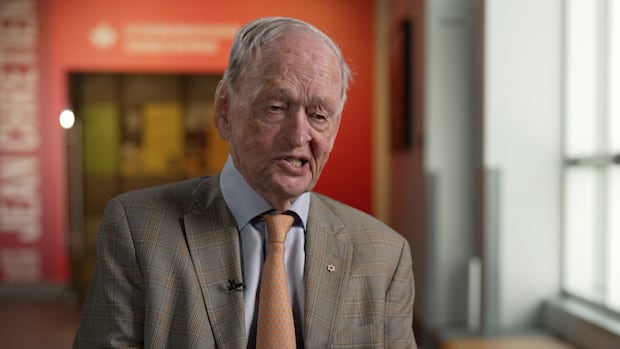
Chrétien calls counter-tariffs a ‘good move’
Former prime minister Jean Chrétien tells CBC News chief correspondent Adrienne Arsenault that Canada’s counter-tariffs on the U.S. are a ‘good move’ and it may be necessary to take them further.Conservatives call on Carney to be ‘up front’
The Conservatives are urging the federal government to be “up front” with Canadians about the impact the retaliatory tariffs would have on families and businesses.
“Canadian people deserve the facts and a plan,” Conservative Leader Pierre Poilievre told a news conference in Regina on Monday. “The best way to keep everyone united and rowing the same direction is to be up front about costs, decisions and the plan going forward.”
Poilievre reiterated calls for the government to release details about the Canada-U.S. trade deal, which fell apart in its last hours last month.
Canadians “deserve to see it so they can judge what we are fighting for and what we are fighting against,” he said.
Ottawa has not yet released details about the anticipated impact the retaliatory tariffs would have in Canada, but it has announced $7.5 billion in supports to help workers and businesses weather the impact of the trade war amid the recent escalations.
The support package comes on top of the nearly $25 billion in tariff aid it implemented over the past 18 months.
WATCH | Conservatives say Canadians deserve details on impact of tariffs: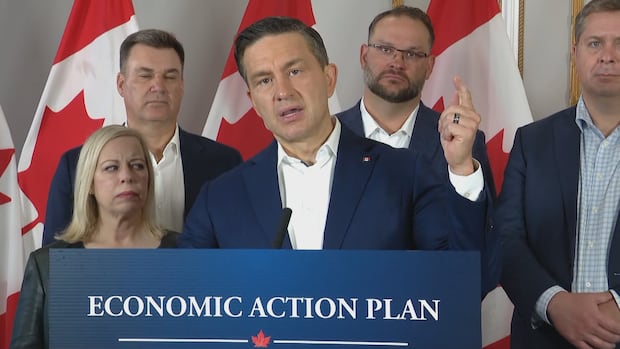
Poilievre calls on PM to release cost analysis of counter-tariffs
When asked at a news conference if he supports the federal government’s planned counter-tariffs on the U.S., Conservative Leader Pierre Poilievre said Canadians need to see how much the counter-tariffs will cost families and businesses, and what measures Prime Minister Mark Carney is taking to offset those costs.Future of talks ‘depends on Canada’: Greer
Speaking to Fox News on Sunday, Greer blamed the breakdown of talks on Canada and suggested that the onus to resume them is on Ottawa’s leadership.
“They looked this deal square in the face and after a few days decided to walk it back,” he said. “The future of it, well, that depends on Canada. They’re the ones who walked away and announced the suspension of talks.”
Carney has attributed the breakdown of talks to the U.S. proposing “new terms that were uneconomic, unfair and undermined the net benefits to Canada, calling into question the reliability of any deal.”
He also said last-minute U.S. demands would have limited Canada’s ability to make trade deals with other countries or protect the French language.
However, Carney has suggested Canada is open to heading back to the negotiating table, but only if the U.S. stops “throwing shade” and starts “being serious” about finalizing a trade deal.
Trump has continued to voice criticisms of Canada following the breakdown of talks and leading up to the latest escalation.
On Friday, the president threatened to stop all trade with Canada.
“All we have to do to cut our trade deficit with a country is not trade with them. Canada is one,” he said to media in the Oval Office at the White House. “If we don’t do any trading with Canada, we just end all trade with Canada, we’d save ourself $90 billion. Don’t forget, they do almost all of their business with the United States and we do a relatively small amount of business with them.”
In a Truth Social post on Sunday, Trump took aim at Canada’s exchange rate with the U.S., calling it “unacceptable.”
On Monday morning, he posted a photo of the map of North America, with Canada, Mexico and Greenland overlaid with the American flag, depicting the entire region as the United States.
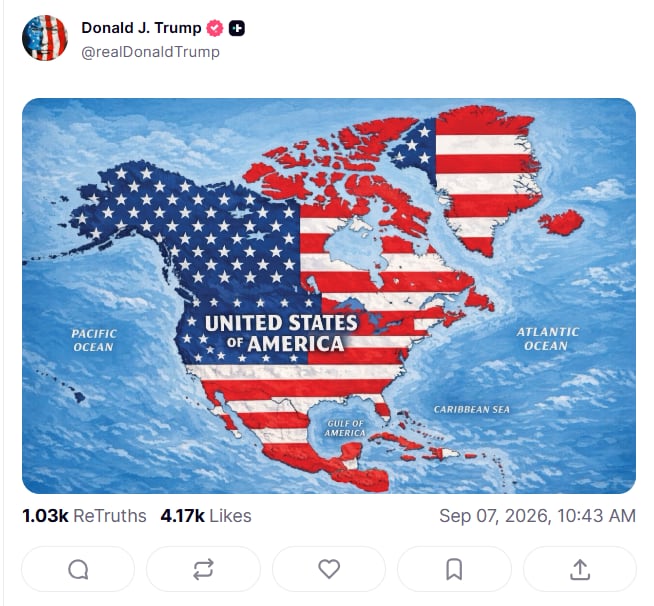 (U.S. President Donald Trump via Truth Social)
In another post Monday, Trump targeted a Canadian aircraft manufacturer, saying “no more selling Bombardier in the United States.”
Trump said the company earns over half of its revenue from the U.S., “All while Canada blocks our GREAT American Banks, and Companies, throughout the U.S.A.”
Calling it “completely unjust and unfair,” Trump went on to say if Canada wants access to U.S. markets, it must build in the U.S. and “stop treating America like a ‘piggybank.'”