
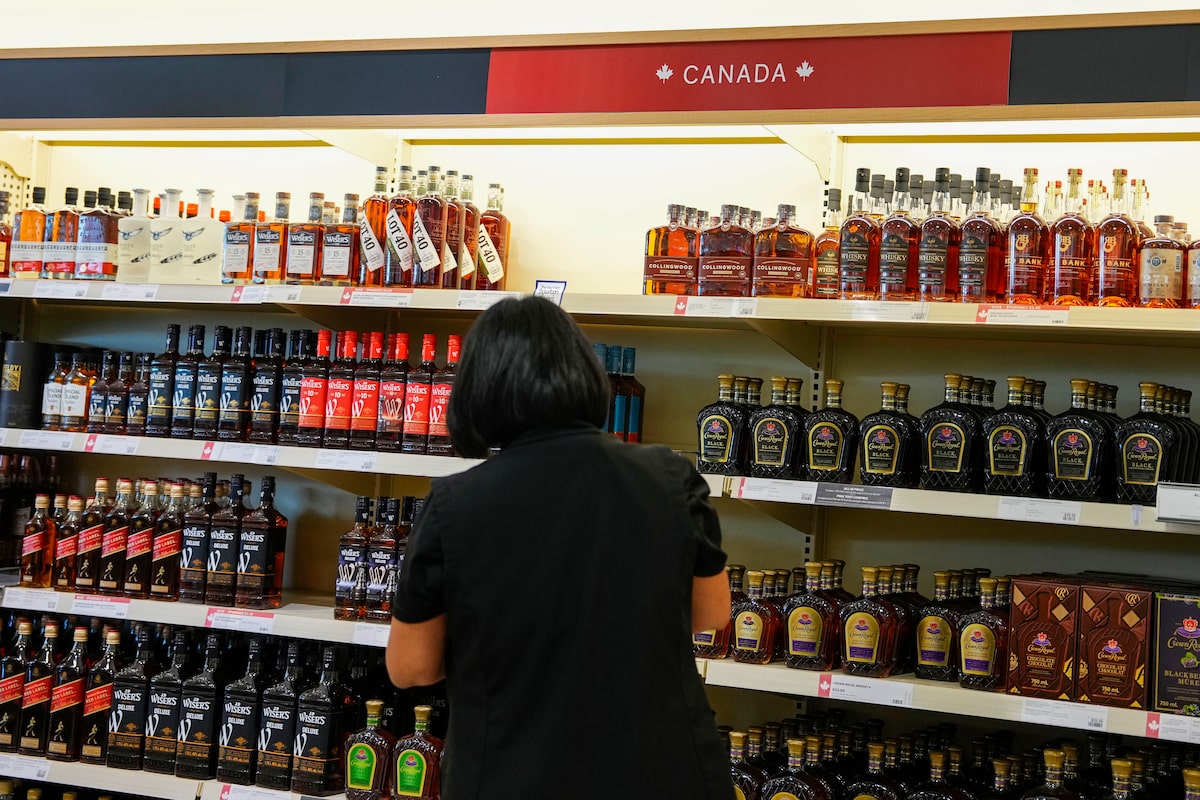
Canadian alcohol is among the goods targeted in the U.S. President’s latest tariff measures.Justin Tang/The Canadian Press
U.S. President Donald Trump has issued a sweeping ban on imports of Canadian alcohol, motorcycles and some dairy products as Washington ratchets up pressure in response to Ottawa’s latest countertariffs.
On Tuesday, Mr. Trump signed an order stopping the import of a broad range of alcoholic beverages, including beer sold in cans and bottles, rye whisky and many types of wine. He issued separate orders banning the import of whey protein, molasses and motorcycles.
The measures, which are scheduled to take effect on Sept. 29, followed Canada’s decision on Tuesday to proceed with tariffs on $28-billion worth of U.S. products. Ottawa’s levies were “dollar-for-dollar” retaliation for a new round of U.S. tariffs that hit Canadian products last month.
The tit-for-tat tariffs, combined with more threats from Mr. Trump, amount to a major escalation in the trade war that has been ramping up since Ottawa walked away from the negotiating table last month.
In a video posted online on Tuesday, Prime Minister Mark Carney sought to rally Canadians behind the government’s decision to hit back against the U.S. while warning of tough times ahead.
Prime Minister Mark Carney is warning Canadians that the country’s pivot away from the United States will come at a cost, but that the alternative would be far worse.
The Canadian Press
“I don’t believe in escalating the conflict. That’s not constructive,” Mr. Carney said in the 15-minute video, which was full of historical references to past economic tensions with the United States and previous generations’ efforts to protect Canadian sovereignty.
“But our tariffs are necessary to protect our workers, protect our companies and our communities. We can’t let American goods into Canada tariff-free while they charge our companies to export.”
Alongside the outright bans on Canadian products, Mr. Trump also adjusted several existing tariffs on Tuesday, increasing levies on a number of cheese products, motorboats and paper products while removing them from cement, sugar and toilet paper, among other items.
And he threatened in a social-media post to restrict Canadian companies’ ability to compete for certain U.S. government contracts.
Mr. Trump said he would order the U.S. General Services Administration to remove Canadian products from its Multiple Award Schedule program, which government agencies use to purchase things such as information technology and office supplies.
Canada struck back at U.S. President Donald Trump on Tuesday with tariffs on about $28-billion worth of U.S. goods, in response to the latest round of tariffs on Canada. So far, Mr. Trump’s pressure has backfired, strengthening support for Mr. Carney rather than forcing concessions.
The Associated Press
The GSA oversaw the procurement of around US$50-billion worth of goods and services from American and international vendors as part of that program in 2025. However, not all U.S. government procurement happens this way, said Ted Murphy, co-leader of the global arbitration, trade and advocacy practice at U.S. law firm Sidley Austin LLP.
“It’s not like somebody buying 100,000 laptops; that might be a more direct procurement, you’re going to put out a more direct [request for proposal],” Mr. Murphy said in an interview.
“Here it’s like somebody needs 12 laptops today, and they might need 25 laptops tomorrow, and they want to have people in the pipeline so they can basically go shopping. It’s like Amazon for government procurement.”
Dominic LeBlanc, the minister responsible for Canada-U.S. trade, said in a social media post on Tuesday evening that he was in contact with his American counterpart, U.S. Trade Representative Jamieson Greer. “When the US is ready to engage, our government will work in good faith and constructively towards a more secure mutually beneficial trading relationship that fully respects Canadian sovereignty,” he wrote.
The Trump administration has long complained about Canada’s restrictions on dairy imports, which are part of the country’s supply-management system. And over the past year, provincial restrictions on U.S. alcohol sales and measures to exclude U.S. companies from provincial government contracts have become major irritants for Washington.
Persuading Ottawa to change how it allocates dairy import licences and getting the provinces to back down on their alcohol bans and procurement restrictions were major U.S. goals in the trade talks that fell apart last month.
In return, Ottawa had been seeking lower tariffs on key Canadian industries, including steel, aluminum, automobiles and lumber, and to avoid additional tariffs.
In his Tuesday video, Mr. Carney reiterated his argument about why Canada walked away from the negotiating table at the last minute. He said the U.S. wanted to introduce language that would have restricted Canada’s ability to make trade deals with other countries and to promote French content online. He also said the U.S. refused to extend tariff relief to Canadian mid- and heavy-duty trucks.
“The most fundamental issue is that the cumulative U.S. demands revealed that they wanted us to become even more reliant on them, not less,” Mr. Carney said. “In too many areas, they wanted dependency, not a true economic partnership.”
U.S. President Donald Trump has repeatedly complained about Canada’s dairy supply management system as well as provincial restrictions on U.S. alcohol sales.Julia Demaree Nikhinson/The Associated Press
Ottawa’s countertariffs, which came into force at 12:01 a.m. Tuesday, apply to 629 U.S. products – everything from clothing and home appliances to metals and electronics. Most of the tariffs are set at 25 per cent or 50 per cent, although a small number are set at a lower rate of 15 per cent.
The levies are designed to shore up the domestic Canadian market for companies that are losing market share in the U.S., while also putting pressure on politically important states ahead of the U.S. midterms in November. However, they also add another layer of complexity and cost for Canadian businesses, particularly manufacturers that may have trouble sourcing key inputs domestically.
Mr. Carney acknowledged Ottawa’s decision to retaliate against the U.S. and to double down on efforts to diversify the country’s economic partnerships will be challenging.
“That pivot will come with a cost. There’s always a cost to action, but it doesn’t come close to the cost of standing still,” he said in the video.
B.C. Premier David Eby said Tuesday that his province would expand its Buy BC campaign encouraging people to support local goods and services, and added that his province had not ruled out further countermeasures on top of continuing its ban on U.S. alcohol products.
Carney focuses on attracting investment and economic growth as U.S. trade war deepens
Saskatchewan Premier Scott Moe said in a statement on Tuesday that Ottawa’s countertariffs were a “necessary” response to U.S. levies. But he also warned that “we cannot lose sight of the fact that tariffs and countertariffs increase costs for businesses and consumers on both sides of the border,” and urged both sides to resume negotiations.
Candace Laing, chief executive of the Canadian Chamber of Commerce, echoed this sentiment, saying Canada needed to respond in some way, but domestic businesses are suffering from uncertainty.
“Businesses can adapt to difficult conditions as long as the rules are clear. It’s much harder trying to make investment, hiring and purchasing decisions when the rules – and the tariff rates – change from one day to the next,” Ms. Laing said in a statement. “For small to medium sized businesses in particular who are already operating on tight margins, this state of play is extremely challenging.”
Canadian alcohol exporters were already facing a crippling 50-per-cent tariff, imposed last month, that was forcing brewers, wineries and distillers to rethink their U.S. strategy. In 2024, Canada exported $1.4-billion worth of alcoholic beverages to the United States, accounting for about 90 per cent of the country’s alcohol exports.
Spirits producers are the most vulnerable. According to the trade group Spirits Canada, nearly half of all Canadian production is destined for the U.S.
Saskatchewan’s retaliatory tax on American alcohol to kick in for retailers
For craft brewers in British Columbia, a prospective U.S. beer ban is unlikely to do much damage. “I honestly am struggling to think of a brewery that actually exports into the U.S. now,” said Ken Beattie, executive director of the BC Craft Brewers Guild. “It’s always been a very difficult market to get into.”
Trade disruptions have already changed the business of local beer in other ways, he said. Until recently, most brewers bought 473-millilitre “tallboy” cans from American manufacturers. In the past 18 months, some have switched to Chinese manufacturers.
“We’ve spent all these years being the best of neighbours and the best of trade partners to each other – and now we’re not. So people have to look around” for alternative suppliers, he said.
At Canada’s large corporate breweries, more significant volumes are sent to the U.S., although “not a massive amount,” said David Bridger, president of the Canadian Brewery Council, which represents much of the country’s unionized brewing and distribution work force.
Still, a U.S. ban may affect Canadian workers, “because there’s going to be some hit on production,” he said.
“The trade conflict that we’ve got right now – nobody, I think, is happy about what’s going on.”
With reports from Bill Curry in Ottawa, Laura Stone in Toronto and Andrea Woo in Vancouver