

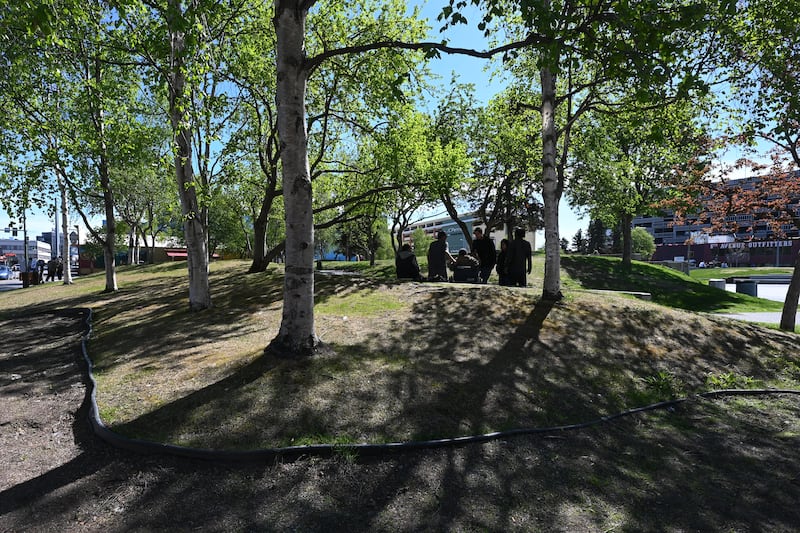
 People sit in the shade at Town Square Park on a 70-degree day on June 3. (Bill Roth / ADN)
Downtown Anchorage property owner Kelly Kass had a double homicide happen on his back porch last year. More recently, an Airbnb guest at his East Seventh Avenue multi-unit building pulled a gun to defend themselves against an intruder who barged through the door.
“I’ve had to change the door locks multiple times. I’ve had to add reinforced hinges because people are prying the doors,” Kass said at the Downtown Community Council meeting last Wednesday. He said he’s spent thousands of dollars on hardware, surveillance and security equipment to protect his building.
Kass was one of several people who took the opportunity to vent before the council, the police chief and the mayor’s special assistant on homelessness and community safety, who also attended the meeting.
Several members of the public said there’s been a noticeable uptick recently in crime and general mayhem in downtown by people who appear to be in crisis or experiencing homelessness.
Homeless advocates note that not all crime is caused by the unhoused population. Often, it’s people who have housing but who are addicted to drugs and are committing crimes to fuel their habits.
“It’s sometimes hard to tell the difference,” said Emily Robinson, chief operating officer with Restorative & Reentry Services, an organization that provides services to homeless residents and contracts with the city. “There are crimes that come from our unhoused neighbors. But it’s not 100%.”
This story has been made free to access as a public service.
This story was reported, and made available without a subscription, with support from the Alaska Community Foundation. If you’d like to help us continue expanding local news coverage and access to essential information, you can subscribe or make a tax-deductible donation to ADN.
Some avoid downtown
The Downtown Community Council had invited Anchorage Police Chief Sean Case and Thea Agnew Bemben, Mayor Suzanne LaFrance’s special assistant on homelessness and community safety, to the meeting to address rising public concerns over what the council described as a “high volume of individuals loitering throughout the day and sleeping overnight” in Peratrovich Park at 500 W. Fourth Ave., and in east downtown near Fourth Avenue and Cordova Street.
 A man wrapped in a blanket crosses Cordova Street near Third Avenue near the Downtown Soup Kitchen Hope Center on Sept. 3. (Marc Lester / ADN)
Besides loitering and outdoor sleeping, open drinking, confrontations with tourists and passersby, and a “lack of noticeable intervention” on the part of authorities are all problematic, according to the agenda for the meeting, which followed up on public safety concerns raised during the council’s prior meeting in July.
Case and Agnew Bemben acknowledged the ongoing problems and laid out efforts to lower the impacts on residents and businesses, including two crisis stabilization centers in the works and a new intensive case management facility to be located downtown adjacent to the existing Quyana Clubhouse, operated by Southcentral Foundation.
[Much-needed mental health resources to open soon in Anchorage]
Kim Verreydt, who co-owns a therapeutic massage business on Cordova Street, said someone turned off the electricity to her building from an outdoor switch the night before Wednesday’s meeting. Not long before, a person holding a tiki torch used it to snatch a purse through an open window during an office party and used the stolen credit cards to make unauthorized purchases, Verreydt said.
As far as she knows, no arrests have been made, she said.
Ben Neumann — of the Neumann family that owns Phillips Cruises & Tours, Grizzly’s Gifts, and the Historic Anchorage Hotel — said he avoids bringing his family downtown, describing it at the meeting as a “hostile environment.”
Downtown has devolved into a place that “looks and sounds like the end of civilization,” Neumann said.
‘Bigger than our resources’
The mayor’s office is “1,000% aware of the problem” and knows how much the community, particularly those downtown, is impacted, Agnew Bemben said. Several initiatives are underway to try to address some of the problems, she pointed out.
Among other things, code changes adopted by the Anchorage Assembly have made it easier for police officers to break up camps or arrest people for low-level, illegal activities like public intoxication, threatening or menacing behavior, having sex in public, or spitting or transferring bodily fluids onto someone without their consent.
There are more shelter beds, including 300 year-round beds currently, expanded outreach teams and easier access to treatment for drug and alcohol misuse and mental health issues, she noted.
“We can get people into detox very quickly, right from shelter, right from the safety center, right from our outreach team,” Agnew Bemben said.
But Anchorage really needs 450 to 500 shelter beds, more police officers, more treatment options, more housing and other services, she acknowledged.
 Thea Agnew Bemben, special assistant to Anchorage Mayor Suzanne LaFrance, talks about the city’s homeless shelter on East 56th Avenue in January 2024. (Marc Lester / ADN)
“The problem is bigger than our resources right now,” she said.
Neumann said he would like to see greater use of involuntary detention to force such people into mental health and substance misuse treatment.
Agnew Bemben said Alaska’s strong constitutional privacy protections make removing someone’s rights and freedom difficult, but not impossible.
More conflicts, more arrests
The police chief acknowledged that he too has seen an upsurge in problematic behavior over the past few weeks, not just downtown but in hot spots throughout the city.
Part of what’s driving the surge could be a decrease in the number of officers working overtime on downtown foot patrols during late summer, Case theorized. The two-person foot patrols were deployed in April, paid for by the city’s hotel bed tax.
Another contributing factor to what’s happening downtown could be that some officers who were working as bike cops have returned to classrooms as school resource officers now that school is back in session, Case said.
With the colder months quickly approaching, Case said he expects more officers to work overtime and a new class of police recruits will graduate in the fall, giving the city a stronger law enforcement presence.
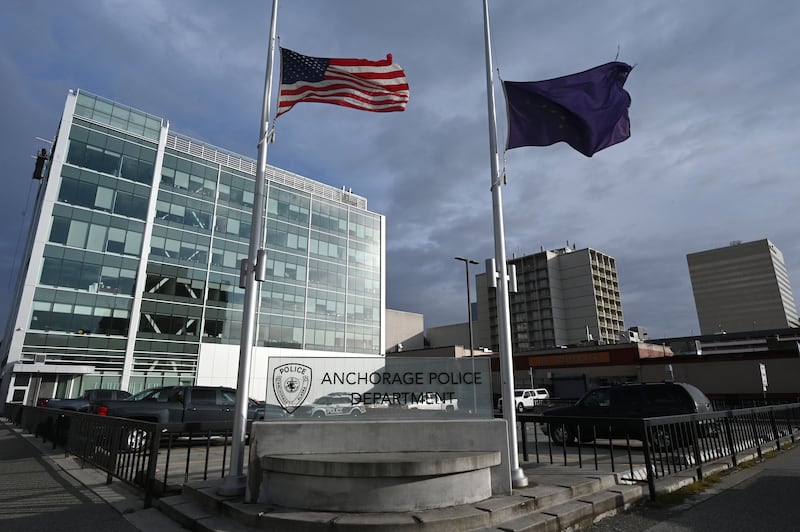 Anchorage Police Department headquarters on Fourth Avenue downtown in October 2023. (Bill Roth / ADN archive)
Case noted that officers have been arresting more people for crimes like disorderly conduct and that more than 200 cases are pending.
“Those cases are starting to stack up,” Case said.
Case also mentioned a new tool the Anchorage Police Department will roll out on Sept. 23 that should help. It’s a diversion program that aims to get more people with behavioral health and substance misuse problems into treatment rather than being arrested.
People who are 18 and older who face a misdemeanor for drug possession, criminal mischief or disorderly conduct, for example, could avoid arrest if they agree to go into treatment and if officers determine they are appropriate candidates.
Frustrations linger
Despite the steps being taken, some who live, work or own property downtown continue to worry for their safety and those of their tenants and neighbors.
“I’m up every night looking at my cameras because, what’s going to happen next? It’s really, what’s going to happen next?” Kass said. “It’s just very disturbing and we got to get to the bottom of it.”
Agnew Bemben said she understands the frustration.
At a meeting of the Third Avenue Radicals group on Thursday, the mayor’s special assistant again noted, as she did the night before at the Downtown Community Council meeting, that existing needs outweigh the city’s resources to respond to what often seems to be an overwhelming problem. The group advocates for public safety, an end to homelessness, and the revitalization of east downtown.
Agnew Bemben encouraged the group to make their concerns heard since the administration and the Anchorage Assembly will be crafting a new city budget in the coming weeks. The administration is expected to submit its proposed budget to the Assembly on Oct. 2.
Jim Renkert, who chaired the meeting, said the grassroots organization’s membership does that regularly and will continue to do so.
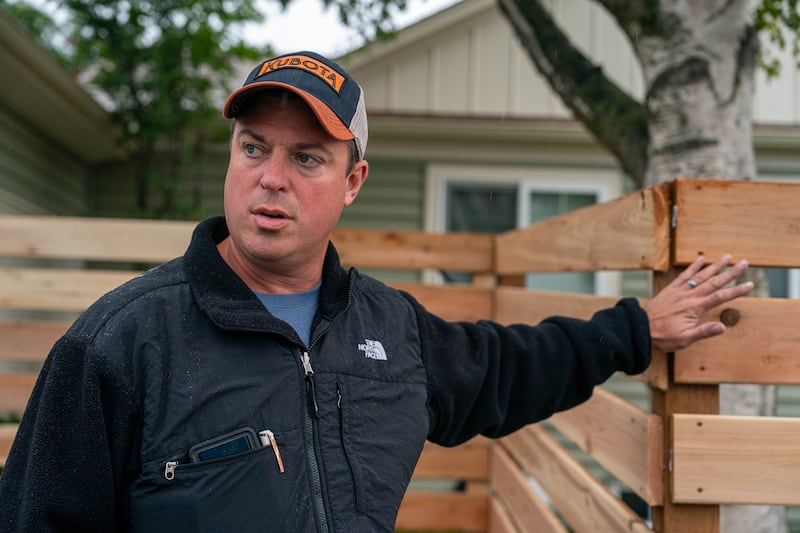 Vacation rental owner Rob Cupples gestures toward a fence that he built this summer since a large homeless camp sprang up nearby, in August 2023 in downtown Anchorage. (Loren Holmes / ADN archive)
Rob Cupples, a member of the Third Avenue Radicals who owns vacation cottages and car rentals, asked Agnew Bemben to develop an app so that people who encounter a homeless camp can easily share the location with the city from their cellphone. An app would make it faster and easier to file reports as opposed to the city’s existing, computer-based system.
Agnew Bemben said she liked the idea and would look into it.