
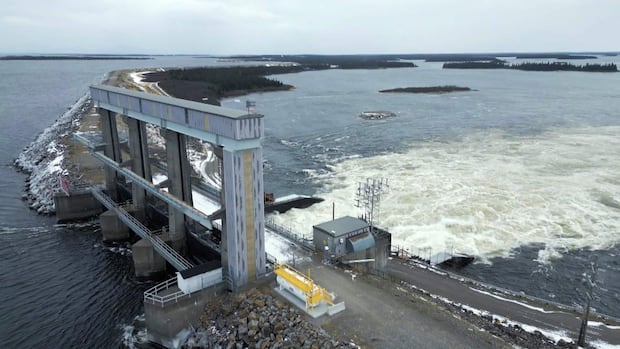
Two advocacy groups are asking for a fresh impact assessment on the new Gull Island hydroelectric project. The call is going out to Members of the House of Assembly ahead of next week’s special debate on Churchill River power development.
Roberta Benefiel, who is both the president of Grand Riverkeeper Labrador, an anti-hydroelectric group, and a member of the social justice and environmental group Council Of Canadians in Newfoundland and Labrador, said the organizations want to see more information, and a means to get it.
“A new assessment on Gull Island, a proper assessment, taking into consideration all of what we’ve learned about the impacts of these projects, not just economically,” she said.
 Roberta Benefiel was a witness at the Muskrat Falls public inquiry in 2019. (Terry Roberts/CBC)
In the 2000s, Benefiel took part in the environmental review of the Lower Churchill Project, including a proposed development at Gull Island that did not proceed at the time, and a build at Muskrat Falls, being a hydro site farther downstream. Beyond any blanket objection, she remained engaged for years, detailing specific environmental concerns, while the Muskrat Falls project progressed. In 2019, she testified at the Muskrat Falls Inquiry.
Speaking to CBC now, she openly questioned how the lessons of the failure of the Muskrat Falls hydro project were being brought to the new project proposed at Gull Island.
There are too many, specific concerns to easily list, she said, but one example would be related to greenhouse gas emissions — and measurement of greenhouse gas — from the Churchill River reservoirs, including a new reservoir to be created at Gull Island. She’d also like to see an attempt at costing the damage being caused in the creation of the new dam, reservoir and power transmission corridors.
“Until the best available science is used to measure these emissions and to look at the cost of this environmental damage, then we shouldn’t even be looking at a project until those things are done. That’s our view, on both organizations, that is important. We need to know,” she said.
Past review and release from further assessment
A question being raised now is what the Gull Island development needs in terms of any impact assessment (also known as environmental assessment) and other regulatory review.
It’s not known at this point what the project will even entail.
A different proposal for a power plant at the site was registered for environmental review in 2006. It was cleared from further review in 2012.
The new agreement between the Quebec and Newfoundland and Labrador power companies, set to be debated in the legislature, includes the possibility of a larger facility — up to 700 megawatts (MW) more in installed power capacity at Gull Island compared to what was previously considered.
The Impact Assessment Agency of Canada told CBC no new impact assessment is needed before construction of a power plant there. That’s “assuming that there are no substantive changes to the project.”
“[The agency] has yet to receive any information from the proponent to be able to confirm that the project scope and components are the same as what was previously assessed,” states the emailed response to questions this week.
Return to Gull Island
In 2012, the Gull Island hydro plant was to have an installed capacity of 2,000 MW. Per documentation available online, it required a dam 99 metres high by 1,315 metres long. The reservoir would have been 225 kilometres long, flooding about 85 square kilometres beyond what the river already reached. It was to be built by a subsidiary of Nalcor Energy, a now-defunct Crown corporation.
The 2026 project, by comparison, is to be built by a subsidiary of Hydro-Québec, the Société d’énergie de la Baie James. It will have an installed capacity of anywhere from 2,250 MW to 2,700 MW, according to the agreement announced. Its capacity is “depending on the final configuration.” The estimate is the reservoir behind the dam would be about 230 kilometres long (it isn’t described in square kilometres to be flooded).
It is all, per the power company documentation: “subject to additional technical and environmental studies to be carried out by the parties and input to be received from the relevant key interested parties and governmental authorities.”
The agreement does state commitments made by Nalcor Energy and the Government of Newfoundland and Labrador for the old Gull Island project will be upheld for any new build.
Barring ‘a significant change in project design’
Teaching about impact assessments at the School of Science and the Environment at Memorial University’s Grenfell Campus, associate professor Camille Ouellet-Dallaire said there are other examples of industrial projects finishing assessment but not immediately moving ahead, where approvals remain valid.
As an example, she named the World Energy GH2’s proposed wind-hydrogen-ammonia development in western Newfoundland. That project, Project Nujio’qonik, was released back in April 2024 and its release from further review is still valid.
“The difference that we have here with the Gull Island project is that it is really not clear when they’re saying that it’s going to be an improved, or larger project, how much of it is going to be relying on the current impact assessment,” Ouellet-Dallaire told CBC.
 Professor Camille Ouellet-Dallaire says it’s not unusual for projects released from environmental assessments to later see amendments with some additional review work involved, but not as much as a full regulatory review. (Submitted by Camille Ouellet-Dallaire)
In Canada, she said, companies have made changes to approved projects, through the use of amendments, “to sometimes quite significant extent.”
“I think one of the challenges we’re seeing here is that it’s not clear exactly how significant or big the changes are going to be to the proposed 2012 [Gull Island] project and until we get that sense it’s not quite clear […] exactly how the environmental process is going to proceed,” she said.
She mentioned there’s also the addition under the new power development plan of a possible 2,000 MW wind farm, tied in to the Churchill River reservoirs for balancing, to consider.
Ouellet-Dallaire said there can be differences in public consultation and engagement when projects spend years on hold. Amendments years later, she suggested, can risk people questioning the strength of the overall review. People may not feel properly heard, given the split and large gap in time involved.
“From a social acceptability perspective […] not doing an impact assessment might be a problem,” she said.
Government says project already studied
Late last month, in response to questions from CBC, a provincial government spokesperson said the project has already been extensively studied, but didn’t explicitly say whether more assessment would be done.
“More than 35 years of studies have been undertaken to ensure that this project is developed in a way that is both environmentally and economically sustainable,” the statement said. “The provincial government is committed to building this project in an environmentally sustainable and sound manner and in the best interest of our province.”
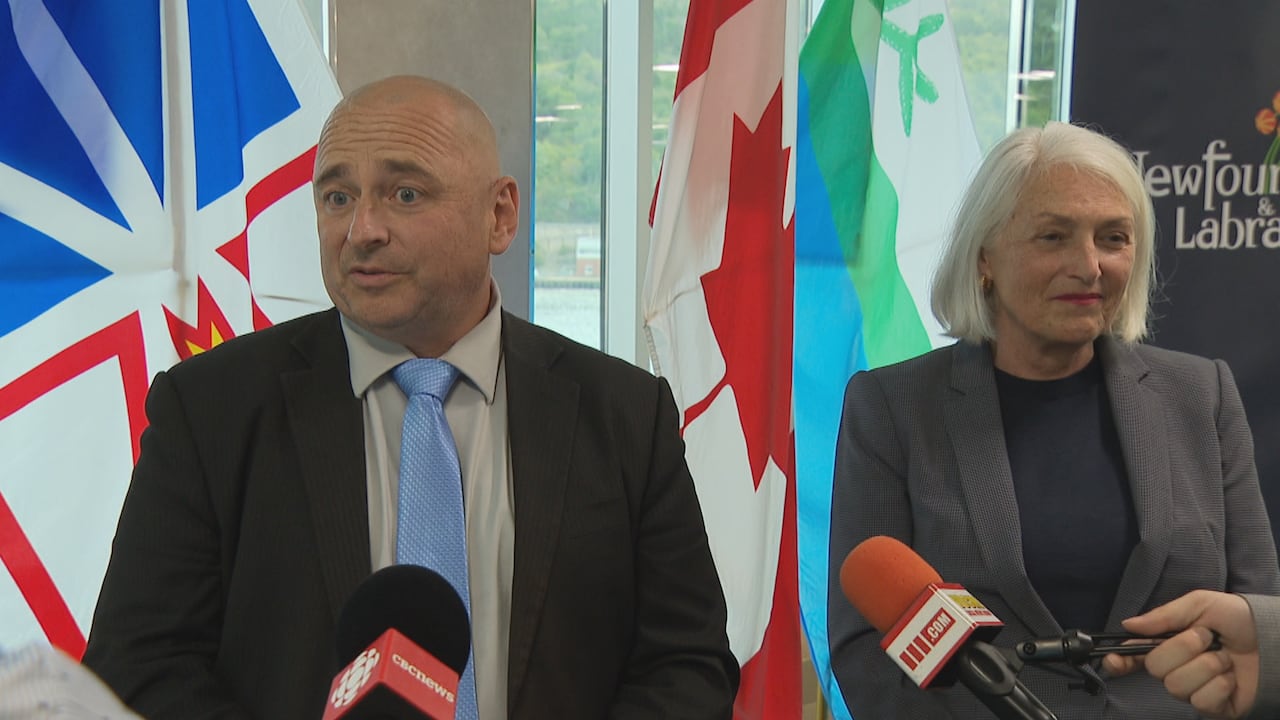 Former environment minister Chris Tibbs responds to questions about the Gull Island environmental assessment, at an event separately announcing a change in environmental assessment in Newfoundland and Labrador, under a new agreement with the federal government. Tibbs stands beside federal Fisheries Minister Joanne Thompson. (Mike Simms/CBC)
Earlier this week, former Newfoundland and Labrador Environment minister Chris Tibbs stepped in for current minister Andrea Barbour during an announcement of a new agreement between Canada and Newfoundland and Labrador on streamlining assessments for projects.
Tibbs was asked about the Gull Island assessment and what would be involved.
“I can’t comment on anything that’s within the environmental assessment right now but it’s moving through just as any other project,” he said, despite the project not yet being registered for assessment, as CBC later confirmed.
Will the environmental assessment be addressed in the upcoming House of Assembly debate on the new power agreement with Quebec?
“It could possibly be. If that’s the will of Newfoundlanders and Labradorians,” he told reporters.
Download our free CBC News app to sign up for push alerts for CBC Newfoundland and Labrador. Sign up for our daily headlines newsletter here. Click here to visit our landing page.