

Listen to this article
Estimated 4 minutes
The audio version of this article is generated by AI-based technology. Mispronunciations can occur. We are working with our partners to continually review and improve the results.
The long-awaited LRT link to Orléans is about to enter one of the final milestones on the way to opening, but there’s still no firm timeline for when passengers will be able to hop aboard.
OC Transpo announced at a transit committee meeting on Thursday that it expects the east extension of Line 1 from Blair to Trim stations to begin pre-trial running in early October.
That phase will last for at least a week, according to associate general manager Troy Charter.
If successful, it would be followed by a 21-day phase of trial running, a formal testing period where the trains are put through the motions to see if they can meet performance, safety and reliability targets.
Richard Holder, director of the rail construction program, said this trial running is different than the current informal testing.
It will be overseen by independent experts with a daily team meeting to review performance.
“What occurs in trial running is a big program so we can say on a daily basis: are we achieving the targets?” he said. “The period of pre-trial running, we do all that, except we won’t have an actual score at the end of the day.
“The idea is that day one of trial running, we hit the ground running. It’s seamless.”
Charter said that, if the extension passes that final test, it would still require five to 10 days of preparatory work and final certification before it could finally open to passengers.
Beacon Hill-Cyrville Coun. Tim Tierney did the math. He said adding up all the steps could put an opening date some time in November at the earliest, though OC Transpo did not explicitly confirm that.
“There’s great excitement in the east end it’s actually finally happening,” Tierney said
But that’s only if all goes well. If there’s a major hitch, the trial running period would have to start all over again.
OC Transpo general manager Rick Leary said he’s not yet comfortable making any commitments about a date for passenger service.
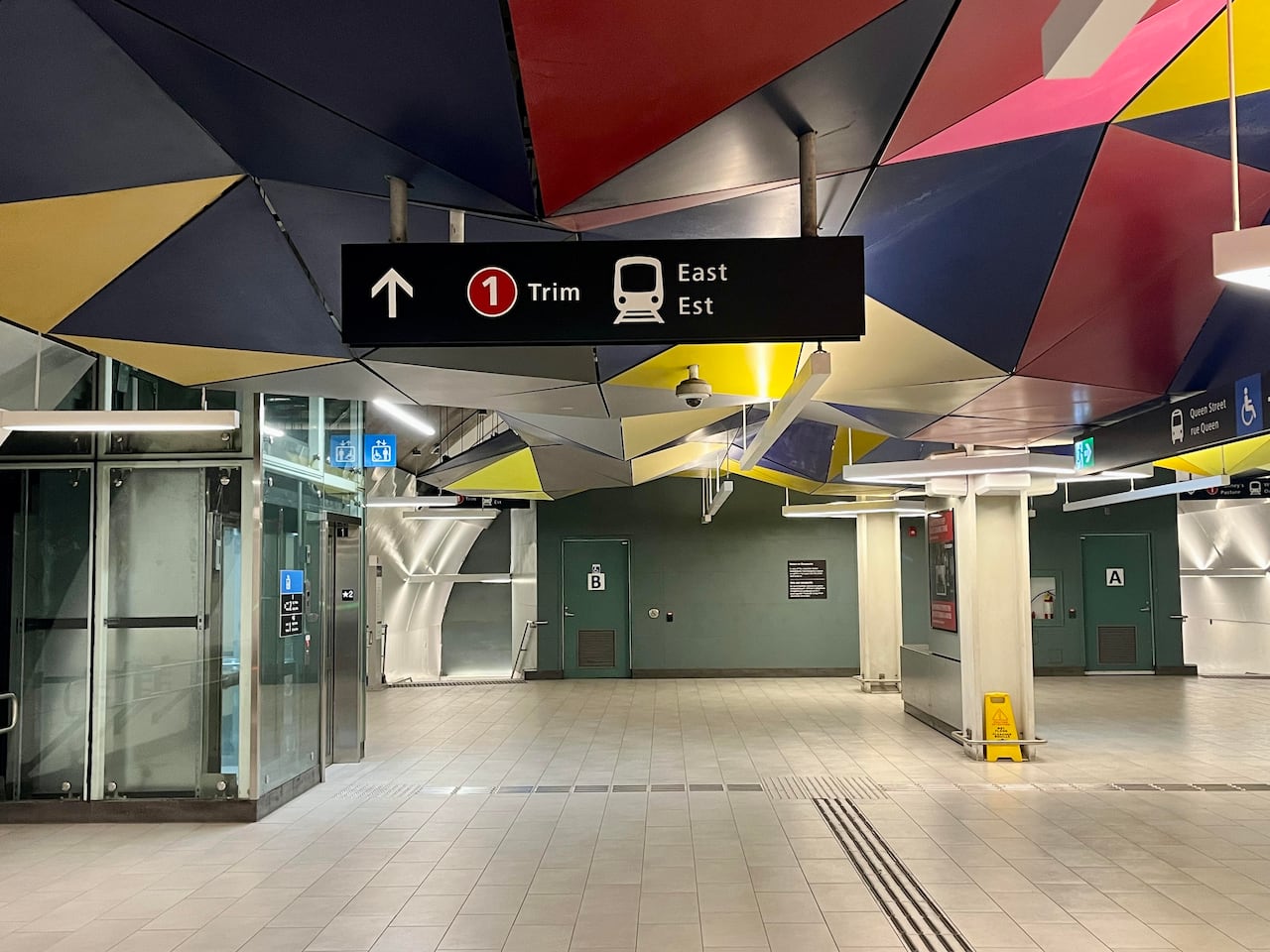 A sign at Parliament station in downtown Ottawa directs LRT passengers to the eastbound Line 1 terminus at Trim Road, which hasn’t yet opened in July. (Sarah Kester/CBC)’Smart bugs’ free up train cars for testing
The extension has faced repeated delays, most recently due to a shortage of train cars as OC Transpo grappled with bearing issues that kept many vehicles off the rails.
OC Transpo has looked to solve that issue by installing “smart bugs” that can detect faulty bearings in real time. Fifty-six cars now have those sensors, allowing OC Transpo to lift a rule for those cars that took them out of commission after 100,000 km of service.
Charter said testing will require a total of 23 trains. Since trains have two cars, that means OC Transpo will need 46 cars in total plus four spares.
At first, eight trains will run on the east extension without the public, along with 15 during peak periods on the existing part of Line 1.
“Right now we’ve been achieving getting eight trains, but not at those peak times when we have 15 on the main line,” Charter said. “So there’s still some work that has to happen with getting our train availability up.”
Then OC Transpo will run both as one integrated system with 23 trains running from Tunney’s Pasture to Trim stations. Passengers will have to disembark at Blair station before the trains head further east.
Charter said he wants to see that happen before moving to pre-trial running.
The line will run largely along Highway 174. Holder said drivers should expect periodic off-peak single lane closures and a weeks-long full closure of the eastbound on-ramp at Place d’Orléans Drive this fall as work wraps up.
In 2017, when plans were first announced to stretch the line to Trim Road, it was scheduled to open by 2022. Two years later, that was pushed to 2024.
More recently, OC Transpo has given shifting dates, at one point saying that early 2026 was achievable.
But the bearing issues, caused by metal flaking off inside a crucial component that joins the wheels to the axles, upended those plans.