

Listen to this article
Estimated 4 minutes
The audio version of this article is generated by AI-based technology. Mispronunciations can occur. We are working with our partners to continually review and improve the results.
More than 21,000 bus passes have been distributed so far as part of a one-year pilot program to let youth in communities across Manitoba use public transit for free, the provincial government says.
The majority of those — about 19,000 — were distributed in Winnipeg, while the rest were outside the capital city, a provincial spokesperson said in an email.
The Manitoba government pledged free transit for kids and teens in its March budget, at a cost of $10 million.
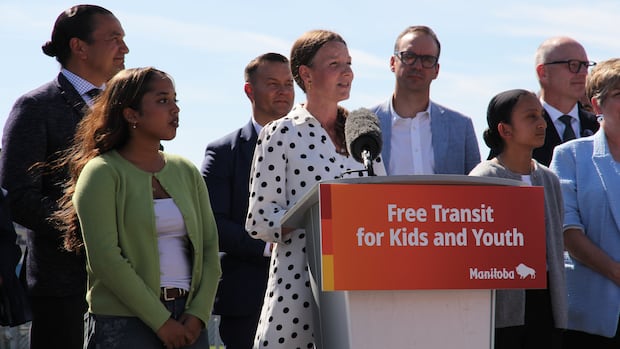
Education Minister Tracy Schmidt on Thursday urged students to “take full advantage of this opportunity.”
The transit passes “can be used to get to school, to get to work, to visit your friends, and really anything that you want to do,” she said during a news conference at Winnipeg’s Grant Park High School.
In Winnipeg, the youth transit passes are being distributed through schools, starting with students in grades 11 and 12 on Thursday. Those in grades 9 and 10 will be able to get them Sept. 22, while grades 7 and 8 will be able to pick up their passes by the end of the month, the province said in a news release.
The passes are valid from September 2026 to August 2027.
Free transit passes will be available to children age 11 to 17, as well as high school students age 18 to 21. Brandon, Flin Flon, Winkler and Selkirk are also included, the province said.
Premier Wab Kinew said Thursday that the new passes are making a difference for young people heading back to class this month and helping their families. A monthly youth bus pass typically costs $88.55, Winnipeg Transit’s website says.
Winnipeg Mayor Scott Gillingham said while the city already offers free transit to kids 11 and younger if they’re riding with a fare-paying customer, the new partnership with the province “takes that idea a significant step further.”
“When we can work together to make life easier for kids to get to where they need to get to, while taking some pressure off the household budget, that is good for everybody,” Gillingham said.
The hope is to help young people build a habit of using public transit, which is good for the city and the environment, he said.
Pam Currie, a longtime teacher and parent of a student at Grant Park, said on top of helping kids get to and from school, she thinks the new passes will allow more students to participate in after-school activities.
“Transportation challenges should never be the reason that kids can’t participate fully,” Currie said at the news conference, and she thinks the initiative will “level the playing field.”
The new passes will also benefit kids like her own son, whom she currently drives to and from school and activities, she said.
“I look in the passenger seat and I see him with his head down, scrolling on his phone. And I’m the one planning the routes. I’m the one planning logistics to get us there on time,” Currie said.
“After I put this bus pass in his hands, he’s going to gain the independence. He’s going to be able to think about timing, responsibility, critical thinking.… If he wants to get to his reffing jobs, we have to think critically about how much time, what bus routes he needs to take. These skills for our teens are going to be invaluable.”
The City of Winnipeg said in a news release that the pilot program is available to students in public, independent and homeschool programs.
The city said it will closely monitor Winnipeg Transit ridership, crowding and service reliability, which will help identify routes and times where changes may be needed.
Winnipeg police, transit inspectors and community safety officers will also have a more visible presence on main routes serving middle and high schools, in anticipation of an increase in youth riders, the city said.