
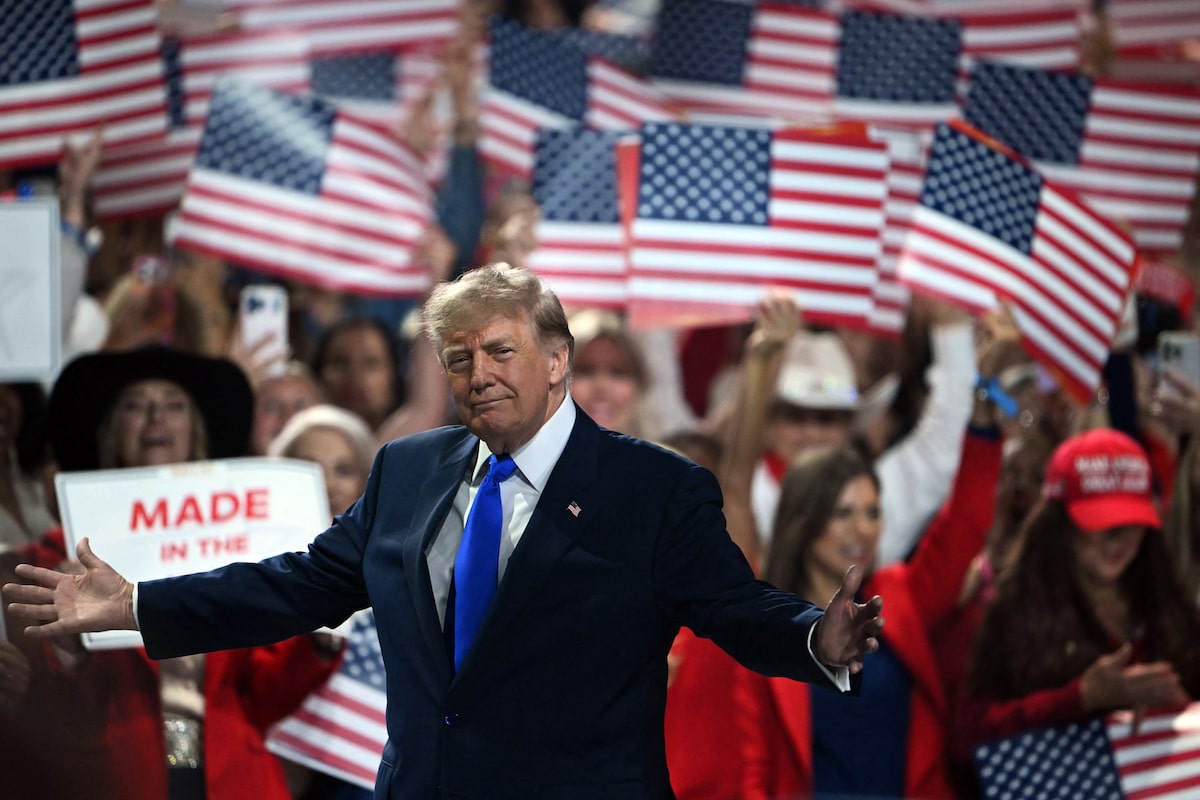
U.S. President Donald Trump at the Republican National Midterm Convention in Dallas on Wednesday.RONALDO SCHEMIDT/AFP/Getty Images
Gus Carlson is a U.S.-based columnist for The Globe and Mail.
Conventional wisdom suggests that in politics and in business, a leader’s ability to make sound decisions depends heavily on the accuracy and insight of the information received from advisers – and his or her willingness to listen.
For U.S. President Donald Trump, his stumble on Monday over the demonization of Bombardier as an example of inequitable trade with Canada proved once again that the White House flunkies – including some in cabinet positions – giving Mr. Trump policy guidance need to do more homework. And he needs to check his sources.
Rather than being a symptom of what Mr. Trump describes as Canada using the U.S. as a “piggybank,” Bombardier is actually the poster child for cross-border co-operation that is benefiting the U.S. as much as anyone. His rant on Truth Social that “if they want our Market, they must build here” was quickly torpedoed by a blizzard of evidence showing that Bombardier does, in fact, build in the U.S. A lot.
Bombardier shares fall after Trump threatens ban on U.S. sales
The company employs more than 3,500 people in 20 states and its supply chain comprises almost 3,000 companies in 47 states. Underscoring the holes in Mr. Trump’s ultimatum, Bombardier actually sources more than 50 per cent of its aircraft components from U.S. manufacturers – more than its American competitors such as Gulfstream. Bombardier is also a preferred partner to the U.S. military.
We’ve seen this movie before in this administration – some instances have been consequential; others have been just plain weird, and in any other context, would have been a source of embarrassment.
On the consequential scale, the failure of senior advisers to heed U.S. intelligence warnings that if attacked, Iran would block the Strait of Hormuz, and who then encouraged Mr. Trump to move forward with an attack, was right up there on the dumb-and-dumber scale. The experts in question, including Energy Secretary Chris Wright and Interior Secretary Doug Burgum, should have known better. After all, about one-fifth of the world’s oil supply passes through the strait, and any disruption would be felt in markets around the world – including those in the U.S.
The repercussions of the war on global oil markets have been predictably significant. Oil prices rose immediately on the first attacks – they are still yo-yoing, sometimes in the US$100 per barrel range – and gas prices followed. The forced Mr. Trump’s hand to dip into the U.S. Strategic Petroleum Reserve, a move that did little to ease the pressure at the pumps or on the pocketbooks of his GOP faithful.
On the weird side is the White House’s obsessive – and unpopular – battle with media outlets critical of Mr. Trump, especially late night talk show hosts such as Jimmy Kimmel and Stephen Colbert.
ABC’s Jimmy Kimmel says James Talarico interview to air on YouTube after FCC threats
Leading the charge has been Federal Communications Commission Chair Brendan Carr, who has threatened to revoke the broadcast licences of major networks because of critical coverage of Mr. Trump that he blames for driving down the President’s approval ratings to historically low levels. The posture backfired – public sentiment was solidly against the threats and a flood of lawsuits has followed.
Some have argued that Mr Carr was just doing Mr. Trump’s bidding and is nothing more than a water-carrier for a notoriously thin-skinned boss who has no problem going on the attack against those who say mean things about him. And clearly, as former Trump cabinet members such as Kristi Noem and Pam Bondi learned the hard way, if you’re not part of the solution – as in his solution – you’re part of the problem.
One pressing question is whether these missteps will hurt GOP candidates in the midterm elections this November. Reaction to Mr. Trump’s comments on Bombardier suggest the party is concerned. Several prominent Republicans from Kansas, where Bombardier’s U.S. operations are headquartered, pushed back on Mr. Trump, desperate to protect local jobs and economic stability.
Roger Marshall, for example, a Republican U.S. senator for Kansas up for re-election, said he would fight to save Bombardier jobs in his state: “I’ve already taken that concern inside the Oval Office,” he said.
The other – and perhaps more pressing question – is whether Mr. Trump and his advisers are listening.
New reports this week suggest that the President’s aides have stopped giving him advice or trying steer him away from potential potholes because he doesn’t listen to them anyway.
One widely quoted anonymous administration source said many in Mr. Trump’s inner circle have adopted a “Why bother? He’s the boss” policy.
That means we can expect more Bombardier-esque whiffs to come.