

Listen to this article
Estimated 4 minutes
The audio version of this article is generated by AI-based technology. Mispronunciations can occur. We are working with our partners to continually review and improve the results.
Twenty-five years ago, Shawn Matheson had a foot in two worlds.
As a firefighter with Mississauga Fire and Emergency Services, he and his colleagues watched the collapse of the twin towers in New York City live on television with a deeper appreciation of the horror than most others.
A an officer in the reserves, Matheson knew instinctively where events were headed.
“Like any of us in the fire service, we were trying to figure out just what was all going down and what it meant,” Matheson said.
“And I guess my thoughts were sort of switching between the tragedy of what I was seeing unfold on live TV … as well [as] about being a soldier and what that meant.”
Like countless others this week, Matheson has been reflecting on the attacks of Sept. 11, 2001, that resulted in the deaths of nearly 3,000 people — including 24 Canadian citizens.
Being both a firefighter and a soldier has made him keenly aware of the risks and the cost of service, which eventually led him to volunteer for mental health non-profit Wounded Warriors Canada.
As fate would have it, on the day of the attacks a portion of his station was asked to spell off firefighters at a station near Pearson International Airport as the U.S. airspace was closing and aircraft were touching down all across Canada.
The attacks happened on a Tuesday, which also happened to be parade night for his Toronto-based reserve unit, the Governor General’s Horse Guards (GGHG).
It was, he said, a surreal feeling.
‘Those hours of the unknown’
“It was a very unique day to be putting on our uniform, realizing that in all likelihood, Canada would be going to war,” said Matheson, who started out as a full-time armoured soldier in the 1980s and served in Bosnia before becoming a reservist and firefighter.
“In those hours of the unknown, you know, what we realized was, who knows what was going to happen next.”
In the weeks after the terrorist attacks, Matheson travelled with fellow firefighters to New York to attend funerals as remains were recovered from the ruins.
“There’s some incredible strong connections in the fire community amongst different departments, not only in Canada, but south of the border,” he recalled. “So there were firefighters in Mississauga that had friends in the New York Fire Department [and the] surrounding departments around New York City. They played in hockey tournaments together.”
While they were at Ground Zero, the remains of six more people were recovered, Matheson said.
The sense of loss was palpable.
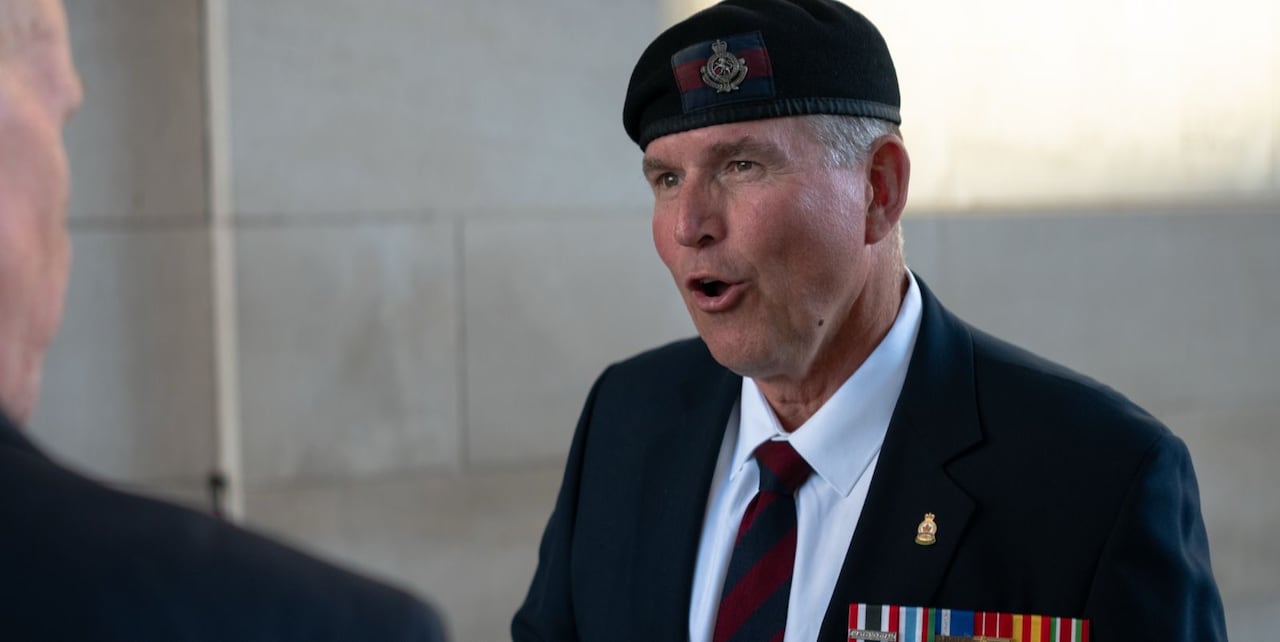 During the Afghan war, Matheson commanded the Governor General’s Horse Guards and watched as 14 of his soldiers were deployed overseas to fight. (Wounded Warrior Canada)
Later, as Canada’s involvement in the Afghan war became deeper and deadlier, he commanded the GGHG and watched as 14 soldiers from his unit were sent to buttress regular force units fighting in Kandahar.
Luckily, he said, they all returned.
As the 25th anniversary of 9/11 unfolded, Matheson was on a Wounded Warriors fundraising bike ride through Canadian First World War battlefields in Belgium.
He couldn’t help but reflect on how support services for both the military and first responders have evolved since the events two and a half decades ago.
Recognition that first responders are affected by the harrowing events they face, Matheson said, is something that was long overdue.
And in many ways, for Matheson, that was the lesson of 9/11.
“They do get exposed to a lot of trauma,” said Matheson. “These people on fire rigs and police cars and ambulance buses. they’re going to war every day. They don’t know at the end of the day, the end of a shift, how things are going to play out in terms of going back home.”