

Listen to this article
Estimated 4 minutes
The audio version of this article is generated by AI-based technology. Mispronunciations can occur. We are working with our partners to continually review and improve the results.
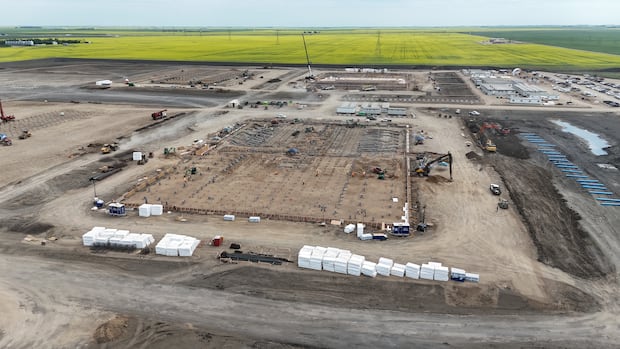
Construction is underway near Regina for an AI data centre billed as Canada’s largest.
The provincial government says it’s evaluating proposals for at least 30 more.
Saskatchewan seems bound to have a role in the country’s expanding AI landscape — a landscape that changed last week when a new federal framework for responsible data centre development was announced.
“If we don’t build the infrastructure of the future here, we will have to buy it from somewhere else,” said Evan Solomon, the federal minister of artificial intelligence and digital innovation.
Solomon’s announcement emphasized the relationship between Canada’s domestic digital infrastructure and its sovereignty.
“How we build matters,” he said.
That raises important questions in Saskatchewan.
Who is accountable?
AI data centre proponents promise they’ll bring employment, tax revenue and economic growth, but skeptics question whether those potential benefits justify the demands the centres could place on power infrastructure and other resources.
Data collected by the Angus Reid Institute in June indicated 68 per cent of Canadians would oppose a large AI data centre being built near their homes. Urban residents (67 per cent) and rural residents (73 per cent) showed similar levels of opposition.
The federal government’s new framework sets out five expectations aimed at addressing such concerns: that the centres create lasting local benefits; that they not shift electricity costs to Canadians; that they minimize water use and environmental impacts; that their owners be transparent about local impacts and that they bring strategic value to Canada.
Blayne Haggart, a political science professor at Brock University, senior fellow with the Centre for International Governance Innovation in Waterloo, and a former economist, sees a lack of mechanisms to hold companies accountable if they don’t stay within the framework.
 Blayne Haggart is a political science professor at Brock University and a senior fellow with the Centre for International Governance Innovation in Waterloo. (Brock University)
“These [rules] can almost mean anything you want them to mean. They’re very, very vague,” Haggart said.
Local governments may be poorly equipped to evaluate such enormous projects, which come with an overwhelming number of technical and planning concerns, he said.
Canada’s multi-billion-dollar investments into AI are not currently justified by the revenues on offer, Haggart said.
“So that means that at some point, economics tells us that this [bubble] is going to burst and we could be left with a lot of [expensive] white elephants on our hands.”
Who benefits?
Kaitlin Hebert is executive director of AiSK, a non-profit that promotes growth of the AI sector in the province. In an interview with Leisha Grebinski, host of CBC Saskatchewan’s Blue Sky, Hebert said the province has an opportunity to shape the AI infrastructure boom on its own terms.
“I think it’s really important that we’re acknowledging that Saskatchewan is not getting left behind. The fact that Bell chose us demonstrates that we are in fact a viable option here,” she said.
Bell’s 300-megawatt data centre is projected to cost $1.7 billion to build. The company says it will generate up to $12 billion in long-term economic value for the province. It hasn’t said how much economic value the centre is expected to generate for Bell.
Hebert noted Saskatchewan is attractive to AI infrastructure developers because of its energy resources, open spaces and a colder climate that can reduce the cooling costs of massive data centres.
WATCH | Future data centres in Sask. must be Canadian, self-powered: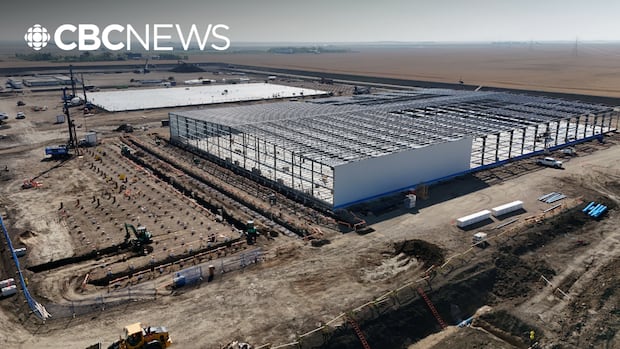
Future data centres in Sask. must be Canadian, self-powered
The Saskatchewan government has released a new framework for future AI data centres. The province will allow only Canadian companies to build such centres, and they must provide and produce their own power.
“We keep joking … finally being boring in Saskatchewan is actually an economic benefit for us. And also being cold,” she said.
Being attractive to developers puts local municipalities in a good position to define and negotiate their terms, Herbert said.
“If you want to set up shop here, you’ve got to have the appropriate consultation practices in place … Maybe you support us in our digitization strategy,” she said, referring to some municipalities’ struggles with closing the gap between paper and digital processes.
“As long as both municipalities and the decision-makers are well-informed … and there’s true engagement with the parties that are interested in building, in actually co-designing what those agreements mean with the decision-makers,” she said.