
Vermeer: A Life Lost and Found
Andrew Graham-Dixon
W.W. Norton (2025)
Announcements, Events & more from Tyee and select partners
Stephanie Kelton Asks: What If Deficits Aren’t the Problem?

SFU brings the renowned economist to Vancouver for a fireside chat on rethinking government spending.
A few years ago, my wife and I visited the Rijksmuseum in Amsterdam to see paintings by the Dutch masters of the 17th century.
At the far end of the Gallery of Honour was Rembrandt’s The Night Watch — enormous, spectacular, a foreshadowing of IMAX. Crowds moved around it, trying to find the best view.
We didn’t join them. We went instead to a side gallery where a few people clustered in front of a small painting: The Little Street, by Johannes Vermeer.
We knew the painting from reproductions, but the original stunned us. It seemed real, not in a photographic sense, but in its power to put us on the cobbles of the Little Street while we waited for the playing children or the two women at their tasks to look around and notice us.
That sense of lived reality emerges from most of Vermeer’s very few paintings, and it is a major reason for his immense popularity.
But British art historian Andrew Graham-Dixon finds that Vermeer’s art is not just “snapshots” of everyday life in 17th-century Netherlands. In Vermeer: A Life Lost and Found, Graham-Dixon argues that most of Vermeer’s work is profoundly spiritual, intended as a guide to worship for the Christian sect that he belonged to.
Strong arguments require strong evidence, and Vermeer himself offers very little. Graham-Dixon finds a great deal more evidence in the history of the Netherlands and the people with whom Vermeer connected. We see Vermeer indirectly, through his family and friends and especially those who shared his religious beliefs. And from that perspective, his paintings teach us a new way to see both them and the world around us.
Much of Graham-Dixon’s book is devoted to the turbulent history of the Netherlands after the rise of Protestantism in the 16th century. Having accepted the new faith, the Netherlands was plunged into an endless war with its masters, the Catholic Habsburgs of Spain. Religious wars also turned neighbouring Germany into a wasteland.
A state like no other
By the mid-17th century, when Vermeer was a young man in the town of Delft, Spain had abandoned its efforts to reconquer the northern Netherlands, now known as the United Provinces or the Dutch Republic. In defending themselves, the Dutch had created a state like no other in Europe.
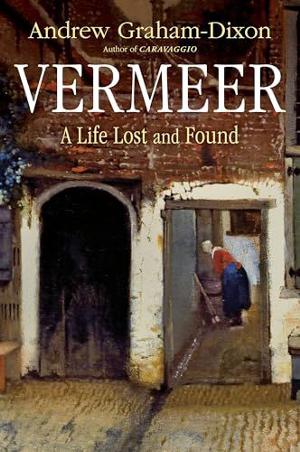
Andrew Graham-Dixon’s new biography of Dutch master painter Johannes Vermeer examines the political and religious forces that shaped the artist’s life and work.
Graham-Dixon makes it clear that the republic was no democracy, but a “federation of oligarchs,” regional lords who united to protect one another. Through organizations like the Dutch East India Company, the oligarchs built a global empire that has shaped history ever since.
They also made the republic the richest country in Europe, dealing in gold and sugar, Asian fabrics and spices. It was quite an achievement for a country described by a British visitor in 1648 as “the buttock of the world.” The republic even had an interurban public transit system, horse-drawn barges carrying passengers on canals and rivers with a departure every 30 minutes.
The Dutch were eager to commemorate themselves in art, and painting became a thriving industry controlled by a painters’ guild. Much art was religious, portraying and celebrating people and events in the Bible. Still more was “genre painting,” showing scenes from ordinary life that carried a strong moral message.
Vermeer’s earliest work was biblical (and evidence that as a young man he had visited Italy and seen the Italians’ latest work). And he could do genre painting, or work depicting everyday life, as well. Paintings such as The Glass of Wine and The Girl with the Wine Glass, for example, depicted older, well-dressed men plying younger women with wine. They were conventional in theme, but remarkable in technique.
Vermeer used light as few other painters have, before or since, to create a kind of reality. Even banal topics gain an unexpected shock value by making us feel we have just blundered into an intimate moment.
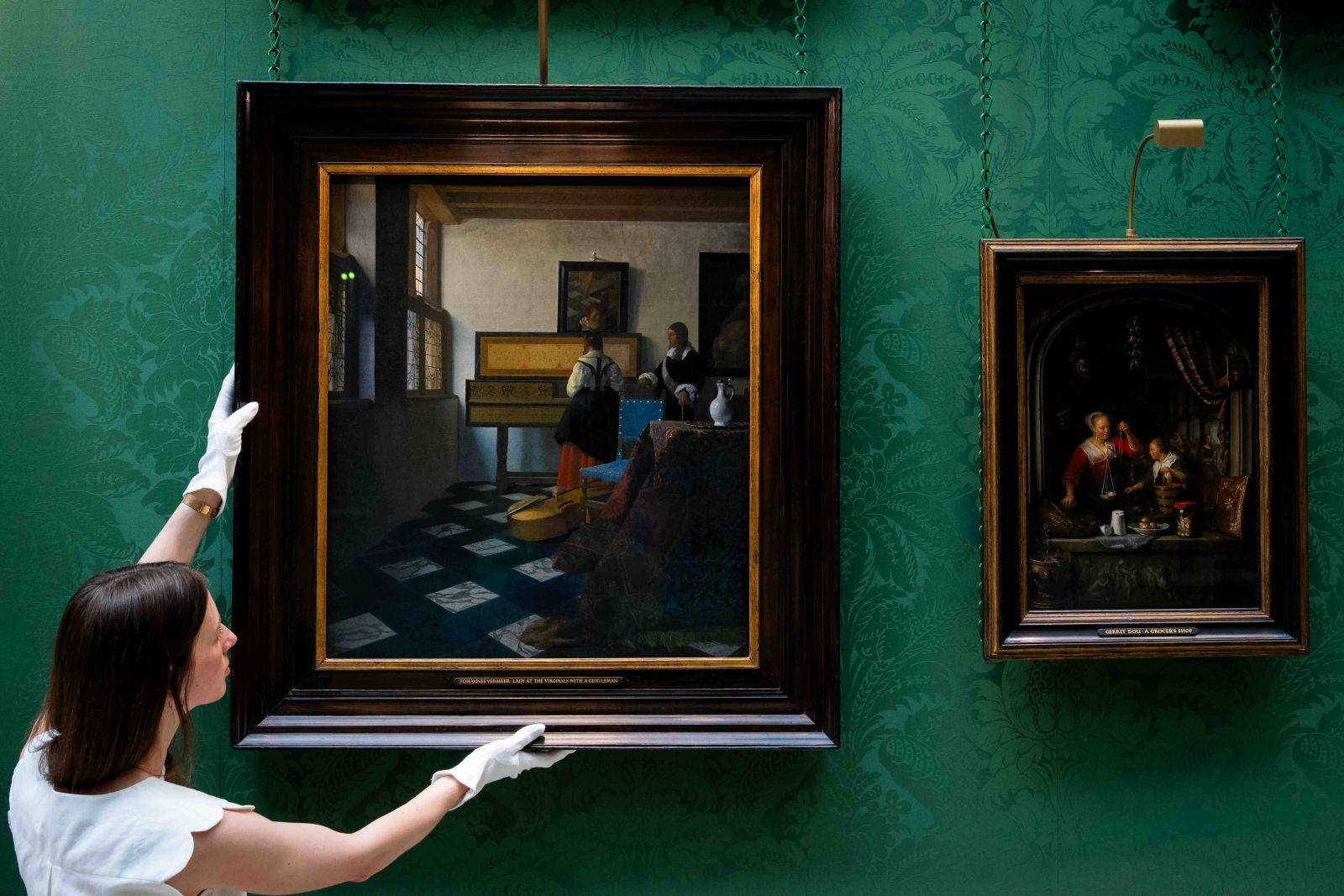
A Royal Collection Trust staff member with Johannes Vermeer’s A Lady at the Virginals with a Gentleman (The Music Lesson), an early 1660s oil on canvas, in the Picture Gallery at Buckingham Palace, London, in July 2026.
Photo by Aaron Chown/PA Wire.
A rejection of what came before
The United Provinces’ Dutch Reformed Church was strongly influenced by Calvinism, an austere sect that believed not only in original sin but in predestination — the principle that we were all damned to hell or welcomed in heaven before we were even born, and regardless of our faith or deeds.
Calvinism pushed even some Calvinists to a kinder, more humane Christianity, especially as expressed by ex-Calvinist Jacob Arminius. His followers in turn developed his teachings further.
One such group, known as the Remonstrants, had no use for priests or pastors, preferring to gather in small groups in private homes where they could pray, sing and discuss the Bible as the spirit moved them. Remonstrants believed in full equality of men and women, and tolerance of differing faiths.
The Remonstrants were only one of the many sects in the Dutch Republic, and the Reformed Church lacked the power to suppress them. So the sects were tolerated as long as they worshipped in private, in places that were not designated as churches.
Vermeer and his parents were Remonstrants, as were many of their neighbours. But Delft also had a neighbourhood whose residents were mostly Catholics.
One such resident, Maria Thins, was not only Catholic but separated from an abusive husband, and very wealthy. She objected when her daughter Catharina insisted on marrying young Vermeer.
But Graham-Dixon tells us Catharina was determined not to marry a bad man like her father. And he draws the conclusion that she saw in Vermeer a very good man.
A life dedicated to faith
Thins eventually agreed to the marriage, but demanded that the young couple and their growing family of 11 surviving children move in with her. The children were brought up Catholic. She partially supported the family, but they made some money from Vermeer’s paintings and his work as an art dealer. A local baker provided the family with bread; Vermeer eventually paid him with a painting.
Another source of revenue came from a prosperous couple who shared Vermeer’s Remonstrant beliefs. Pieter Claes van Ruijven and his wife Maria de Knuijt owned a house that served as a place of worship — unmarked and discreet — for invited fellow believers.
Here Graham-Dixon makes his argument: The van Ruijvens commissioned paintings from Vermeer not simply to decorate their walls, but to guide worship. They were not mere snapshots of everyday life, but demonstrations of faith expressed in the places and people of Delft.
Vermeer often painted pictures in pairs, like the Woman Holding a Balance and The Milkmaid. The first shows a woman holding an empty scale while she looks at her jewelry. She is, Graham-Dixon argues, not admiring her own wealth, but reflecting as a Christian on what is truly valuable — a life dedicated to faith.
And the milkmaid is not just pouring milk from a jug, but using it to make bread and milk to feed the poor. She is actively doing good, as a Christian should. Even the nail in the wall behind her is symbolic of Christ crucified, Graham-Dixon says.
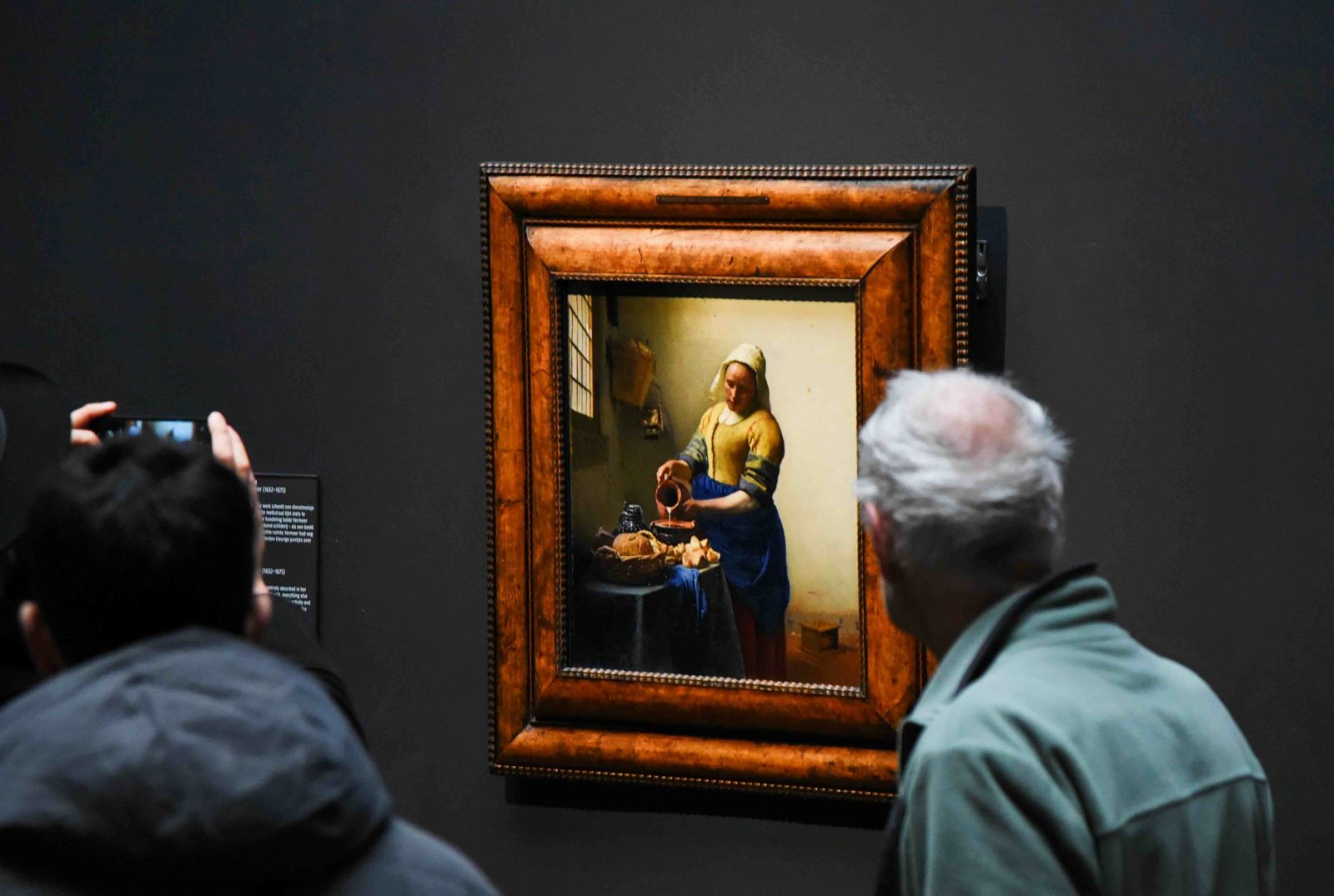
Museum visitors at the Rijksmuseum in Amsterdam admire Johannes Vermeer’s famous painting The Milkmaid in January 2024.
Photo by Bert e Boer via Shutterstock.
These paintings and many more were hung on the walls of the van Ruijvens in Delft to show those who gathered there how religion filled their own lives, even in a small town in the Dutch Republic.
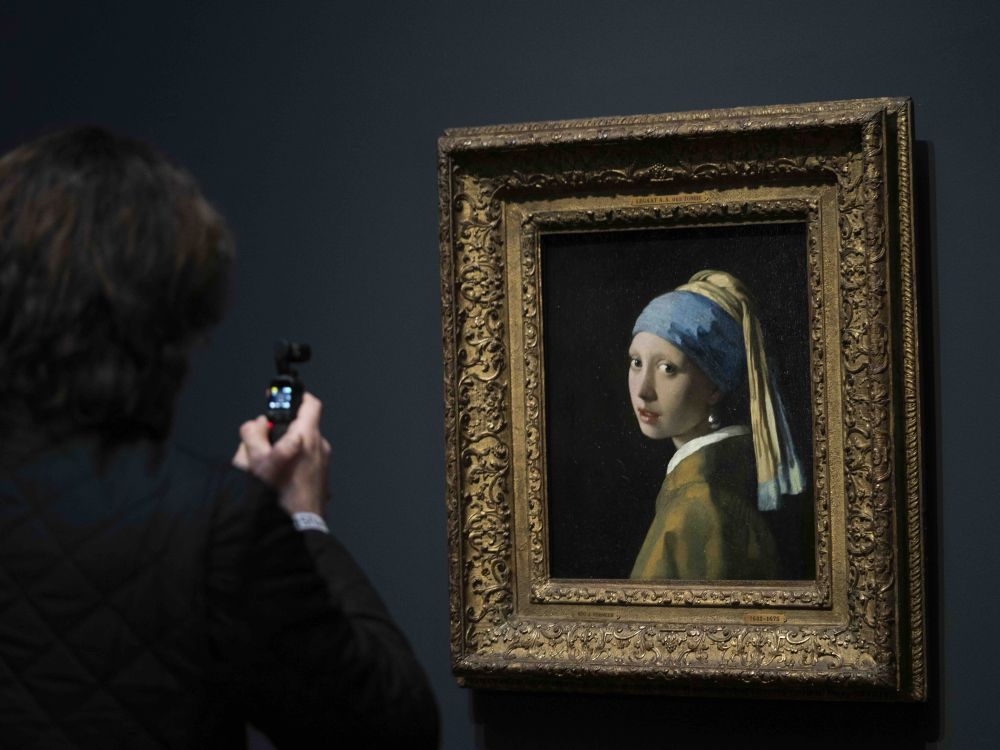
Graham-Dixon’s theory even explains the Girl with a Pearl Earring. He says it is a portrait of the van Ruijvens’ daughter Magdalena, and that she is painted as Mary Magdalene, for whom she had been named.
She is standing before Christ’s empty tomb; she has just heard Christ’s voice behind her, and in turning to meet his gaze, she meets ours.
‘The church invisible’
As for The Little Street, it is a picture of an ordinary street, but also a picture of what Graham-Dixon calls “the church invisible.” It’s a specific street in Delft, the Oude Delft. The house on the left, only partly in the image, is the home of the van Ruijvens, known as the Golden Eagle. The black door leads to an alley with a schuilkerk, a hidden place of worship used by Remonstrant believers.
How Tom Thomson’s Paintings Stop Time in Its Tracks
Graham-Dixon’s interpretation is backed by enormous documentation and considerable speculation. He may well be wrong on some facts, but he makes a strong case for Vermeer as a painter of religious concepts embodied in everyday people and places.
Vermeer’s short career as a painter was almost entirely for the van Ruijven family, who kept him on a retainer. The family kept his paintings together until 1696, when Magdalena’s husband died. (She herself died much earlier at age 27.)
Graham-Dixon sees Remonstrant tolerance as a step toward the 18th-century Enlightenment.
The spiritually intense moments captured in Vermeer’s paintings also seem to me an anticipation of the English poet William Blake’s vision.
A passing moment in a Vermeer painting is as intense and timeless as Blake, who wrote in Auguries of Innocence:
To see a World in a Grain of Sand
And a Heaven in a Wild Flower,
Hold Infinity in the palm of your hand
And Eternity in an hour.
Even if we don’t share Vermeer’s religious beliefs, or Blake’s, we should understand that both portray a world that is real, transient and yet eternal.
To stand in imagination on the cobbles of The Little Street, or to look into Magdalena’s eyes, is to be in that world.
If we understand the quiet intensity of those moments, we may begin to find that intensity in every moment of our own lives. 