
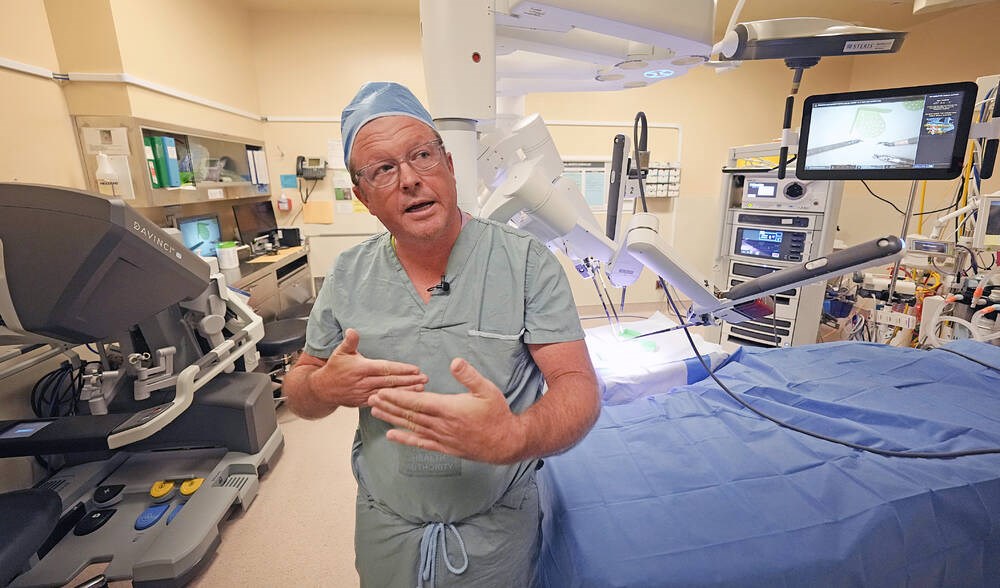
Dr. Jeff McCracken hopes to meet with the health minister this fall to tout the benefits of technology that he says reduces surgical hospital stays and recovery times.
It took Dr. Jeff McCracken almost two decades to acquire the most advanced robotic surgical equipment for Greater Victoria hospitals. Now, in the final decade of his career, he intends to see that Greater Victoria remains on the map for its advancements in this area.
It was almost 20 years ago that the chief urologist and head of robotics for Royal Jubilee and Victoria General hospitals was drawn to work alongside one of the world’s best robotic surgeons as part of a one-year fellowship in Seattle.
The equipment was less sophisticated then, so much so he recalls sporting a hockey helmet in training sessions because the robotic arms were so uncoordinated that he would sometimes turn around only to be clocked in the head.
Returning to Victoria, he campaigned for 18 years for capital region hospitals to acquire those robotic systems.
McCracken said his faith wasn’t misplaced; Vancouver Island donors came through, and hospitals here now have that equipment.
Through the first two phases of the Victoria Hospitals Foundation’s fundraising campaign It’s Time, which wrapped up last month, a record $38 million was raised in less than two years from about 6,200 donors.
The campaign enabled the purchase of three robotic systems and about 100 pieces of surgical and oncology technology requested by physicians.
Royal Jubilee received its first da Vinci XI robotic surgical system in February 2025. That was followed in March by a second da Vinci fourth-generation robot at Victoria General Hospital to expand into specialties such as gynecology, oncology, thoracic and pediatric surgery, as well as a Mazor X neurosurgical robot for brain and spine surgeries at Victoria General.
With the da Vinci Xi robot-assisted system, a physician looks at a high-definition three-dimensional screen, and tiny robotic arms holding tiny tools — specialized scissors, hooks and shears — copy what the physician’s hands and fingers are doing in real time.
Unlike a human’s wrists, the robot’s have a 360-degree range of motion, while the technology filters out hand tremors, and the camera provides a better view inside the body than the human eye could see on its own.
Traditional open surgery requires incisions of up to 12 inches and comes with more tissue damage, greater blood loss, longer hospital stays and greater risk of infection.
Laparoscopic or “keyhole” surgery is less invasive, involving incisions up to half an inch — similar to robotic surgery — but uses straight stick-like instruments with more limited angling as seen through a 2-D high-definition monitor.
Now that McCracken has the minimally invasive equipment he’s always wanted for Victoria hospitals, he’s wasting no time getting as many specialists trained on it as fast as possible.
Urology was first, followed by general surgery, ear, nose and throat, thoracic surgery, gynecology in March, then pediatric urology in April, said McCracken.
Local surgical teams have so far performed more than 800 robotic procedures across seven specialties, according to the foundation, which just released its annual report.
Orthodontist Gerald Kersten, 65, diagnosed with prostate cancer, was among the first of 300 Islanders to undergo robot-assisted surgery at Royal Jubilee last summer.
The technology gave him a “second chance at life” when the risk of traditional open surgery was deemed “too high” given his rare blood-clotting disorder, history of stroke and blood-thinning medication.
Friends advised him to seek treatment in bigger cities, but he said he was confident in the team and technology in Victoria.
“In six weeks, I was cycling on our dream trip in Riccione, Italy,” said Kersten, who retired in July and on Sept. 1 completed his final radiation treatment.
The ability to perform minimally invasive surgery on patients who might not otherwise recover well or survive open surgery, and to see them discharged in days rather than weeks, is among the biggest benefits of robot-assisted surgery, McCracken said.
Specialists can also collaborate on surgeries, working sequentially on the same patient for procedures involving multiple organs.
“They actually all operate together on the robot, and they just take turns in the seat,” said McCracken. The robot at Victoria General has a dual-seat console, which helps in training surgeons.
Last year, colorectal surgeon Dr. Sepehr Khorasani and urologist Dr. Mike Metcalfe did the first robotic pelvic “exenteration,” removal of the entire rectum, anus, prostate and bladder. The robot-assisted system reduced the patient’s hospital stay to days rather than weeks.
Since the spring, gynaecologic oncologist Dr. Mona Mazgani and general surgeons, including doctors Sepehr and Sohrab Khorasani, have been doing extensive oncological surgeries together using the robotic suite, whether it’s for tackling two cancers or removal of several organs as a result of advanced or recurrent cancers invading multiple organs.
“We can do some of the most complicated surgeries in Canada now that we have the most diverse group of surgeons able to use the robot,” said McCracken.
Physicians are now being trained to perform robot-assisted surgeries for liver and pancreatic cancers, and potentially procedures where rare tumours must be removed from bones or soft tissues while preserving nearby nerves and blood vessels. “That’s the vision for the next little while, to delve further into what we can do to cure cancers that aren’t common,” said McCracken.
Greater Victoria physicians have already reached several milestones, including B.C.’s first robotic-assisted emergency surgery and first robotic colectomy (removal of all or part of the large intestine).
Most centres in Canada that have robotic surgery are using it primarily for urology, some for gynecology, others for thoracic surgery, but Victoria is among only a few centres in Canada doing major robot-assisted colorectal surgery, along with Kingston, Toronto and Montreal.
With the number of surgeons being trained in robotic surgery in diverse areas, fellows and residents have been “kind of fighting to get here,” said McCracken.
“I think we’re a standout program nationwide now. People are coming from all over the country to see what we’re doing here. It’s incredible.”
The da Vinci Xi robot-assisted surgical systems ring in at about $2 million each, and on average, each surgery costs roughly $2,000, given that some of the instruments with intricate moving parts, such as those in the surgical wrists, for instance, can only be used up to 20 times. There’s also a maintenance contract.
McCracken argues that it’s just “marginally different” than the cost of operating in other ways, but robotic surgery has “hands-down, the shortest recovery times in hospital.”
Faster discharges help clear hospital beds — which cost $2,000 to $4,000 a day, including staffing — for other patients and reduce cancelled surgeries.
“We’ve demonstrated that since the inception of robotics for all surgeons, these numbers have considerably improved,” said McCracken.
Still, given that Victoria’s two main hospitals using robotic technology struggle with over-capacity issues — Royal Jubilee was at 111 per cent in 2024 — it’s a challenge for medical administrators to clearly show cost savings.
“We free up beds, but there’s just so many patients in the hospital that somebody else just moves into them, and of course that’s still an efficiency, but it’s not something that can be easily measured in dollar amounts,” said McCracken.
In his last 75 surgeries, he said, roughly 70 patients were safely discharged in less than 24 hours. That helps prevent the “swell” of patients on the ward every week, said McCracken.
Recent data for urology shows hospital stays are down by 70 per cent, and what had been three-to-four-day stays have dropped to less than 24 hours, said McCracken. He said other specialties are seeing similar benefits.
With patients who have had robot-assisted surgery getting back to work quicker, they’re not using as much employment insurance or taking potentially addictive narcotics after surgery, said McCracken. “There are all sorts of societal benefits to this program.”
Dr. Sepehr Khorasani said that in the United States, where he did part of his training, robot-assisted surgical systems are considered the basic “standard of care” because of the benefits to patients.
“What we need to realize is that, yes, you pay a lot of money up front, but you gain a lot back in the long term,” he said.
Khorasani said patients not only spend less time in hospital, but they’re not “bouncing back to the emergency department, waiting for 12 hours to be seen, and then be readmitted and have an intervention.”
He said while the health authority saves thousands of dollars each day as a result of shortened stays in hospital, “obviously, a price cannot be put on how important it is when your loved one gets back to life, to work, and can still be productive.”
The Victoria Hospitals Foundation is already preparing for the third and final chapter of the It’s Time campaign next month, focusing on cardiac, stroke and vascular care.
“For many years, there was an assumption that the most advanced healthcare innovations would emerge only from Canada’s largest centres,” said foundation CEO Avery Brohman.
“Today, health care leaders are paying attention to what is happening on Vancouver Island and looking to our community as an example of what can happen when philanthropy is deeply integrated into the advancement of care.”