
Good morning ! In case you missed it, over the weekend I caught up with Tyler Kolek, who shared some insight on his summer and approach to this season in a special Saturday newsletter. Be sure to check it out.
10 players – eight already in the Basketball Hall of Fame and two who eventually will be, both on the first ballot whenever they’re eligible.
That’s all that remains on our countdown.
Before we get to today’s honoree, a word on the 10 remaining players…
As I see it, there are two definitive gaps in the top 10: the gap between the top four players and (spoiler alert) Dave DeBusschere at No. 5, and the gap between DeBusschere and the five we’ll consider today. Before the 2025-26 season, you could have convinced me that DeBusschere and Brunson were in the same mini-tier, but that argument went out the window in June.
Why the gaps? Let’s take a 10,000-foot view.
Four of the players in the top five – Patrick Ewing, Walt Frazier, Willis Reed and DeBusschere – were members of the NBA’s Top 75 Team that was announced five years ago. Of those, Willis spent his entire career with the Knicks while Clyde and Pat spent the entire relevant portion of their career here. Only DeBusschere played meaningful basketball for another franchise, spending the first six and a half years in Detroit and making three All-Star teams in the process.
(Fun fact: after a solid rookie season in which he was the fifth leading scorer for the Pistons, DeBusschere nearly led them in scoring during their 1963 opening round loss to the Hawks. He averaged 20 points and 16 rebounds in the series, nearly out-dueling 1953 MVP Bob Petit in Game 1. Then, to close out his Knicks career, he faced off against 1973 MVP Dave Cowens three years in a row, getting the better of him two out of three times. How many guys in NBA history can claim to have bookended their career with playoff bouts against Petit and Cowens, with Wilt, Kareem and Unseld sandwiched in between?)
Even factoring in DeBusschere’s Pistons years, the lion’s share of his contribution to NBA history came as a member of the Knicks. The same obviously goes for Brunson, who was still a member of the Mavs when the Top 75 list came out, but who will undoubtedly be featured in a Knicks uniform on the poster for the Top 100 in 20 years.
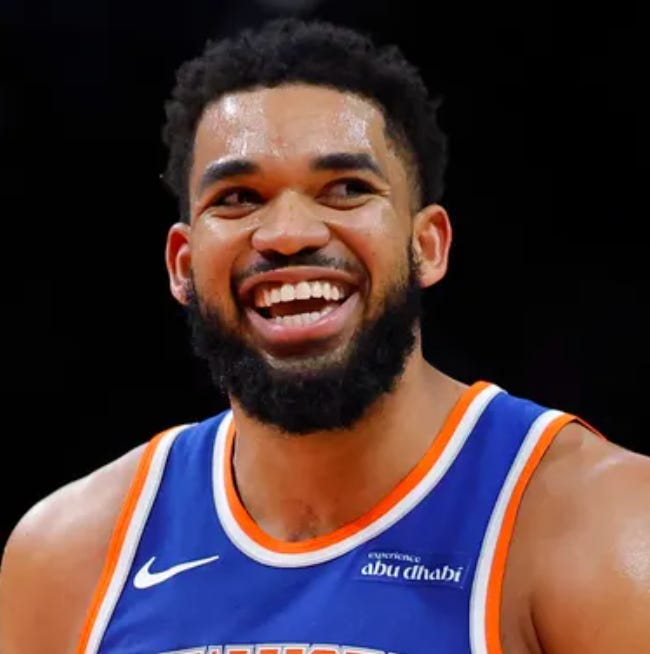
Now…two players we’ll consider today, Carmelo Anthony and Earl Monroe, also made the league’s 75th anniversary team, and a third – Bernard King – should have damn well made the list. A fourth player we’ll consider here – today’s honoree, Karl-Anthony Towns – has what I would consider to be an outside shot at making the Top 100 in 2046, but it’s going to take some heavy lifting on his part (and almost certainly another ring) for him to get there.
But KAT, more than any player near the top of this list, has played a significant chunk of his career for another franchise. Even with his 2026 championship ring, my guess is that Towns will always be remembered as a Timberwolf at least as much as a Knick, not just because of his nine seasons there but because of his importance to that franchise and that community. That makes his ultimate place on this list a little tricky, but at the very least, it knocks him down from that top five.
Pearl, Melo and King are different. When a typical NBA fan thinks of those three players, the first image that pops in their mind has them wearing a Knicks uniform. So why, then, should they not be considered as part of the higher group?
In Anthony’s case, he appeared in more regular season games and more postseason games as a member of the Nuggets than he did as a member of the Knicks, and his greatest postseason success happened in Denver, when he was the leading scorer on the 2009 Western Conference finalists. In King’s case, while his highest highs undoubtedly came in New York, he played fewer than a quarter of his 874 regular season games in a Knick uniform. In Monroe’s case, even though the majority of his career was spent in New York which is also where he won his lone NBA title, his best individual basketball was played in Baltimore, where he was arguably the best player on the 1971 team that went to the NBA Finals.
This last point made Monroe’s Knicks career one of the harder ones for me to consider during this exercise. As much as any player in NBA history, Monroe gets credit for sacrificing his individual stats for the betterment of the team. All of the prominent players on New York’s first two championship teams did this to some extent, but Reed, Frazier and DeBusschere all got their fair share of individual accolades in the process. Monroe was at one time an All-NBA 1st Team level player who slotted in as the second, third and sometimes fourth option on offense during New York’s 1973 title run. Immediately after DeBusschere and Reed retired, he went back up to averaging 20 points and being an All-Star. Should it matter that it was for a 40-42 team that got wiped in the first round? It certainly can’t be ignored.
This is all to say that while Monroe, Towns, King and Melo have arguments for being in the top tier, one can also poke holes in their respective cases as top-five Knicks ever (and, were one so inclined, even argue that some players below them – guys like Barnett, OG, Houston and even Starks and Oakley – should be higher).
For that reason, we’re considering them as a group, along with one other player we haven’t mentioned yet who tops this quintet:
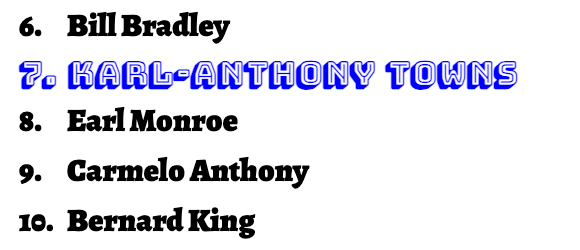
I promise I’m not being biased putting Bill Bradley at six, as he’s the only one of these five who has appeared on the Knicks Film School podcast. I recognize that at his best, Bradley was never on the same level as the other four. King and Melo finished second and third in MVP voting, respectively, while KAT sometimes looked like the most important player on the team that just won a title. Monroe, as we’ve discussed, could do far more than he showed. They didn’t call him Black Jesus for nothing.
As for Bradley, there are 34 players who have made the Hall of Fame while playing exclusively for one NBA team, and the Senator from New Jersey is among them. In fairness, it is the Basketball Hall of Fame and not the NBA Hall of Fame, which brings in Bradley’s time at Princeton, where he was one of the most accomplished collegiate players of his time, as well as his Olympic gold medal and his brief time in Europe, where he won a EuroLeague championship while attending Oxford on a Rhodes scholarship.
(In related news, I went for a two-mile run yesterday morning before writing this newsletter, and then I made myself a sandwich.)
Regardless of how much credit Bradley got for his basketball accolades outside of a Knicks uniform, what he did while wearing that uniform is more than enough to slot him atop this group. He suited up for 95 playoffs game as a Knick, starting all but the six he played in as a rookie. That trails only Ewing and Oakley, and unlike them, the majority of Bradley’s career was played before the NBA added and extra round.
Also unlike Ewing, Oakley, and most everyone else who played for this franchise, Bradley has two championship rings on his nightstand. He was never a top scoring option on those teams, but that’s only because he didn’t need to be. When he did hear his number called, Bradley delivered. He was New York’s leading scorer in the 1973 finals, and one year earlier, was one of three Knicks to average 20 a game in their five-game defeat at the hands of the Lakers. It quickly got lost to time, but in Game 1 of the ‘72 finals, Dollar Bill scored 29 points on 11-of-12 shooting in New York’s only win of the series. In total, during the Knicks’ six-year run of dominance from 1969 to 1974, he scored the ninth post postseason points in the entire league.
That total package gives him the slightest of edges over KAT and Monroe, who I slotted 7th and 8th essentially by flipping a coin. Like Monroe, Towns was asked to change his game for the betterment of the team, and like Monroe it helped bring the Knicks a title. The difference is that Karl has had stretches of sheer dominance since coming here. Had the NBA not given into appeals from Cade Cunningham and Luka Doncic last season, Karl would have made his second consecutive All-NBA team. Where KAT’s postseason is concerned, after a 2025 run that contained many significant shots, the defining moment of New York’s march through the East remains Towns’ shift from scorer to hub in the middle of the Atlanta series. And don’t let his pedestrian individual numbers in the finals fool you; KAT’s team-leading plus/minus showed exactly how valuable he was against the Spurs.
That just leaves Melo and King. Again, flip a coin. Before Brunson, were they the most gifted scorers to ever wear a Knicks uniform? Almost certainly. Did they have big playoff moments? Bernard’s 1984 performance against the Pistons will always rank among the greatest individual playoff series in NBA history, but Anthony is no slouch either, having averaged 28 & 8 across 21 postseason games in New York. His low assist numbers and lower efficiency will always stand out in the minds of his greatest detractors, but Melo’s Knicks lost to better teams. Whether or not the trade that brought him here is a primary reason why New York’s roster lacked the requisite talent is not relevant to this conversation. He did his job far more than he got credit for.
Ultimately, I had to balance the two major pock marks for both players (King’s short stay and Anthony’s relative lack of success) with the incredible heights they reached when they were at their best. For me, that meant slotting them below the most important players on the title teams but above everyone else.
Lastly, on KAT, I would be surprised if he isn’t above Bradley the next time we did this exercise. My guess is that by that time, the top five will expand to a top six, with Towns rightfully taking his place alongside the other pillars in franchise history.
Step one to making that happen: getting an extension done to keep him in New York for the remainder of his prime.
Hopefully we get some news on that front soon.
🏀
“Injustice anywhere is a threat to justice everywhere.”