
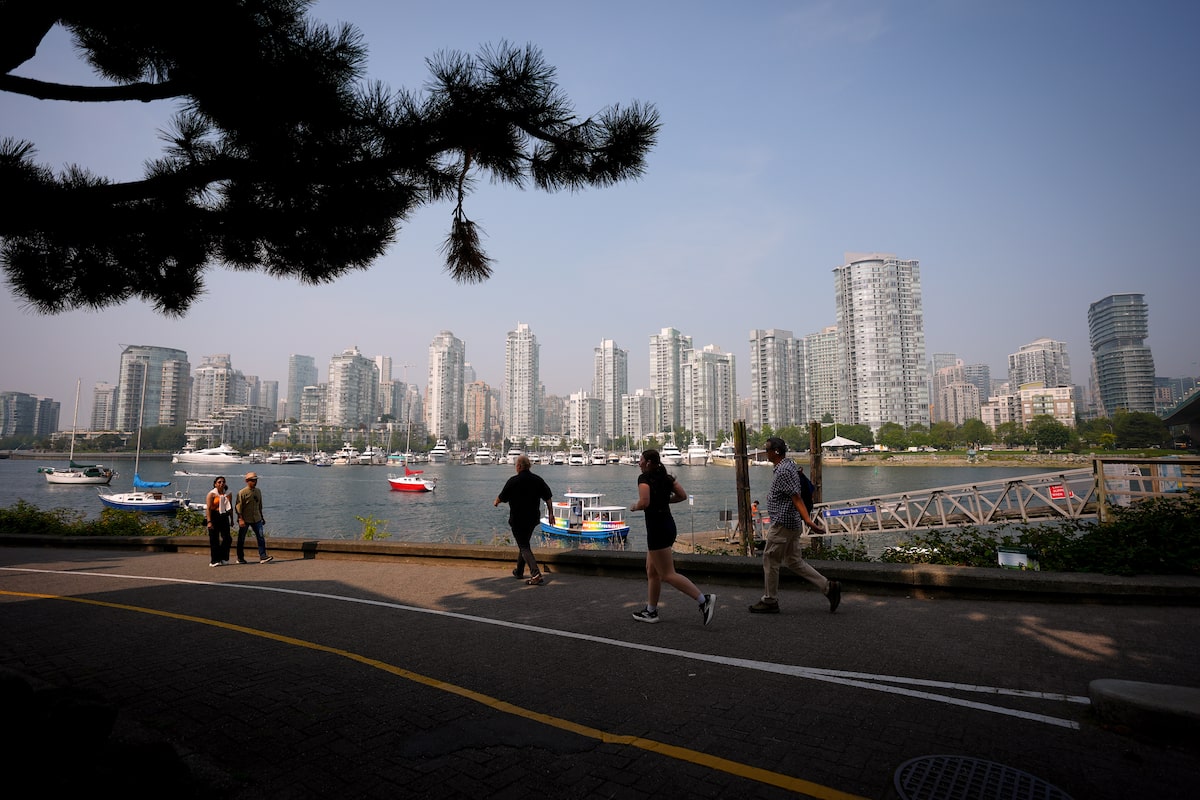
There were 3,945 completed unsold condos in Metro Vancouver at the end of March, 2026, according to an internal industry report.DARRYL DYCK/The Canadian Press
The number of completed unsold homes across Metro Vancouver is expected to reach approximately 4,200 by year’s end and have a total estimated value of $4.6-billion, according to an internal industry report that has been circulated within the industry and obtained by The Globe and Mail.
Prepared by real estate advisory firm Rennie with data sourced from the Canada Mortgage and Housing Corp. and analytics firm Zonda Urban, the report is dated April 20, 2026 and is labelled “For Internal Use Only.”
Rennie confirmed the authenticity of the report, but declined to provide a more up-to-date version or commentary on the report.
The report highlights that there were 3,945 completed unsold condos in Metro Vancouver at the end of March, 2026, split between 3,080 units in concrete buildings – typically high-rise towers – and 865 units in low-rise wood-frame buildings. Townhomes and other building forms are not included.
By city, Burnaby had 1,118 completed but unsold units, with a total estimated valuation of $1.092-billion. The report splits Vancouver into three areas – Downtown, East, and West – with a total of 668 units valued at $1.334-billion. Richmond was third-most with 516 units valued at $521-million.
The smallest condos are being hit hardest by the market decline
Across Metro Vancouver, the 3,945 units have a total value of $4.351-billion. When including projects expected to complete construction by year’s end, however, Rennie estimates the total at 4,195 units valued at $4.577-billion.
Rennie estimates that the total is projected to dip to 3,812 by the end of 2027, before jumping to 5,330 by the end of 2028 and then 6,333 by the end of 2029, before falling to 6,063 by the end of 2030.
The report also identifies the developers with the most completed unsold condos, with Ledingham McAllister – a developer with a history dating to 1905 – at the top of the list with 701 units valued at $688-million across seven projects.
Second is Anthem Properties with 395 units with a total value of $368-million across eight projects. Rounding out the top five are Onni Group, Pinnacle International, and Westbank, the last of which has just 178 unsold units but a total value of $602-million. Some of those developers also operate in the Greater Toronto Area.
The report does not list the projects, but the projects were recently identified by The Realist, whose data was obtained from a different source and are generally in line with those in Rennie’s report.
How young condo owners became accidental landlords
This amount of completed unsold condos, sometimes also referred to as standing inventory, can create problems across the industry – not just for developers, but also investment firms and lenders – because the units remain on the books and, in effect, constitute trapped capital – $4.6-billion worth – that cannot be used elsewhere.
“From the developer perspective, there isn’t that return of capital and profit,” said James Paleologos, President of Realtech Capital Group, a Vancouver-based real estate lender. “They’re usually making their money on the last handful of sales, so it’s leaving profit and maybe even equity capital out in the market.”
Mr. Paleologos said that developers have to decide whether to drop their prices. Some may feel inclined to “get out” of the project, while others may not want to take a loss or cheapen their product. Oftentimes, the bigger developers – whose lenders are more often the big banks – may be able to afford holding on until the market bounces back.
“It’s a matter of motivation for these to move. There are some developers who don’t need to sell and probably won’t until prices recover – and that could be years. But that’s a very small slice of the market. For most of these groups, it’s gonna come down to whether they get to a point where they can’t hold out any longer.”
In some scenarios, the construction loan may have to be converted into an inventory loan, which typically carries a higher interest rate, says Mr. Paleologos. Either way, the loan can’t be fully repaid and will stay on the books for longer than anticipated. Developers also often raise equity from other investors, and there may be time constraints related to that money too.
Opinion: Buyers want houses, but housing policy keeps pushing condo shoeboxes
Assuming 60 per cent of the $4.6-billion in unsold condos is financed by debt with a 6 per cent interest rate, that would mean $165.6-million in the economy is going to lenders as interest, annually, instead of being deployed elsewhere. That may be why lenders – particularly the big banks – are not panicking quite yet.
“It’s considered a pretty benign loan, from a bank’s perspective, in terms of their stress,” said Mr. Paleologos. “They usually value the units initially at a pretty safe level, and they’re only lending 50- to 60- per cent of that, so there’s so much room before you end up being in trouble. Anything is possible, but I would say, right now, most lenders would probably tell you their inventory loans don’t cause them too much concern. But it’s still on their radar for sure. It’s not like land. Land terrifies lenders right now.”
Brad Newman-Bennett, a Vancouver-based VP at Cushman & Wakefield Structured Finance, says standing inventory is a problem, but he’s more concerned about the big picture.
“I think the bigger question is what this market will look like three, four, or five years from now? There’s a reset going on in terms of working through how to finance projects going forward and what that looks like.”
“There’s a trickle-down effect to all of this, as far as the broader economy. Developers are cutting staff. Lots of realtors aren’t earning commissions. Tradespeople were so busy, but I think now everybody is scrambling for work. Everything in the economy is impacted, especially because real estate in the Lower Mainland is such a massive part of our economy.”