
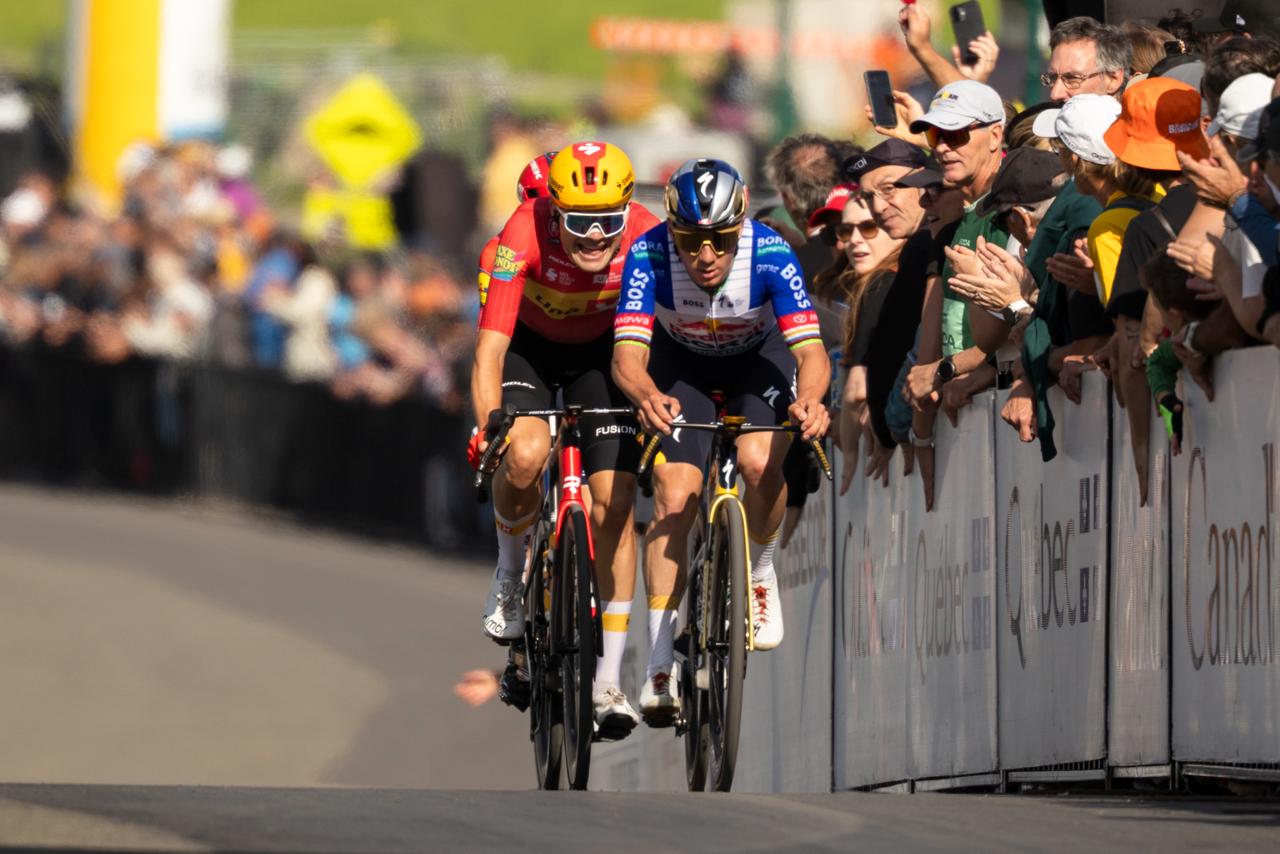
After Sunday’s Grand Prix Cycliste de Montréal, which used much of the same terrain that will feature at the worlds, the Belgian got a pretty good look at what Mathieu van der Poel and Wout van Aert will be up against. It’s a debate that’s been going on social media for some time.
Is Camilien-Houde simply too long for the two Classics stars, who definitely excel on the Flandrian steep bergs? The Double Olympic champ thinks so.
Evenepoel on his rivals
“With the way they ride on the longer climb, it’s really difficult for the heavier guys,” Evenepoel told WielerFlits.
The numbers back up his point. Isaac Del Toro won the Montreal race ahead of Paul Seixas, with Evenepoel finishing among the strongest riders behind them.
Camilien-Houde is just under two kilometres long and an average grade of 7.4–8 per cent.
For a comparison, Camilien-Houde is longer than the Koppenberg and Paterberg combined, and considerably steeper than the famously long Oude Kwaremont. Although the latter is 2.2 km, its average gradient is around four per cent.
“If you look at the average weight of the top-10, we might be at 63 or 65 kilograms,” Evenepoel said. “They are not heavy men, but riders like Wout and Mathieu can survive this on super days,” he added.
Van der Poel and van Aert are estimated to be about 10 kg more than that.
The worlds versus the GP
The other big factor is length. Sure, on Sunday they went up the climb 16 times, but the race was also just a bit over 200 km. Also, an early break went and the pack was really on cruise control for the first 80 km.
The worlds will be 273 km, and they head up the climb 12 times.
But this comes after a significantly longer section where attrition will really, really set in.
Van aert’s history in Montreal
Now, to counter Evenepoel’s thesis, it should be noted that van Aert did finish second at the 2022 Grand Prix Cycliste de Montréal, in a five-man group.
That race was won by none other than Tadej Pogačar, who, as we all know, won’t be racing this year. The current (but not for long) world champion crashed out of the Vuelta a España, and was forced to end his season.
Not only did he have to give up his chance of winning the Spanish Grand Tour, but also the worlds defence and Euro champs defence. The bummer about the latter is it was being held in his home country of Slovenia.
He still planned on coming to Canada to root for his fiancée Urška Žigart and pals like Primož Roglič. Žigart, unfortunately, crashed on the weekend and reinjured her jaw, which means she too will have to skip Montreal. She might not have been an outright favourite for the win, but would definitely be in the mix and could have been a wildcard.
The Belgian is in good form
This year’s Paris-Roubaix winner showed some fine form at the Vuelta, however, winning two stages, taking the green jersey, and also getting second in the mountains. The polka dot jersey placement might not be an exact measure of his climbing — he was in multiple long breaks where he snagged points. Still, it shows he can go pretty good up some climbs, in a way, just not the big mountains. (Although he also won Ventoux at the Tour de France in 2021. That year, he also won the final time trial, as well as Champs-Élysées. He was legit a triple threat that year.)
The road worlds begin on Sept. 20 and finish with the men’s race on Sept. 27. Canadian Cycling Magazine will be there on the scene, with plenty of content on the site and our social media.