
‘Complete failure’ to protect babies at killer nurse’s hospital, report findsYour support helps us to tell the story
From reproductive rights to climate change to Big Tech, The Independent is on the ground when the story is developing. Whether it’s investigating the financials of Elon Musk’s pro-Trump PAC or producing our latest documentary, ‘The A Word’, which shines a light on the American women fighting for reproductive rights, we know how important it is to parse out the facts from the messaging.
At such a critical moment in US history, we need reporters on the ground. Your donation allows us to keep sending journalists to speak to both sides of the story.
The Independent is trusted by Americans across the entire political spectrum. And unlike many other quality news outlets, we choose not to lock Americans out of our reporting and analysis with paywalls. We believe quality journalism should be available to everyone, paid for by those who can afford it.
Your support makes all the difference.Read more
Health Secretary Yvette Cooper says plans are under way to install “cot cams” in neonatal units after a damning report found hospital staff could have prevented three of killer nurse Lucy Letby’s murders.
The Thirlwall Inquiry’s final report said Letby should have been removed from the neonatal unit at Countess of Chester Hospital before Babies O and P came to harm, while if doctors had acted on abnormal insulin tests relating to Baby F, whom Letby attempted to murder, then Baby I may have also been saved.
The report says hospital executives prioritised “prevention of reputational damage” over the string of neonatal deaths and found there had been a “complete failure” to protect children.
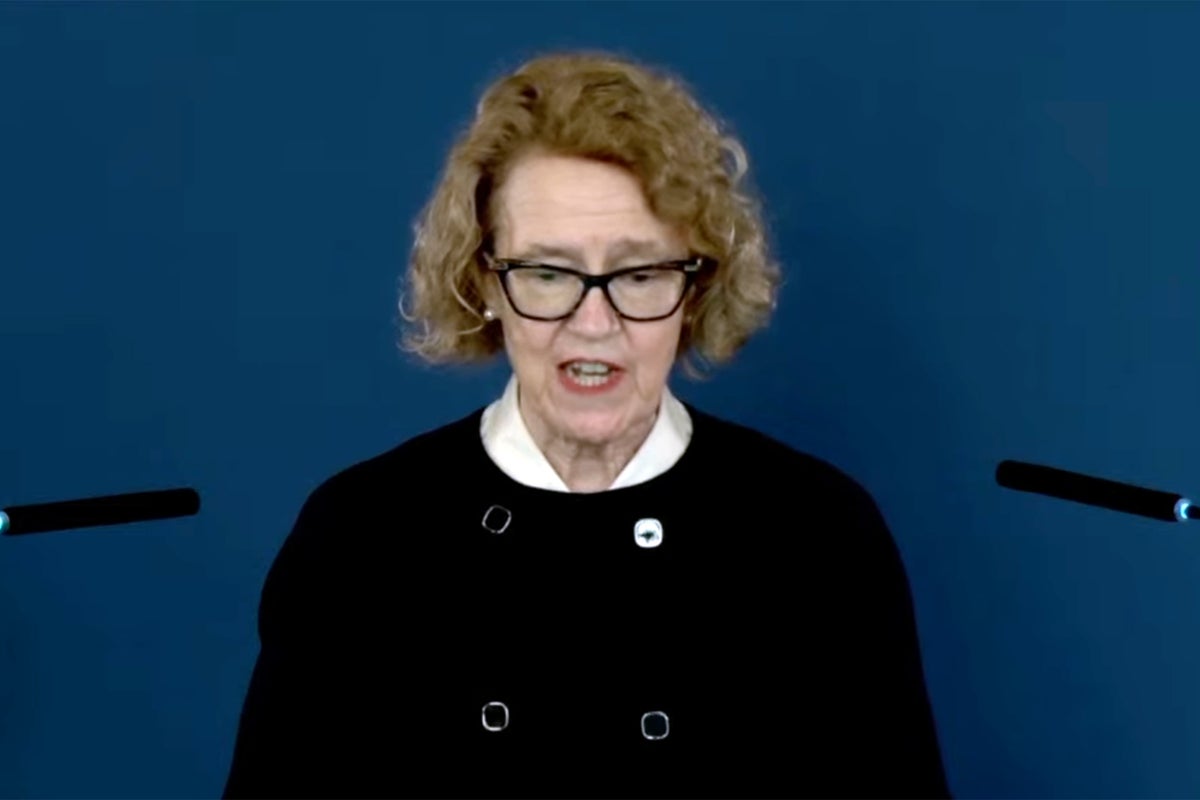
Lady Justice Thirlwall’s report examines events that led to the former nurse’s convictions for murdering seven infants and attempting to murder seven others between June 2015 and June 2016. Letby, 36, is serving 15 whole-life orders for the crimes.
The report sets out a number of safeguarding recommendations, including the introduction of baby monitors in every cot on neonatal wards. Lawyers representing several families affected said it was vital changes were implemented.
The inquiry does not look at whether Letby was guilty, but how concerns about the nurse from other staff were handled and whether her actions could have been prevented.
Inquiry must mark turning point for NHS, says health secretary
Health secretary Yvette Cooper has called for the publication of the Thirlwall Inquiry report to be “a turning point for the NHS” and warned “the safeguarding and wellbeing of babies must never again be treated as a side issue”.
She told the Commons: “There is a section of the report that refers to the way senior oversight of neonatal care had been downgraded in the reorganisation of the Countess (of Chester) Hospital.
“It includes the fact that the board and the medical director reviewed deaths within the hospital; however, it only covered adult deaths.
“The report says the board did not receive any reports about the deaths of babies and children at any stage during the period the inquiry was considering.
“This was a serious failure of governance which no-one on the board seems to have noticed.
“This is further evidence of the inadequacy of the structure which removed the voice of children and babies from the board – and the lack of profile of paediatrics and neonatology.
“I am clear – the safety and the safeguarding and wellbeing of babies must never again be treated as a side issue.
“And as I reflect on some of the safety reports we have seen in recent years on maternity services, let me also be clear – maternity and neonatal services cannot operate on the margins.”
She later added: “This must be a turning point for the NHS.”
Jane Dalton15 September 2026 20:00
Royal College of Paediatrics boss apologises
Another health boss has apologised for its failings in the Letby case.
The Royal College of Paediatrics and Child Health (RCPCH) conducted a review of the Countess of Chester’s neonatal service in 2016.
Professor Steve Turner, president of the RCPCH, said: “At the heart of this inquiry are the babies and their families, and our thoughts remain with them today.
“We apologise for our failings in commissioning the review and the subsequent report; we know that mistakes were made in accepting and undertaking the review. We acknowledge that this delayed families from establishing what had happened to their babies.
“We have been committed to working with the inquiry since it was established, to ensure that lessons are learned both for the college and for the wider healthcare system across the UK.
“We also recognise that the college did not sufficiently support our members at the Countess of Chester at the time, and we extend our apologies to them. These mistakes form part of our lessons learned.
“We have taken the mistakes of the invited review seriously, learned important lessons and significantly changed our invited review processes in the decade since the Countess of Chester review was undertaken.”
Jane Dalton15 September 2026 19:45
‘Foolhardy’, ‘dishonest’ and ‘untruthful’: Former hospital bosses criticised
Jane Dalton15 September 2026 19:25
Cooper orders review of NHS safeguarding ‘framework’
Health secretary Yvette Cooper has instructed Chief Nursing Officer Duncan Burton to urgently review the NHS’s safeguarding framework and training in the light of the Thirlwall Inquiry.
She told MPs: “A revised NHS safeguarding framework was published in April 2026, but I have asked the Chief Nursing Officer to urgently review the framework and the training in the light of this report. We need to look urgently at this.
“But let me be clear: this goes beyond laws and procedures, many of which are already clear. This is about leadership and responsibility.
“Safeguarding is everyone’s business, and safeguarding must be everyone’s priority.
“Concerns must be heard and acted upon. Staff who speak up must be protected and taken seriously, and I expect every leader, every board across the NHS, every professional and manager, every member of staff to uphold their safeguarding responsibilities.
“And I will not hesitate to hold the NHS to account for the highest standards of every level, because at its heart, this is what the NHS stands for: care for patients, and most of all, keeping the most vulnerable patients of all safe.”
Jane Dalton15 September 2026 19:05
NHS trusts to launch bereavement care next year, Cooper says
All NHS trusts are signed up to roll out the national bereavement care pathway in 2027, in line with one of Lady Justice Thirlwall’s recommendations, Yvette Cooper has said.
The health secretary also told the Commons she would legislate to bring in a barring system to remove poorly-performing NHS managers “as soon as parliamentary time allows”.
She said: “The government has consulted on and confirmed plans to apply a barring scheme to senior leaders and managers, not just to clinicians.
“So, we will legislate to introduce the scheme as soon as parliamentary time allows and we will consider (Lady Justice Thirlwall’s) recommendation to expand it further.”
Jane Dalton15 September 2026 18:55
Inquiry tainted by wrong premise, claims Letby barrister
Lucy Letby’s barrister has claimed the inquiry prompted by the child serial killer’s crimes was “tainted by the wrong premise”.
Mark McDonald told the Press Association: “Everything in this inquiry is tainted by the fact that they’ve worked on the wrong premise.”
But he added that he would agree with one recommendation the chairwoman made, saying: “Cameras in the neonatal unit, cameras in the cots.
“Because if they were there when Lucy Letby was working, then she wouldn’t have been on trial. She wouldn’t have been convicted, we wouldn’t be here today.”
Jane Dalton15 September 2026 18:25
NHS has seven months to install CCTV in dozens of units
Health editor Rebecca Thomas writes:
Among the 14 recommendations made in the Thirlwall Inquiry report is that to install baby monitors in all cots and incubators in neonatal units and CCTV cameras focused on insulin storage fridges.
Health secretary Yvette Cooper has promised these cameras.
There are 43 neonatal intensive care units in England, 74 high-dependency units and 39 low-dependency units.
It is not clear how many already have CCTV, but the costs should borne centrally rather than by individual trusts, Lady Thirlwall has suggested.
NHS England will be required to set out how this will be implemented by 31 March next year.
The recommendation is a first; however, it is likely to be fairly achievable, in comparison with the billions in infrastructure issues facing the NHS.
NHS England will also already have an idea of the numbers and costs needed. In 2023, every hospital in England with a neonatal unit was asked whether they had considered installing CCTV following a request by the Thirlwall Inquiry.
A survey of obstetric and neonatal unit staff also highlighted “need for improved security measures, such as CCTV and baby tagging systems, to safeguard babies and ensure the safety of patients and staff”.
Jane Dalton15 September 2026 17:58
Hospital chiefs failed to correct Letby’s misinformation, report says
Hospital bosses failed to correct misinformation Letby put out about her own future.
She was removed from the hospital’s neo-natal unit in July 2016 after consultant paediatricians raised concerns that she may have been harming babies.
Once external reviews had found no evidence of criminality and that a grievance procedure that Letby took out over her removal had been upheld, the nurse believed she was returning to the unit.
An email she sent to staff reported by the inquiry report read: “I was redeployed from the Unit in July 2016 following serious and distressing allegations of a personal and professional nature made by some members of the medical team … After a thorough investigation it was established that all the allegations were unfounded and untrue and I have therefore been fully exonerated. I have received a full apology from the Trust … I will begin making my return to the unit in the coming weeks.”
Lady Justice Thirwall, in her report published today, said she found no evidence that anyone at the hospital responded to the email, or attempted to clarify that she had not been exonerated.
“This was a further failure of management,” she said.
Letby never returned to the ward, and was arrested the following year.
Jane Dalton15 September 2026 17:30
Safeguarding bosses and head of nursing failed to act
Lady Justice Thirwall found the Safeguarding Strategy Board failed to play any role in detecting, preventing or responding to concerns about Letby between July 2015 and November 2017, during which there were six meetings.
Lady Thirwall said all executives and senior managers failed to follow safeguarding processes, and that “particular opprobrium” attaches to former director of nursing, Alison Kelly, “for her repeated and serious failures to ensure appropriate safeguarding responses were initiated”.
The judge said Ms Kelly, as executive lead for safeguarding, should have ensured concerns over Letby’s harming of babies were sent to a local-authority designated officer or police.
Lady Thirwall said: “She [Ms Kelly] did not refer the matter until March 2018, and when she did, the referral contained inaccuracies and was misleading.”
Ms Kelly and two other bosses gave evidence to the inquiry:
Alex Ross15 September 2026 17:12
‘No apology or action can undo what happened’: Hospital boss speaks out
The chief executive of the Countess of Chester has apologised over Letby’s crimes but acknowledged: “No apology or action can undo what happened at our hospital.”
Jane Tomkinson said her thoughts remained with the families and babies who had been harmed.
She said: “We know that no apology or action can undo what happened at our hospital. We are, however, truly sorry for the events that occurred.
“We acknowledge the findings of the Thirlwall Report and will approach its recommendations with openness and a firm commitment to build on the progress we have already made in improving our hospital’s governance, safety and culture since that time.
“We are a different organisation today with new leadership, stronger governance and safety processes, and a more open culture where speaking up is encouraged and acted upon.
“We firmly believe that the changes we have made, as set out in our evidence to the Inquiry, have created a safer environment for our patients and staff.”
Jane Dalton15 September 2026 16:50