
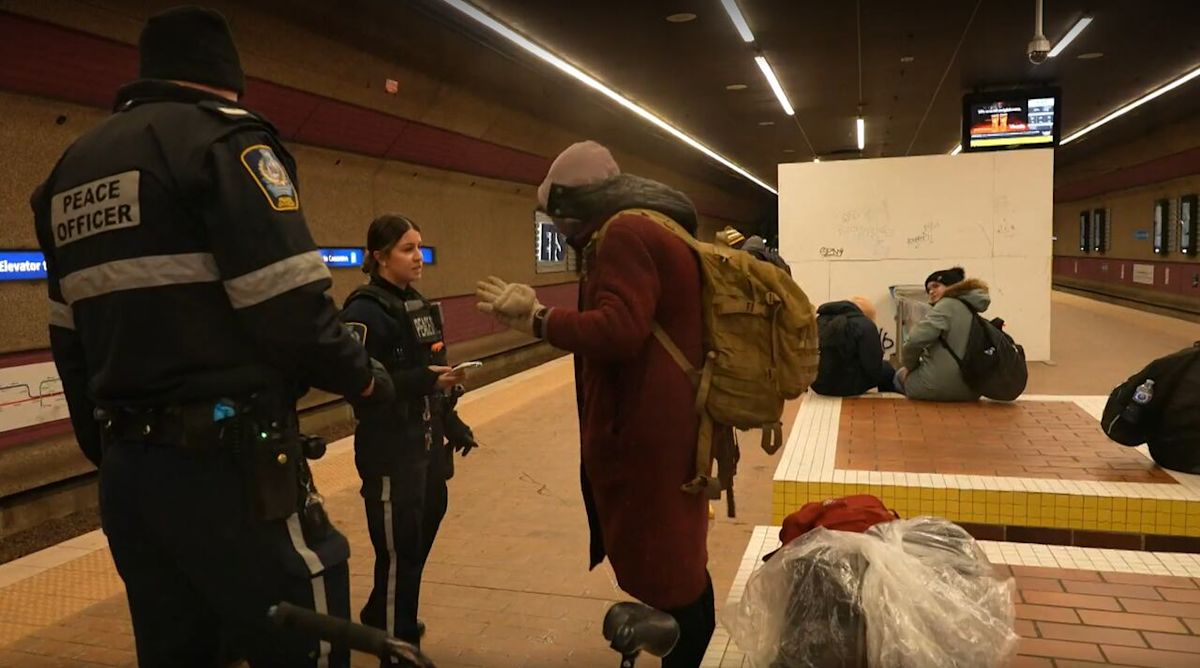
Some legal experts say they are concerned to learn that Edmonton’s transit peace officers issued more than $3 million worth of tickets for trespassing on the city’s transit system to people with no fixed address in 2025.
That data, obtained through an access-to-information request, was made public on Tuesday by the Criminal Trial Lawyers’ Association’s (CTLA) policing committee, the Edmonton Coalition on Housing and Homelessness, the Coalition for Justice and Human Rights, and Justice and Equity Alberta.
Representatives of the organizations who obtained the information say the tickets amount to a punitive measure that targets people who often can’t afford to pay the fines.
Chris Wiebe, a lawyer and spokesperson for both the CTLA’s policing committee and Justice and Equity Alberta, spoke to CBC News about his concerns.
“It’s happening even when the city’s extreme weather response is active during periods of extreme cold last winter,” he said. “You still saw hundreds of these tickets and dozens of these bans being issued.
“And [what] it really calls into question for me is how we’re responding to visible poverty, visible drug use on transit — is it really proportionate?”
Transit peace officers can issue trespass tickets when they have reason to believe someone is on transit property even though they’re banned.
People with no fixed address includes those considered homeless, those who do not or will not provide an address, those who don’t have identification to substantiate an address, or anyone who left the scene before a trespass ticket was issued.
The organizations said the data they obtained shows that in 2025, 5,748 tickets were issued in Edmonton’s transit system under Alberta’s Trespass to Premises Act to people with no fixed address. That number made up 86 per cent of the total of 6,673 trespass tickets issued on Edmonton’s transit system for the entire year.
Wiebe said this makes 2025 the year with the highest number of transit system trespass tickets issued on record, based on data he has gathered since 2018.
Each ticket carries a fine of $600, so the total value of tickets issued to people with no fixed address was $3,448,800.
The city can ban people from Edmonton’s transit system for various infractions like fare evasion, public intoxication, loitering, littering, aggressive panhandling, smoking and urination and defecation.
The city’s peace officers can ban people from Edmonton Transit Service property and vehicles either verbally or in writing. Verbal bans last for one to two days, however, written bans can last for three months to two years.
University of Alberta criminologist Temitope Oriola said he believes the practice of ticketing is the wrong approach given those with no fixed address are often the most marginalized people in the city.
He added that he believes peace officers have been put in a position where they are increasingly having to field mental health and addictions situations, which adds to the growing complexity of their job.
However, Oriola said it is important to ensure those most vulnerable are redirected to supports.
“These are individuals who may not even have the $600 anywhere in their pockets or in their account.”
Addressing the root causes of trespassing
Mayor Andrew Knack was asked about the data while speaking to reporters at city hall.
“If somebody is using that space as a place of refuge because they don’t have anywhere else to go, then that’s the other issue we need to solve,” he said, noting the important role of housing when it comes to addressing some of these issues.
“If somebody doesn’t have transit access or can’t pay for transit, we have a program in place that the transit peace officers can connect them with a social agency. They get access to a free pass through the [Providing Accessible Transit Here] program.”
Knack noted that in the interactions peace officers have with the public, they are only taking enforcement action in seven per cent of cases.
“The other 93 per cent of the time, they’re connecting folks with the right resources, social supports — you name it,” he said. “So it’s in very rare circumstances that transit peace officers break out the enforcement tool.
“We can’t have folks that are in transit using illegal drugs because that also creates challenges. So let’s make sure they’re getting into the right place with the right solution at the right time.”
Wiebe said he believes to address the issue of trespassing, all levels of government should be increasing the types of housing available and increasing the number of transitional shelter spaces for people who are on their way out of jail or residential treatment centres or hospitals.
He added that he believes the city should reinforce publicly that issuing a transit property ban is truly a last resort and said he wants the city to adjust some policies.
“We’re asking that the extreme weather response be changed, … [with] tickets only being issued and enforced — and bans only being issued and enforced — outside of periods of extreme cold.”
CBC News has requested comment from the City of Edmonton’s community standards enforcement team in response to the data that was made public on Tuesday.