
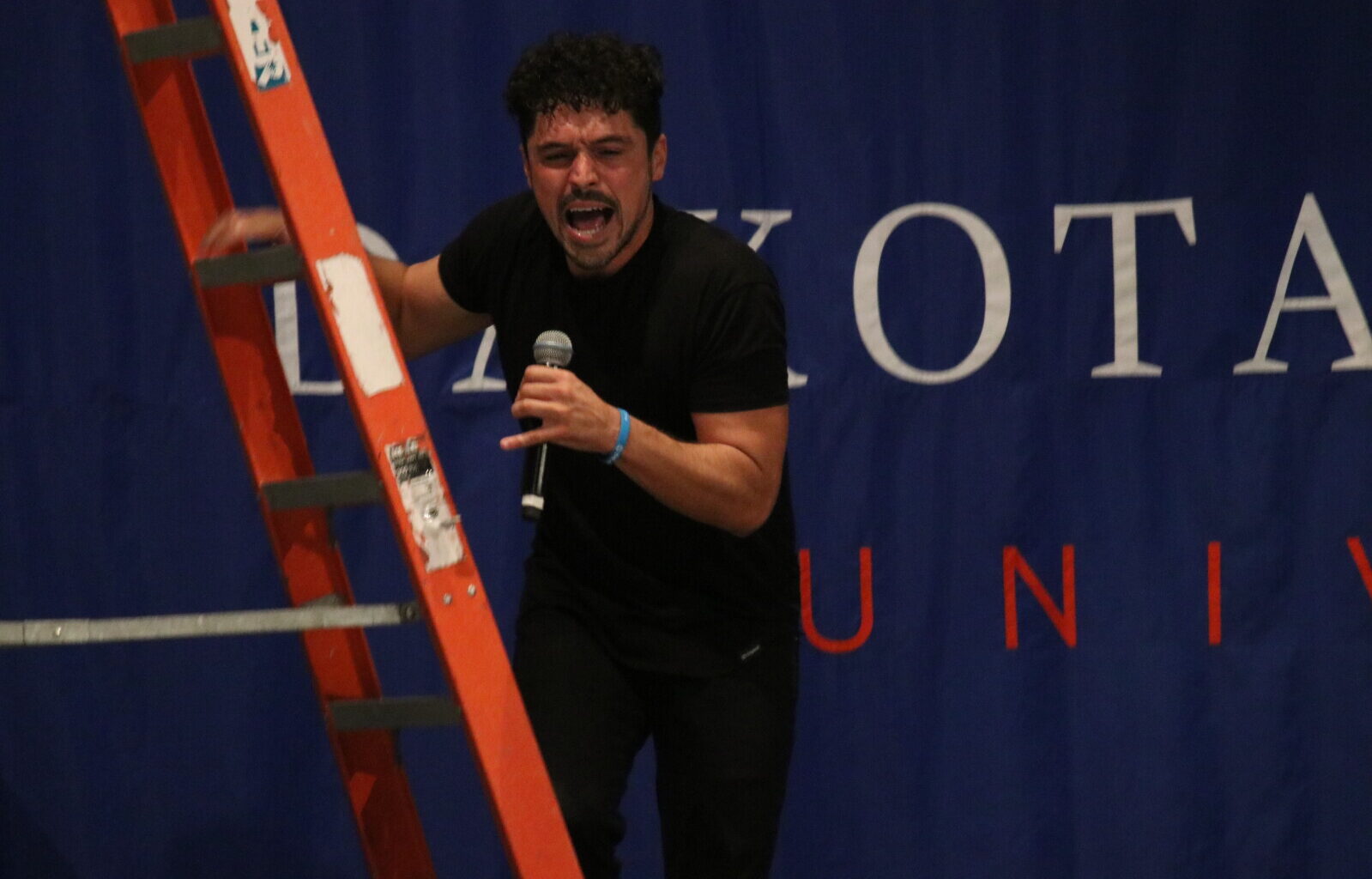
MITCHELL — As Nathan Harmon spoke at Dakota Wesleyan University on Wednesday morning, he climbed precariously onto a 10-foot stepladder beside him on the stage. Still addressing the audience, he leaned back, climbed up and down the rungs and shook the ladder from high above the stage as the audience watched apprehensively, at times appearing close to tipping over.
For Harmon, the unstable ladder was a metaphor for facing mental health struggles without support.
“Everywhere I go, I ask for ladders. And the reason I ask for ladders is because they’re a lot like you, and they’re a lot like me,” Harmon, a motivational speaker who was helping kick off the 437 Project’s 2026 run across South Dakota, told the audience, referring to a ladder’s need for a stable base and support.
The presentation kicked off the fifth year of the 437 Project, which will send 13 participants on a 437-mile relay across South Dakota. The project aims to raise awareness and funds for mental health support
through community conversations and suicide-prevention efforts.

Nathan Harmon, a motivational speaker who addressed the audience Wednesday at the Project 437 kickoff event at Dakota Wesleyan, attempts to climb a ladder on stage at the Sherman Center.
Erik Kaufman / Mitchell Republic
Beginning Thursday, runners will depart from the west side of the state to begin the 437 relay-style journey across South Dakota. The group will pass through Rapid City, Pierre and Madison before finishing in Sioux Falls as part of their run, which usually takes about three to four days depending on the pace.
The gathering was part of a wider event that saw Harmon, the participating runners and other officials stopping in South Dakota communities to promote the tour as they made their way out west to celebrate the start of the relay.
Lisa Larson is one of those officials. The Mitchell resident and local contact for the 437 Project is a suicide attempt survivor and has run the relay previously in 2023 and 2024.
She is also the founder of Rooted 23
, a nonprofit focused on mental health awareness, connection and hope. She and her organization are again supporting the relay in an effort to bring awareness and reduce the stigma of discussing mental health.
Taking part in her runs with the relay made a huge impact on her, revealing to her it is beneficial to talk about mental health openly and freely.

Renee Trisco, vice president of mission at Avera Queen of Peace Hospital, speaks during the 437 Project kickoff Wednesday, Sept. 12 at Dakota Wesleyan University.
Erik Kaufman / Mitchell Republic
“I hid my suicide attempt, but then once I got to be a part of the 437 Project, I just felt like I needed to share my story and find that courage to do so to help the next person,” Larson told the Mitchell Republic.
The connectivity is a common theme surrounding the 437 Project.
Renee Trisco, vice president of mission at Avera Queen of Peace Hospital in Mitchell, highlighted Avera’s five-year sponsorship of the 437 Project and its mission to raise suicide prevention awareness. She emphasized that every life is sacred and deserves compassion and connection. She also introduced Avera’s Ask the Question campaign, encouraging individuals to have the courage to directly ask others if they are thinking about suicide to open doors for support and healing.
“Ask the Question encourages each of us to be courageous and caring enough to ask directly – are you thinking about suicide?” Trisco said. “That question, asked with compassion, can open the door to help support and help with healing.”
The three speakers focused their comments on normalizing mental health conversations and proactive community engagement, advocating for awareness not only for good mental health practices but also for resources such as the 988 Suicide and Crisis Lifeline, which is accessible through phone call or text.
But they all stressed the need for compassion, understanding and being there for each other when life becomes difficult. That all comes through a human connection.

Lisa Larson speaks during the 437 Project kickoff event Wednesday, Sept. 12 at the Sherman Center at Dakota Wesleyan University.
Erik Kaufman / Mitchell Republic
Human interaction – the sharing of feelings, troubling thoughts and the understanding that it’s good to ask for help – is something with which Harmon can identify.
The Indiana native struggled with a difficult and unstable childhood, addiction issues and legal troubles. Now sober for more than a decade, he has dedicated his life to traveling the world — speaking in schools, communities, and venues through his group Your Life Speaks — to share his lived experience and promote human connection and mental health awareness.
He covered those topics in his presentation, but it was his demonstration with the ladder that laid out his view in the simplest of terms.

Nathan Harmon stands atop a ladder while volunteers support him below during the 437 Project kickoff event Wednesday, Sept. 12 at Dakota Wesleyan University.
Erik Kaufman / Mitchell Republic
After an energetic display on the free-standing ladder that looked as if it would fall over on him at any second, Harmon called out for volunteers, bringing a handful onto the stage. He likened the support needed to use a ladder to horizontal stability, represented by friends and equals who offer companionship, and vertical stability, made up of people like mentors, coaches and teachers.
Both areas of support are necessary in life and on a ladder, he said.
“I can’t just have my friends, I can’t just have people on the horizontal. At the end of the day, I appreciate you. But you didn’t know how to help me because you’d never been here before,” Harmon said.
As he spoke, he positioned several volunteers around different parts of the ladder, some gripping it strongly near the front, others positioned firmly along the sides. With them in position, Harmon tried to jostle the ladder, but with its support group the ladder stayed firm.
He then climbed nimbly to the top of the ladder, standing flat-footed and confident on the very top rung, towering over the stage and the audience below. It was a display that would not have been possible without the volunteers below.
He implored everyone present to be that ladder holder when friends, family or even strangers need it.
“When I become a ladder holder, I walk into rooms and I care about people. I’m not afraid of asking direct questions when I think about suicide. I created a bridge, a pathway,” Harmon said when he climbed back down. “The most powerful tool we’ll ever have is the human connection. Because real is real. And I can’t see my blind spots. The truth is we are better together.”
4/9: Nathan Harmon, a motivational speaker, addresses the audience during the 437 Project kickoff Wednesday, Sept. 12 at Dakota Wesleyan University.
Erik Kaufman / Mitchell Republic
5/9: Nathan Harmon, a motivational speaker, addresses the audience during the 437 Project kickoff Wednesday, Sept. 12 at Dakota Wesleyan University.
Erik Kaufman / Mitchell Republic
6/9: Nathan Harmon, a motivational speaker, addresses the audience during the 437 Project kickoff Wednesday, Sept. 12 at Dakota Wesleyan University.
Erik Kaufman / Mitchell Republic
7/9: Renee Trisco, vice president of mission at Avera Queen of Peace Hospital, speaks during the 437 Project kickoff Wednesday, Sept. 12 at Dakota Wesleyan University.
Erik Kaufman / Mitchell Republic
8/9: Lisa Larson addresses the audience during the 437 Project kickoff Wednesday, Sept. 12 at Dakota Wesleyan University.
Erik Kaufman / Mitchell Republic
9/9: Nathan Harmon stands atop a ladder while volunteers support him below during the 437 Project kickoff event Wednesday, Sept. 12 at Dakota Wesleyan University.
Erik Kaufman / Mitchell Republic