
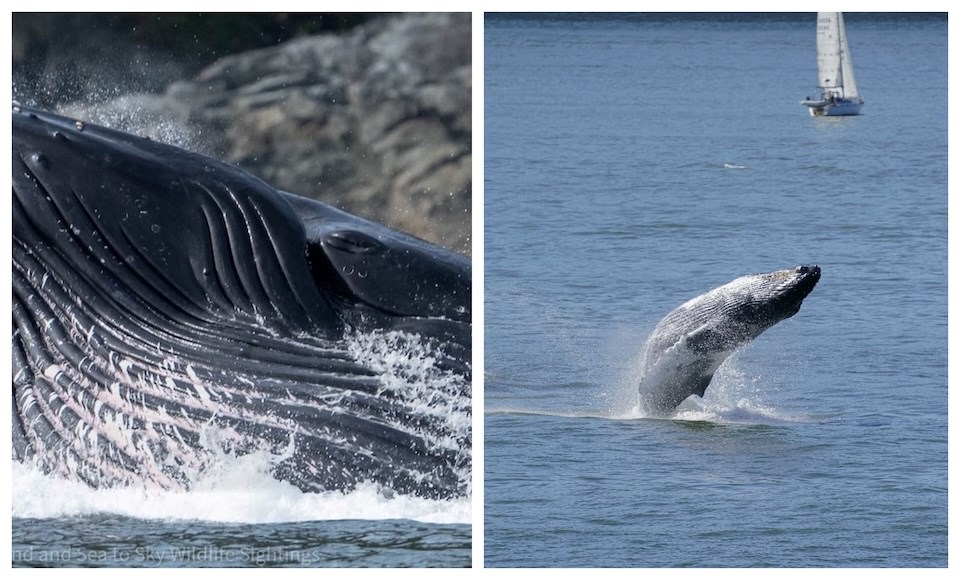
They’re the largest whale species that visit the region.
Some cetaceans are having a whale of a time in local waters.
Humpback whales typically swim in the Pacific Northwest during the warmer months, much to the delight of Metro Vancouverites.
Actually, humpback whale sightings have increased in Metro Vancouver over the past several years, as have other whale species. Humpback whales reclaimed a feeding spot they historically used, thanks largely to robust conservation efforts.
Fans of marine life recently posted photos and videos to the Facebook group Howe Sound and Sea to Sky Wildlife Sightings.
Lydia Wada shared three videos of three humpbacks in West Vancouver’s Whytecliff Park on Tuesday (Sept. 15), showcasing the behemoths diving underwater and displaying their beautiful tails (see gallery above).
Danfred Ceballos Pretesto also shared a beautiful video of a humpback at Whytecliff on the same day.
“A cinematic moment of grace that leaves you speechless at Whytecliff Park,” he writes in the post.
Bee Kay also got in on the move-like magic at Whytecliff, sharing a couple of videos of the whales surfacing in the late evening, sunset-soaked waters before dipping beneath them.
Group administrator Alex Cole captured a handful of jaw-dropping images of a humpback whale off Seymour Bay, southeast Bowen Island on Sept. 11.
The marine mammal was “working its way up and down the coast, very close to shore, lunge feeding. It’s a spectacular behaviour and amazing to watch! There have been so many humpbacks around this season,” he writes.
“Humpback whale season” starts in April but really ramps up in May and June. Stefan Shipmaker shared an absolutely epic photo from June to the group.
Humpback whales have one of the longest migrations of any animal
Humpbacks have one of the longest migrations in the animal kingdom, wintering in tropical spots like Hawaii and Mexico before making their way to B.C. and Alaska in the spring. They give birth in the hot spots before travelling. I got to speak to a top whale researcher at the dedicated whale museum in Mazatlan, Mexico, who spoke about the humpback population down there and how he studied them in B.C., too.
Humpbacks are the sixth-largest whale worldwide, measuring in at a whopping 50 to 80 feet long (15 to 25 metres). They are easily distinguishable by their tail flukes.
Researcher and whale expert Óscar Guzón, who gave the tour at Mazatlán’s National Whale Museum (Munba), showed us a game where we had to tell individual humpbacks apart by looking at the tails.
He says researchers identify the animals by documenting the black-and-white pigment and scars on their tails, which are distinctive to each individual. As someone who has worked with humpbacks for 20 years, he’s identified several that make journeys from Mexico up into B.C. waters.
Our coastal waters offer important feeding grounds for whales, so it’s important that people maintain distance from them when in the water. Concerned citizens launched a petition to “restrict jet skis” in Vancouver’s harbour after a jet ski struck a grey whale in May.