
 Signature: EseFbcFGMUh94XLLxqA/DDm9pKtq9pxsIHYjL529m3d9lJvE+9R1Xio/yvCSMbjghJc4sBo610jRANaob5ik2F/JOgUBI4iENUaWHHxu/J2tirSyYXjqrUC8HxJOWYZmEajFvbnxFf2y41JTV5WwWA0s6mNjp6X9VCPdh/spe80KjcvYqxTqFPYTUYhEw+ar4OQ4fNfPTEQAIJ6YTcAoY05ZpE0Vwjunt2dxroGshd/l94sNDBZtlEtK9OqRpVOIHjpieudPi/Gljg/qBza34gZVczTTLt9j3VU+APnsmT2GOrqJC7NRISOtJGuZmK1A+fElC2lXBgbGuRCh+mCROz+JgxV3RrIaloAmSe/j92Rnd/+eS8oBlh73OQxoio0l2eAPygKsuoozdgyEwHvXrnWJGDSa5/FvNuTtmBvNMpwJTNScvSv8g6UmMvyup4+cUQSKpRKgNQ/yi1z4cFtmsNQqZOWs5LAHR+FMvDOsuyrcAmVsqzHwd+TlgrDCWuPRflAdjh3iliwAmfgIUUvrnmlvamoykgJ6CC70YsGIrZMiQL9iAoORqkK2+N8nL3rlKDmAdGfe0LcdlCM4CNq7qegKfO1rdPgfHzULAzzaaFyfEreIYyhE4hRg0oGPdQn8Rh6gZiCxzj9JRtW4fRpnguSo9pW310iS0AGF2Y8f2U8/SH9mQOzqWnuTFaaUWcK0tDvH7tlhqCpsHYJjxMAhLx0zf14LCzjVvjbUdxzXgG/nx6g545TnWtKl7lX5k2JIq6AT7TOQ33hjAuBe5zmeuxY4CWa22/uYpKdzbqb4KWvBe28wbvrpVIMiLm9kgLNQ7mZpxbT2NLvFJVFXcIGU8Wg1RhpgHz8tBCO9JvNEC5Zw5uR7+Ge3xfi65MgwKec3HsTClh8mAIHoJ8F/ItxqLm90+wTnFwNka/lVslwf8paD9gpfbRhFlFFAzr4IEEHC
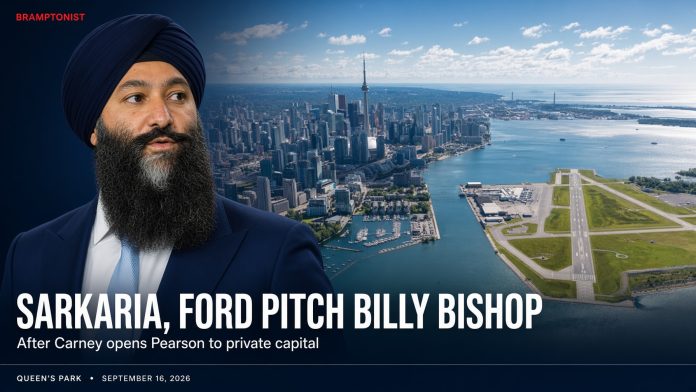
Brampton South MPP and Ontario Transportation Minister Prabmeet Sarkaria is tying an expanded Billy Bishop Toronto City Airport to Prime Minister Mark Carney’s new push to attract private capital and operators to Canada’s major airports.
Carney said Tuesday that the federal government will retain ownership of the land and airport assets at Toronto Pearson, Vancouver, Montreal and Calgary while seeking private-sector investment and participation in their operation and development.
Premier Doug Ford called the plan “fabulous” on Wednesday and said Billy Bishop should be next, describing it as a “shovel-ready” project capable of attracting between $5 billion and $7 billion in private investment and creating thousands of jobs.
Ford also said the expansion would not cost taxpayers anything.
Sarkaria has made a similar argument, saying that if Ottawa is looking for billions of dollars in new infrastructure investment and construction activity, Billy Bishop is an existing airport that could be expanded rather than a project that would have to be built from scratch.
What exists — and what does not
Billy Bishop is already an operating commercial airport. It handled roughly two million passengers in recent years, including about 1.7 million in 2025.
The airport has an operating passenger terminal under a long-term private-sector arrangement with Nieuport Aviation, a pedestrian tunnel and ferry connection to the mainland, U.S. customs preclearance, and scheduled service from Porter Airlines and Air Canada.
But the larger airport promoted by Ontario officials and PortsToronto would be substantially different from the facility operating today.
The proposed modernization and expansion has included a jet-capable runway, terminal improvements and substantially increased passenger capacity. Supporters have described a potential future capacity of up to 10 million passengers annually.
PortsToronto and provincial officials have also cited major projected economic benefits, including up to $8.5 billion in annual economic impact by 2050, as many as 23,000 construction jobs and approximately $140 billion in economic output over 25 years.
Those figures are projections associated with the proposed expansion, not guaranteed economic results.
Cost estimates have also varied. PortsToronto CEO RJ Steenstra has previously put the cost of a major expansion in the $4-billion-to-$5-billion range, while Ford this week cited $5 billion to $7 billion in potential private investment.
PortsToronto has said the project could be funded through airport-generated revenues and users rather than direct taxpayer funding. The financing structure for any future expansion, however, would have to be established before the project could proceed.
Ottawa has rejected the proposed jet expansion
This is where the “shovel-ready” description has an important limitation.
Billy Bishop is an operating airport with existing infrastructure, but the proposed jet expansion is not approved.
The federal government has authorized runway-end safety areas at the airport, with that work proceeding separately from the proposed expansion. Following public consultations this year, Ottawa said it would not proceed with the proposed runway extension to accommodate jets.
That means any future proposal involving a jet-capable runway or other expansion beyond the currently authorized work would require additional federal consideration and approvals.
The expansion has also faced opposition from Toronto Mayor Olivia Chow and residents and community groups concerned about potential noise, environmental and waterfront impacts.
Ontario has continued to support the project. Sarkaria has argued that the economic case remains strong, that Ottawa listened to a “small fringe group” in Toronto, and that the province will keep pushing.
Bill 110 adds another layer
The airport fight has also become part of a broader dispute between Queen’s Park and Toronto over the waterfront lands and the future of Billy Bishop.
Ontario passed Bill 110, legislation dealing with the province’s role in the tripartite arrangements governing the airport and related waterfront lands. Queen’s Park has said it intends to keep the legislation in place, while Chow has called for the relevant land to be returned to the city.
The statute is not a federal approval for a jet-capable runway.
Why Brampton is in the story
For Brampton, the argument is regional rather than waterfront.
The city is closely connected to the Greater Toronto Area’s transportation, logistics, manufacturing and business networks. Ontario officials argue that additional airport capacity and private infrastructure investment could strengthen connectivity and create economic opportunities across the wider region.
Whether the projected jobs and economic benefits materialize would depend on the eventual design of an expansion, its financing, environmental considerations and the federal approvals required to move beyond the airport’s current operations and authorized safety work.
For now, Ford and Sarkaria are trying to put Billy Bishop into the private-capital conversation that Carney opened this week with Pearson and the country’s other major airports.
The airport is operating. The jet expansion is not.