
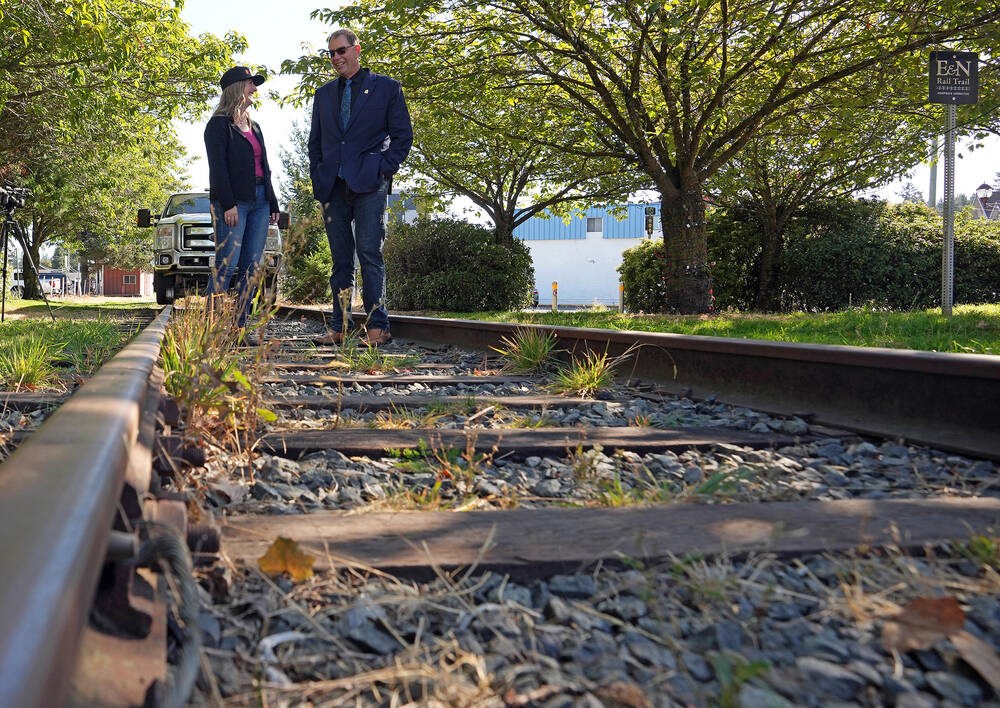
Half a million dollars will go to explore whether the former Esquimalt & Nanaimo Railway could be used for light passenger rail travel.
The federal government has announced $500,000 for feasibility and technical studies to explore whether the former Esquimalt & Nanaimo Railway could be used for light passenger rail travel between Victoria West and Langford.
The studies, to start in the new year and conclude by the end of 2027, will be conducted by the Island Corridor Foundation and will include corridor planning, land-use analysis and community engagement, Esquimalt-Saanich-Sooke MP Stephanie McLean said in Esquimalt on Wednesday.
Revitalizing the corridor is a priority for south Islanders, said McLean, adding she and fellow Victoria MP Will Greaves, who was at the announcement, have worked “doggedly” on the file.
“We are going to see it through one way or another, either to it becoming a reality, or you know, to being sort of a final end of the conversation,” McLean said in an interview.
The studies will also help identify potential economic opportunities for the Esquimalt and Songhees First Nations, said McLean. “This is the Reconciliation Corridor Initiative, so we need to do this at the speed of trust in partnership with the Esquimalt and Songhees Nations.”
Greater Victoria mayors agreed last year to work with First Nations to consider an alternate route that would not bisect the Esquimalt Nation’s 19.3-hectare reserve. About 500 metres of abandoned E&N rail tracks bisect the 384-member nation’s land between Esquimalt and View Royal.
The Reconciliation Corridor Initiative agreement, signed in December 2025, included the Esquimalt and Songhees nations, as well as the municipalities of Victoria, Esquimalt, Colwood, View Royal, Langford and the CRD.
Esquimalt Nation (Xwsepsəm) Chief Jerome Thomas said Wednesday that the lands used by the rail corridor were taken “without consent of our nation,” affecting families and the environment “and our ability to generate wealth from our lands.”
Thomas said the “evolving vision” includes remediating the lands on the reserve and returning them to the nation, developing passenger rail services from Langford to Vic West, supporting members of the armed forces, and “improving transportation for everyone in the region.”
A business case would have to be made, McLean said, but it’s a time when the federal government wants to invest in projects that use Canadian resources and workers.
“We want to build big, we want to build bold, and we want to support connected communities,” said McLean, adding the studies are critical to determine “what is in the realm of possible.”
The issue has been deemed a priority for the next Capital Regional District board, which approved a $1.7- million grant to complete the technical and project feasibility work, following the October municipal elections.
“Everyone locally that needs to be at the table is at the table, and the federal government is at the table, really for the first time since the 1800s,” said McLean.
Trains began running on the rail corridor from Esquimalt to Nanaimo in 1886, but passenger service was halted in 2011 due to track deterioration caused by a lack of maintenance.
The Pacific Economic Development Agency of Canada (PacifiCan), the federal economic development agency for Western Canada, is providing $500,000 through the Build Communities Strong Fund. That fund provides money for new and improved infrastructure that reflects local priorities and drives regional economic growth.
Since the 2000s, much of the corridor has been owned by the Island Corridor Foundation, a non-profit that works with local governments and First Nations to preserve and advance the future use of the corridor.
Commuter rail is seen as a way to deal with increasing traffic between the West Shore and employment centres like CFB Esquimalt, the Esquimalt Graving Dock and downtown Victoria.
McLean said traffic congestion between Victoria and the West Shore has been a problem for generations, noting she was late for Wednesday’s announcement because “I was caught in the Colwood crawl,” noting it took her about 45 minutes to travel nine kilometres.
With more housing being built, the problem will only get worse, said McLean, noting the rail corridor is “a credible solution where there is huge potential for us to improve the flow of traffic and people.”
A report released last year said traffic jams along the stretch of the Trans-Canada Highway connecting the West Shore with the rest of the capital region could become an all-day feature in the next 25 years if no transit improvements are made.
The West Shore is expected to grow at double the rate of the core region. A travel survey conducted by the CRD in 2022 showed close to 100,000 people travel between the West Shore and the core area every day.
Esquimalt Mayor Barb Desjardins said there is also potential for explosive growth in Esquimalt, in part due to significant federal infrastructure funding — $1.1 billion to replace the aging A and B jetties in Esquimalt, a project that is expected to support approximately 1,280 jobs as well as an expansion of military housing.
Desjardins said the feasibility study is already underway with CRD funding, and there is a push to complete a technical assessment of the railway, an environmental and regulatory review, and a study of realignment options for the rail line corridor, potentially around Esquimalt Nation’s reserve lands, with that work expected to be completed this fall.
Light rail allows more flexibility to realign the route and less disturbance to neighbouring lands, she said.
Now with federal funding augmenting the commitment from CRD, the next phase of study includes governance and opportunities for employment, affordable housing, economic development and appropriate light rail technology, she said.
Desjardins said perhaps the biggest part of Wednesday’s announcement is that “the federal government is with us.”
“So it’s an extremely exciting time,” said Desjardins.
In the past, she said, the entire 289-kilometre rail line from Victoria to Courtenay and inland from Parksville to Port Alberni had been considered for revitalized passenger rail, which presented major challenges.
In late 2024, about 10 acres of the corridor was returned to the Snaw-Naw-As (Nanoose) First Nation, whose reserve lands had been bisected by the railway for more than a century. About a kilometre of track and ties was removed by the nation.
If the Vic West to Langford light-rail corridor goes ahead, it could serve as a model for the rest of the corridor, which could be done in phases, Desjardins said.