

Telehealth companies and mass compounders are selling knockoff GLP-1s to patients who believe they’re getting the real thing. They aren’t. These products have never been reviewed by the FDA for safety, quality or effectiveness, and patients are being harmed. Washington needs to act.
The shortages ended. Illegal sales didn’t.
The FDA originally allowed GLP-1 medications to be compounded during a documented drug shortage from 2022 to early 2025, when consumer demand outpaced the supply. The shortages ended more than a year ago, but compounded GLP-1s still make up nearly 1 in 5 weight loss injection prescriptions in the U.S.
The practice is longer about patient access. Compounders and telehealth companies are knowingly sidestepping restrictions, marketing the unapproved versions of these drugs as “personalized” and equivalent to FDA-approved medicines, and profiting from patients who don’t know the difference.
The harm is documented and increasing. Where’s the enforcement?
To address the pressing need for stronger guardrails, PSM published a roadmap for policymakers to act and improve patient safeguards: A Call to Action: Restoring and Strengthening America’s Patient Safety System.
This report outlines the major gaps in enforcement that have allowed telehealth companies and compounding entities to game the system and sell unapproved substances to unsuspecting patients.
The concerns are not theoretical. The FDA has received more than 1,700 adverse event reports tied to compounded GLP-1 products, and calls to poison control centers related to these substances have increased nearly 1,500% since 2019. A 2026 peer-reviewed study found that adverse events associated with compounded GLP-1s were both more frequent and more severe than those linked to FDA-approved versions.
The FDA has sent warning letters to transgressors and published resources alerting consumers of the ongoing threat of unapproved GLP-1 products. But that’s just a start.
PSM is calling for stricter enforcement of existing laws while introducing new policies to further strengthen enforcement options and restore patient safety in the GLP-1 market.
Knockoff ingredients. Foreign sources. Zero accountability.
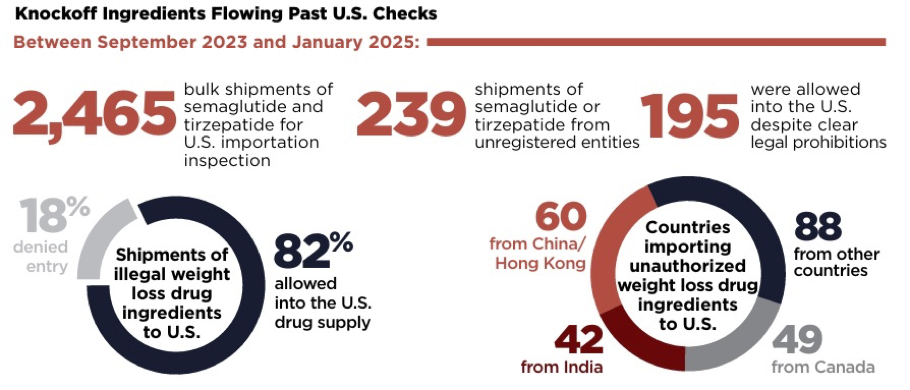
PSM has documented evidence of suspicious, unauthorized, and illegal GLP-1 ingredients flooding into the U.S. from foreign sources, despite U.S. laws forbidding them from crossing the border.
Without FDA oversight on compounding, there is no track-and-trace system. No sterility guarantee. Insufficient clinical data.
Some of those active pharmaceutical ingredients (API) shipments were described as ‘non-sterile liquids’ — a potentially serious concern given their intended use in compounded injectable products that must be sterile. Consumers remain largely unaware that knockoff GLP-1s may contain active ingredients from unregistered overseas manufacturers that are not suitable for human use.
Policymakers and agency officials must ensure these ingredients do not reach patients and hold compounders accountable for using them.
Here’s what needs to happen.
Patients expect to know what’s in the medicine they inject. They deserve safety assurances.
We’re calling for stricter enforcement of existing rules:
State boards of pharmacy should conduct audits when relicensing, and the FDA should pursue documented violators.
Customs and Border Protection should flag suspicious import volumes and report to them to the FDA.
The FDA should prioritize enforcement against impermissible substances.
The FDA should require upfront disclosures in all consumer-facing ads.
And we need new policies to better protect patients:
Codify a definition of “essentially a copy” in federal statute.
Require pre-market inspection and clearance of 503B outsourcing facilities.
Require 503A facilities to report compounding volumes and adverse events to state boards of pharmacy.
Extend DSCSA serialization and supply chain traceability to 503B and applicable 503A drugs.
Introduce oversight of med spas and other non-traditional healthcare providers by state boards of pharmacy.
Washington: Protect Americans from compounded GLP-1s.
See our full set of recommendations here and contact editors@safemedicines.org with questions and inquiries.