
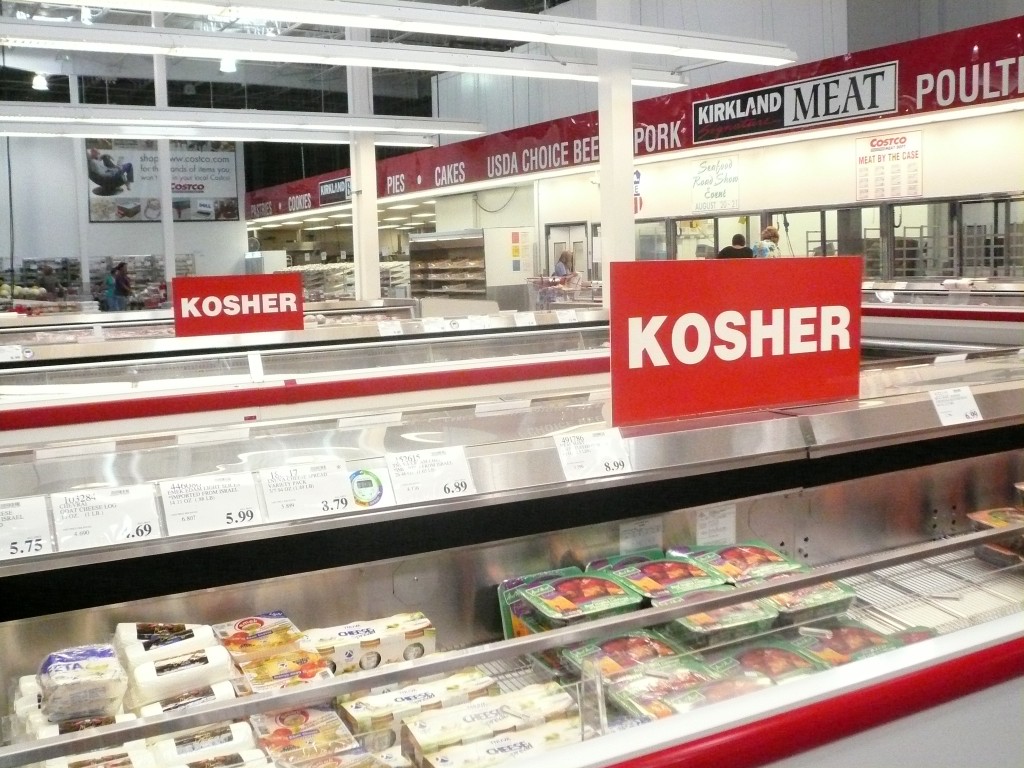
Montreal Kosher (MK) and the Jewish Community Council (JCC) of Montreal have responded to a Federal Competition Tribunal lawsuit filed by Aleph Meats Inc., a west-end butcher shop launched by entrepreneur Mendy Boyarsky in April.
For some time, Boyarsky has railed against what he calls a monopoly on kosher products in Montreal by MK Kosher keeping kosher food unaffordable for many Jews. That’s why he launched Aleph Meats in Côte Saint-Luc, selling beef certified under KSR, Montreal’s kosher certifying authority launched in 1978 under the Sephardi Rabbinate. His Cavendish Mall store was enthusiastically received, and he’s opening a second Aleph Meats outlet in Thornhill, Ont., next month.
In his complaint, Boyarsky alleges that MK maintains a stranglehold on the kosher business and includes allegations that MK imposes exclusive-dealing conditions on merchants, which affects Aleph because it uses another kosher certification, all in violation of Canada’s Competition act.
The Jewish Community Council of Montreal (JCC), which operates MK Kosher Certification, has filed its response, and is asking the Tribunal to dismiss the application, disputing the allegations and arguing Aleph Meats has not provided credible evidence that MK engages in exclusive dealing or abuses a dominant position.
In written representations filed Sept. 10, the JCC points to two recordings submitted by Aleph as evidence of exclusive dealing and says one (of an IGA employee) is contradicted by a contract submitted along with MK director and JCC executive director Rabbi Saul Emanuel’s affidavit.
The JCC also says a second recording from another retailer, “does not prove an exclusive dealing” and is consistent with MK’s requirement that meat sellers carrying its certification sell MK-certified meat. The JCC further submits photographs of businesses carrying multiple kosher certifications, arguing that this “clearly contradicts” the allegation of exclusive dealing.
MK does not prevent merchants or restaurants from obtaining another kosher certification and does not withdraw its certification simply because a business obtains another certification, writes JCC lawyer Jean El Masri, but it does say that all products served by an MK-certified business must meet its standards.
In the case of meat, MK conducts its own inspection regardless of other certifications, and “a merchant or restaurant cannot maintain MK certification if the meat it uses has not been approved by MK.” The JCC says multiple Orthodox kosher certifications are possible, including for meat, as long as those rules are followed.
The JCC also argues Aleph has not shown that it was directly and substantially affected by conduct covered in the Competition Act, or that the matter meets the act’s public-interest test. It also argues that harm allegedly suffered by Aleph itself is not enough to establish “harm to competition.”
Proof, motives and “baloney”
According to the filing, “the problem of the Applicant (Aleph Meats) is not about exclusive dealings, which do not exist, but about his attempt to force the Respondent to rubber stamp an MK Kosher certification.” It adds: “Applicant chose not to seek an MK certification but wants to benefit from it without having to comply with the independent kashrut requirements that we require: he simply wants to circumvent the certification process and the requirements of JCC.”
Rabbi Emanuel’s affidavit notes that the JCC’s role in interpretation and implementation of Jewish laws and traditions, “is based on the trust and acceptance of the Orthodox Jewish community of Montreal and of the country.”
Their position he says, is very simple: For all products except meat, the JCC recognizes the kosher certification of products issued by some but not all Orthodox kosher institutions, based on their evaluation “that their standards are in line with ours.” For meat (packaged or not), says Rabbi Emanuel, the JCC doesn’t recognize any other kosher certification, and insists on applying its own standards and making its own verification. “We do not prevent anyone from obtaining another certification than MK; if we do not recognize the other certification or in case of meat product, we carry out our verification process in order to deliver and maintain the MK certification.”
Rabbi Emanuel also questioned Boyarsky’s motives, noting the case started a year after a Quebec Court ruling in another case involving Boyarsky relating to a property dispute, which involved an arbitration award issued by the Rabbinical Tribunal of Montreal (Beth Din), a division of the JCC. Rabbi Emanuel highlighted extracts of that judgment questioning Boyarsky’s claims and credibility and submits that Aleph Meats filed these Competition Tribunal proceedings “in reaction to the judgment of the Quebec Court and the position expressed by the JCC.”
Boyarsky called the assertion “complete nonsense. They are claiming I am on a vendetta,” he told The CJN. “I’m not interested in pursuing anything for cases that happened years ago. I paid and moved on. There’s no connection, it’s spreading false rumours. It’s baloney.”
The lawyer representing Aleph Meats says he too was surprised that the JCC raised the issue of an unrelated case to question Boyarsky’s motives. “It’s not only not relevant, it’s not true,” Alexandre Michaud told The CJN, noting, “there is no ulterior motive. At the end of the day, he (Boyarsky) opposed the homologation (judicial ratification) of an arbitration by the Beth Din (rabbinical court) and lost because he missed the deadline to oppose it. He moved on, he gets along with the other party, and it has nothing to do with this case.”
Michaud says he will be filing a response to the MK’s submission before month’s end and then the tribunal will decide when and how to proceed. “They were granted an extension to properly respond, so we are asking the same, so that we may respond thoroughly and rectify the facts.”
Rabbi Emanuel also addressed Boyarsky’s claims of annual revenues and lost business. In its application, Aleph Meats claimed annual revenues of $2.4 million selling meat, says Rabbi Emanuel adding Aleph was launched less than five months before the case was filed and has one point of sale.
In 2025, the total gross sales of beef and poultry certified kosher by the JCC was less than $40 million in Montreal, writes Rabbi Emanuel. Indeed, documents filed with the tribunal from the three top-selling companies show annual sales over the last few years, including 2026: Kosher Mehadrin, $17.8 million; Metzelei / Glatt’s, $6.9 million; Marvid Poultry, $12.7 million.
That makes Aleph Meats potential revenue claims of $100 million “a gross misrepresentation” says Rabbi Emanuel, noting that would require every other producer and merchant to cease sales, and all Orthodox Montrealers to purchase Aleph Meats products without an MK certification. He also dismisses Boyarsky’s contention that he is “limited to only one point of sale,” noting there are several retailers serving the Jewish community around Montreal which are not certified by MK.
Rabbi Emanuel also deposited a contract between the JCC and IGA Van Horne (Sobeys) that “does not contain any exclusivity dealing clause, but it does require the IGA to only sell products that are Kosher according to our standards. ”He also disputed claims that MK has issued threats or direction requiring meat processor Montpak not to deal with Aleph Meats. MK’s role, he writes, “is limited to supervising the slaughter of animals and has no exclusivity agreement or even any written contractual relation with Montpak.”
Boyarsky said if MK and Rabbi Emanuel insist there is “no blockage” at any MK establishment, “they can write a letter to all these companies, write a letter to Sobeys, and say that I can sell, that there’s no issue, and there’s no case. Everyone goes home, it’s that simple.”
Michaud says there’s a settlement mechanism within competition law that allows for a respondent, in good faith, to agree to change their behaviour without any admission of wrongdoing, to avoid a trial. He says Boyarsky’s suggestion that a clear statement from MK to clients and retailers that their contracts were not meant to be exclusionary, and that it’s fine to sell meat from someone else, could help remove the “chill” imposed by the largest kosher certifier, giving retailers a chance to offer more variety and benefit consumers by opening the door to more competition, all in the public interest.
Boyarsky meanwhile, points to a clause in the JCC contract with Sobeys submitted by the JCC to counter claims of exclusionary practices, that Boyarsky says suggests otherwise: “THE ESTABLISHMENT shall only be permitted to sell fresh prepackaged KOSHER cut up fresh fruits, meat, deli, poultry, fish, bakery goods or prepared food at its designated KOSHER COUNTER and at no other venue. Prepared foods from other MK establishments may be brought into THE ESTABLISHMENT when sealed and stamped with the MK mark.”
Michaud says the MK’s own filing contradicts its position that no exclusionary practices take place. “They say you can bring in other products as long as they are sold at the kosher counter,” where, he says, it is under MK rules. What’s more, that contract clause is preceded by one that says the JCC is the sole authority on kashrus for that establishment, whose decision is final and binding.
Rabbi Emanuel conceded in his affidavit that the “only narrow exception” to the standard JCC practices is for banquet halls. “It is not viable to have to undergo the process to thoroughly render the kitchen Kosher according (to) our long-established religious standards after each event that is not catered by a business holding an MK certificate, and as a consequence we do require that banquet halls only cater events where all the foods and preparation is certified by MK.”
The JCC also argues that kosher certification is not simply a standardized commercial service but involves religious determinations and controversies that a court can not properly adjudicate, and that court involvement could infringe on the religious freedom of the JCC and members of the Orthodox community, citing, among other cases, the famous 2004 Supreme Court ruling in the Syndicat Northcrest v. Amselem “sukkah” case.
The JCC is asking the Tribunal to dismiss Aleph’s application for leave, with costs.
Boyarsky says he’s not deterred in the least. “We’re fighting tooth and nail,” he said. “There’s no reason prices should be 30 per cent cheaper in other markets. Bottom line, monopolies keep prices higher. Remember, a regular butcher shop buys from a distributor, $20,000–$30,000 at a time. We are doing our own massive shechitas (ritual slaughtering), so it requires massive amounts of capital, but we can’t sustain it indefinitely.”
Meanwhile, he says he’s received a lot of positive feedback “and some condemnation for taking MK to a civil court. What’s interesting about it, the JCC and MK say I have something against them, I have a vendetta, but I’m supposed to take the matter to them? People talking about how bad it is me taking them to court, but they aren’t talking about them keeping the price of kosher high, how people can’t afford kosher.”

Joel has spent his entire adult life scribbling. For two decades, he freelanced for more than a dozen North American and European trade publications, writing on home decor, HR, agriculture, defense technologies and more. Having lived at 14 addresses in and around Greater Montreal, for 17 years he worked as reporter for a local community newspaper, covering the education, political and municipal beats in seven cities and boroughs. He loves to bike, swim, watch NBA and kvetch about politics.