
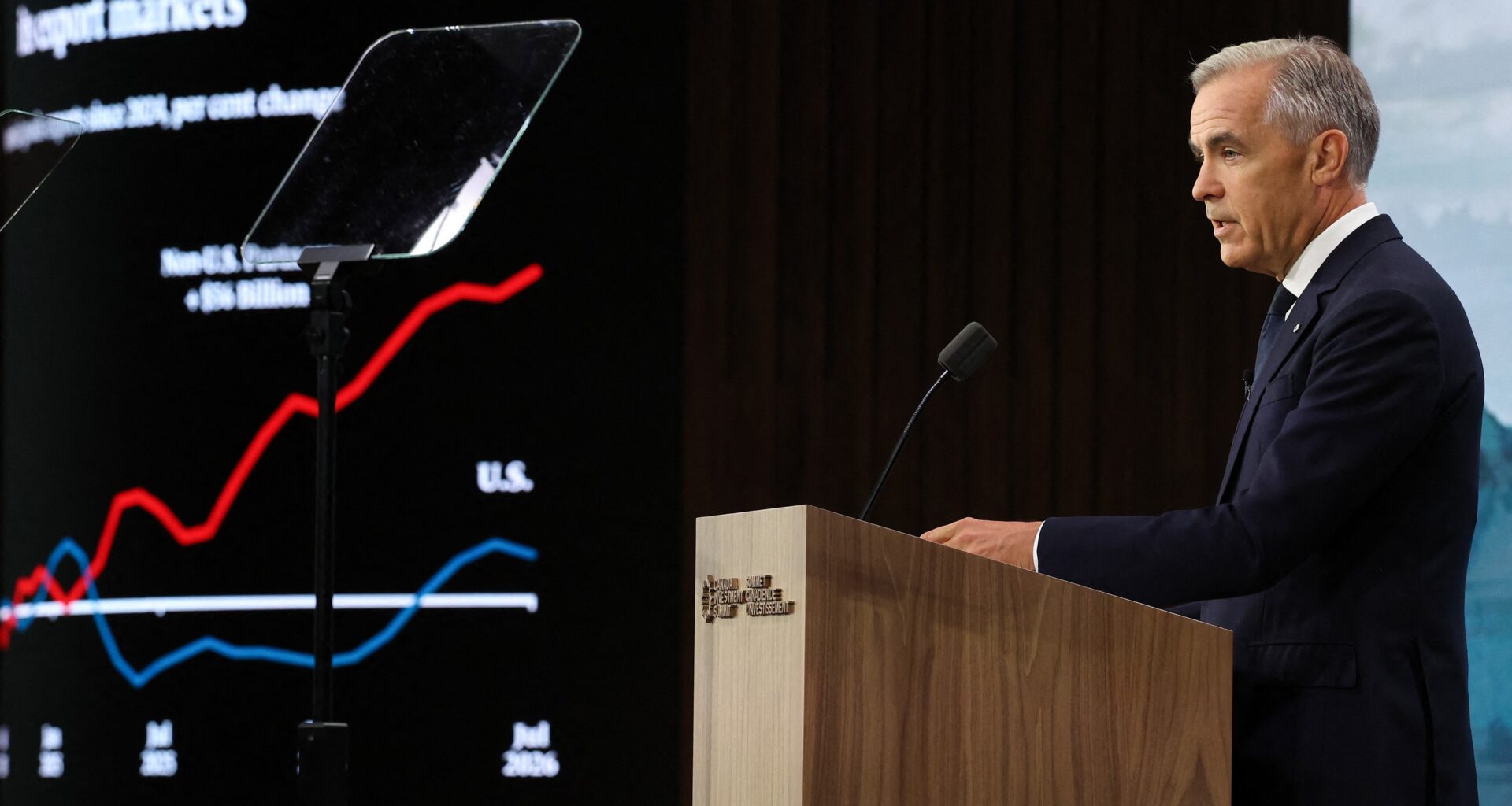
Prime Minister Mark Carney is making a high-stakes but necessary gamble that the federal government can do something it has never before attempted outside of wartime: use its vast spending, taxation, borrowing and convening power to rewire the Canadian economy, in this case away from excessive economic dependence on the U.S. toward more internally generated economic growth and job creation.
That was the central proposition put before the 300 global investment executives who gathered in Toronto for Canada’s first Investment Summit this week. For Quebecers and Montrealers, what unfolded there and what follows next could help to shape where tens of thousands of people work, how modern and resilient our infrastructure becomes, and whether our economy prospers in a world in which an open border with the U.S. is no longer a given, regardless of who’s in the White House.
As Quebec businesses lose markets in the U.S. from Trump’s trade war, the shift to internal growth being engineered by Carney promises to at least soften the blow, and perhaps more. While the much-discussed high-speed rail link between Quebec City and Windsor was conspicuous by its absence at the summit, as was the Quebec premier, there are still tens of thousands of potential jobs for Quebecers in Carney’s Nation-Building agenda. Only 15 of the 167 showcased projects are located in the province, but their collective scale is potentially huge.
Beyond the $11-billion contract and 5,000 direct jobs to build six icebreakers for the Canadian Coast Guard at Davie Shipyard in Lévis, other major initiatives are underway. These include the $49-billion Novatron clean energy project linking Atlantic Canada to Quebec, the proposed $31-billion Kino Aski LNG project, which involves constructing a 1,000-kilometre pipeline to Baie-Comeau, and the $1.2 billion Ashram Rare Earths & Fluorspar project, and many more.
The backing of the federal government is crucial to support and derisk these mostly private sector-driven projects, as well as new investments that could be made by Investissement Québec and La Caisse. When the government of Canada deploys its own capital alongside private and institutional investors — through direct spending, loan guarantees or infrastructure commitments — it absorbs part of the downside risk. A pension fund like La Caisse can more readily underwrite a multibillion-dollar investment in a new energy corridor or a rare-earths mine when Ottawa commits to the building of roads and ports.
The sheer ambition of the investment summit was hard to ignore. The federal government was seeking $1 trillion in private capital over five years. The attendees represented more than 150 core global investment companies from 30 countries who collectively manage more than US$100 trillion in assets. They were shown projects covering mining, clean and conventional energy, transportation, advanced manufacturing, high-tech and more.
Beyond the $280 billion Ottawa has earmarked for new infrastructure and the promised streamlining and speeding up of regulatory approvals to “one project, one review, one year,” Carney also announced a new “productivity mega deduction.” This aims to supercharge new investments in Canada by allowing businesses to immediately expense a much wider range of project-related costs. One senior executive of a large investment fund based in Asia remarked: “What’s most important for us is reducing very long approval times for Canadian projects.”
Present at the summit were Indigenous leaders, who have now secured an unequivocal seat at the big table. It is a clear acknowledgment that progress on major projects would be more costly, politically difficult and time consuming without genuine partnership. As one First Nations representative at the summit said: “Carney’s program will succeed because we are part of it, not only for profit but also as stewards of the land.”
What makes the investment summit and broader nation-building agenda even more remarkable is the expanding role of the federal government in the economy. Even former Conservative prime minister Stephen Harper, invited to close the summit, not only praised the enormous investment bazaar and Carney, but also the widened role for government as part planner and part player in Canada’s emerging 21st-century economy.
This does not mean goodbye to capitalism. Rather, it is an official recognition that private markets alone cannot steer us onto a new path of prosperity. Canada’s now-obsolete economic model was built in an era of 10 working-age people for every elderly person, and on free trade with the U.S. Today, the ratio of working-age to elderly is barely 3-to-1 and falling. Population aging is particularly acute in Quebec. Furthermore, trade with the U.S. is in long-term decline. Canada’s trade with the U.S. as a share of GDP peaked in 2001.
As a result, Canada and Quebec need new sources of growth and jobs. In short, we need a new economic vision and model for the 21st century. Carney’s program of economic renewal — the elimination of interprovincial barriers to commerce, diversifying our trade beyond the U.S., and the nation-building projects — provides this. For Quebec, federal backing for major projects could reinforce the province’s strongest industries, including aerospace, hydroelectric power, AI, mining and education.
The challenge is for the Carney government to maintain momentum and turn investment commitments into tangible jobs and growth — and for the leadership of Quebec to recognize what’s at stake. With Carney having set the stage for economic transformation, including with his other efforts to deepen economic ties with Europe and the Global South, perhaps it is now time for Quebec’s leadership to put aside any differences with Ottawa and move their policy levers in the same direction.
Julian Karaguesian is a Canadian economist, economic advisor, and academic who serves as a Course Lecturer in the Department of Economics at McGill University.
Editor’s Picks