
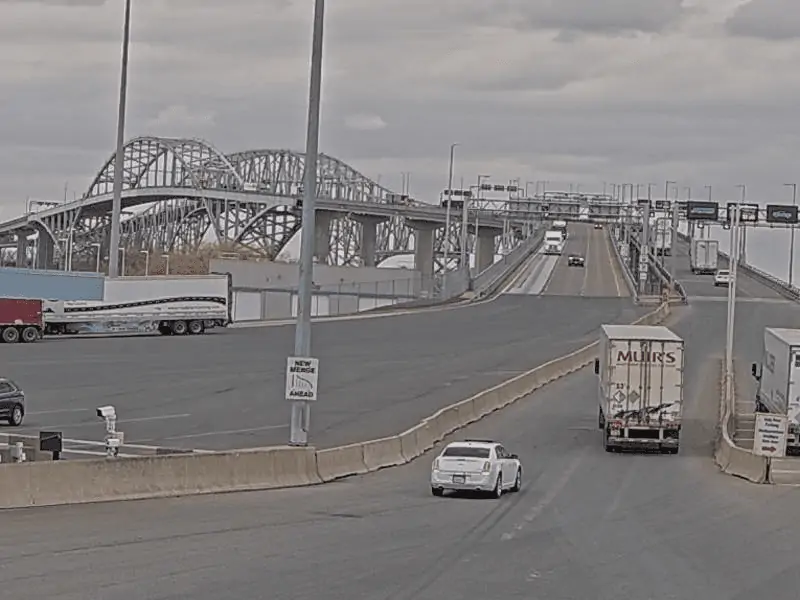
The Blue Water Bridge between Sarnia and Port Huron has emerged as a recurring location in cases involving drug smuggling.
A Brampton truck driver has been sentenced to nine years in a U.S. federal prison after admitting he played a role in a cross-border transportation network moving large quantities of cocaine from California into Canada.
Iqbal Singh Virk, 58, was sentenced Wednesday, Sept. 16, in Los Angeles by U.S. District Judge Sherilyn Peace Garnett after pleading guilty to conspiracy to distribute cocaine and possession with intent to distribute cocaine.
The case began with Virk’s arrest at the Blue Water Bridge in Michigan in August 2024, but the court records paint a much broader picture of his involvement.
According to the federal indictment, Virk was part of a Canadian transportation network that worked with a drug-trafficking organization to move cocaine from Southern California into Canada.
The indictment names Virk, using the aliases “Mark” and “Bill,” along with fellow Canadian trucker Ranjit Singh Rowal. It alleges the pair were among the people involved in the transportation side of the conspiracy, with the organization arranging for cocaine to be moved north across the border.
Virk’s eventual plea agreement went further, acknowledging that the conspiracy involved more than 1,800 kilograms of cocaine being transported from the Los Angeles area into Canada.
That admission is significant because it places Virk’s role within a much larger trafficking operation rather than treating the 2024 border seizure as an isolated incident.
Virk and Rowal operated commercial transport trucks, giving the drug operation a way to move cocaine while appearing to conduct legitimate cross-border business.
The indictment describes a transportation network operating between Canada and the United States and identifies Virk and Rowal among those who carried out acts in furtherance of the conspiracy.
Last 30 Days: 52,384 Votes
All Time: 1,527,212 Votes
4083 VOTES
If a federal election were held today, what party would you vote for?
The case was part of the wider U.S. investigation known as Operation Giant Slalom, which involved numerous defendants and led to arrests in Canada, the United States and Mexico. The RCMP said in 2025 that Virk and Rowal were among three Canadians arrested in the United States as part of the investigation. Authorities said the investigation resulted in the seizure of more than one tonne of drugs.
For Virk, the operation came to an end on Aug. 28, 2024, when his truck reached the U.S. side of the Blue Water Bridge.
A search of the truck uncovered a concealed compartment containing approximately 95 kilograms of cocaine and 20 kilograms of heroin.
The drugs were being transported toward Canada, according to the case against Virk and Rowal.
The seizure ultimately led to the federal prosecution in California, where Virk later agreed to plead guilty.
Virk appeared in U.S. District Court in Los Angeles in September 2025 for his change-of-plea hearing. The court calendar identifies him as being in custody and records that a Punjabi interpreter was present. His lawyers included John Hanusz, while federal prosecutors represented the government.
Judge Garnett sentenced Virk to 108 months — nine years — in federal prison.
The sentencing proceedings included sealed material. The court placed protective restrictions on information that could identify confidential informants, cooperating witnesses and cooperating defendants involved in the investigation.
As a result, some of the material considered during sentencing is not available publicly.
Virk’s co-driver, Rowal, previously pleaded guilty in the same investigation and was sentenced to 37 months in U.S. prison.
The broader investigation continues to involve numerous defendants and allegations of an international cocaine-trafficking operation. The RCMP said Operation Giant Slalom involved arrests and investigations across several countries.
But for Virk, the case has now resulted in a nine-year federal prison sentence after his admission that he was part of the transportation network used to move more than 1,800 kilograms of cocaine from California toward Canada.
INsauga’s Editorial Standards and Policies
Stay in the know.
Subscribe now to receive our daily email of today’s top stories in your city!