
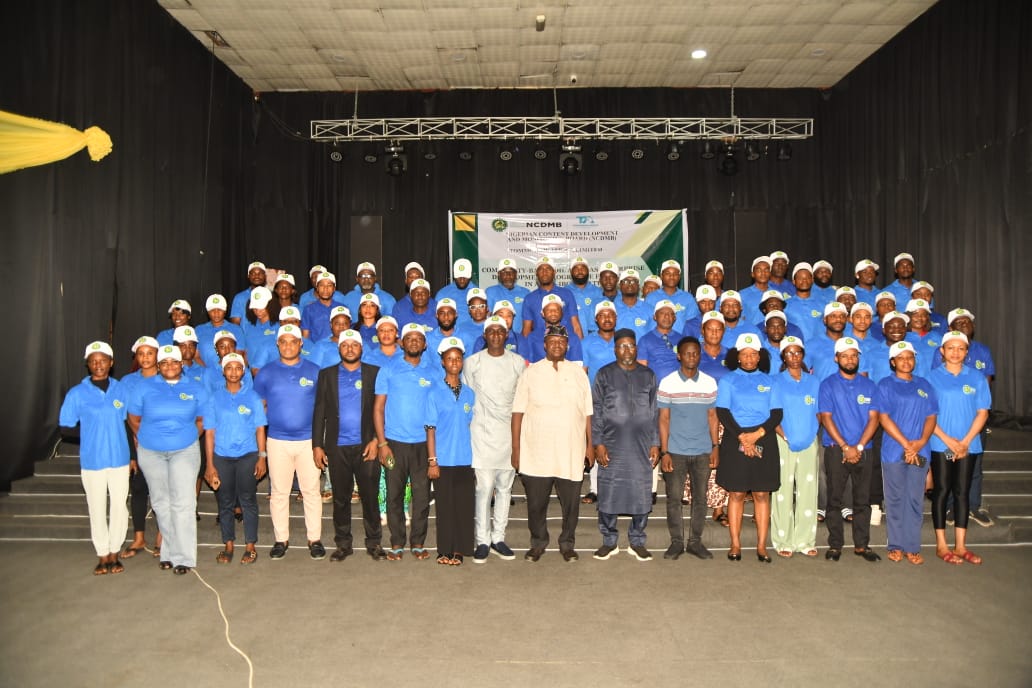
…100 beneficiaries each from Abia, Akwa Ibom, including persons with disabilities
By Ibrahim Hassan-Wuyo
The Nigerian Content Development and Monitoring Board (NCDMB), in collaboration with Tommorow Africa Limited, has trained 200 young Nigerians under its Community-Based Oil and Gas Enterprise Development Programme.
The initiative is aimed at equipping youths with entrepreneurial skills and strengthening local participation in Nigeria’s oil and gas value chain.
The capacity-building programme was held in Abia State from August 25 to September 4, 2026, and in Akwa Ibom State from September 7 to 17, with 100 participants trained in each state.
Beneficiaries were drawn from host communities and included young men and women as well as persons with disabilities, reflecting the programme’s focus on inclusion and community development.
The organisers said the programme was designed to provide participants with practical skills, industry knowledge and resources to establish sustainable businesses and take advantage of opportunities within the oil and gas sector.
The Abia phase attracted representatives of NCDMB and other government and industry stakeholders.
Mrs Sarah Adaobi Ugochukwu, Director, Produce Department, represented the Abia State Ministry of Trade and Commerce.
Oil and gas industry stakeholders, particularly members of marketers’ associations, also supported the programme and participated in field visits organised for the beneficiaries.
The field component exposed participants to industry operations and provided opportunities for them to interact with operators and other stakeholders across the oil and gas value chain.
In Akwa Ibom, the programme received the support of the state government, with the Ministry of Environment and Mineral Resources represented by the Director of the Petroleum Department, Engr. Anietie Emah.
According to the organisers, the programme was designed to bridge the gap between young people in oil-producing host communities and economic opportunities within Nigeria’s energy industry.
The training focused on practical enterprise development, identification of business opportunities, innovative solutions to challenges in host communities and sustainable economic development.
Participants also received mentorship from industry experts, business development and entrepreneurship support, access to relevant networks and practical field experience.
The organisers said the programme would provide beneficiaries with a platform to transform viable ideas into businesses capable of contributing to job creation and local economic growth.
Eligibility for the programme was targeted at young people between 18 and 35 years with a minimum qualification of SSCE, NECO or its equivalent.
Both male and female applicants were eligible, while female participation was particularly encouraged. Beneficiaries were also required to commit to completing the training and field-experience components.
The inclusion of persons with disabilities was intended to broaden access to economic opportunities and ensure that disadvantaged groups were not excluded from skills acquisition and enterprise development initiatives.
The programme also aligns with efforts to strengthen indigenous capacity and increase community participation in opportunities within Nigeria’s oil and gas industry.
Beyond technical and entrepreneurial training, the initiative seeks to help participants identify viable business opportunities, establish sustainable enterprises and develop solutions to economic and social challenges in their communities.
With 100 youths trained in each of the two states, the organisers said the programme would create a pool of young entrepreneurs capable of applying their knowledge and practical experience to businesses across the oil and gas value chain.
The partnership between NCDMB and Tommorow Africa Limited is also expected to strengthen host communities by creating pathways for skills acquisition, entrepreneurship and sustainable livelihoods.
The broader objective, according to the organisers, is to empower communities, build local capacity and develop sustainable enterprises that can contribute to Nigeria’s oil and gas sector and the wider economy.