

Higher mortgage payments are putting growing financial pressure on Canadian homeowners, according to new findings from the 2024 Canadian Housing Survey, a joint initiative of Statistics Canada and Canada Mortgage and Housing Corp.
Statistics Canada’s analysis of the survey found that 26.1% of homeowners with a mortgage were living in unaffordable housing in 2024, up from 23.6% in 2022. Housing is considered unaffordable when shelter costs consume 30% or more of a household’s before-tax income.
More than one in three mortgage holders, or 36.2%, also reported experiencing financial difficulty because of higher mortgage payments over the previous 12 months, up from 28.3% in 2022.
Among households that bought their first home between 2019 and 2023, 27.4% were living in unaffordable housing in 2024, while 34.1% said higher mortgage payments had caused financial difficulty, more than double the 16.4% reported among recent first-time buyers in 2018.
Affordability dissatisfaction among the group also increased sharply, with 33.1% saying they were dissatisfied or very dissatisfied in 2024, compared with 13.4% in 2018.
First-time buyers still stand apart
A separate CMHC analysis of the same survey found that recent first-time buyers remain relatively unlikely to be in core housing need.
“Mortgage qualification requirements act as a strong affordability screen,” CMHC said, adding that “only households with sufficient income, stable employment and manageable debt loads can enter ownership.”
Just 4.6% of first-time homebuyers were in core housing need in 2024, compared with 6.0% of other homeowners and 22.1% of renters.
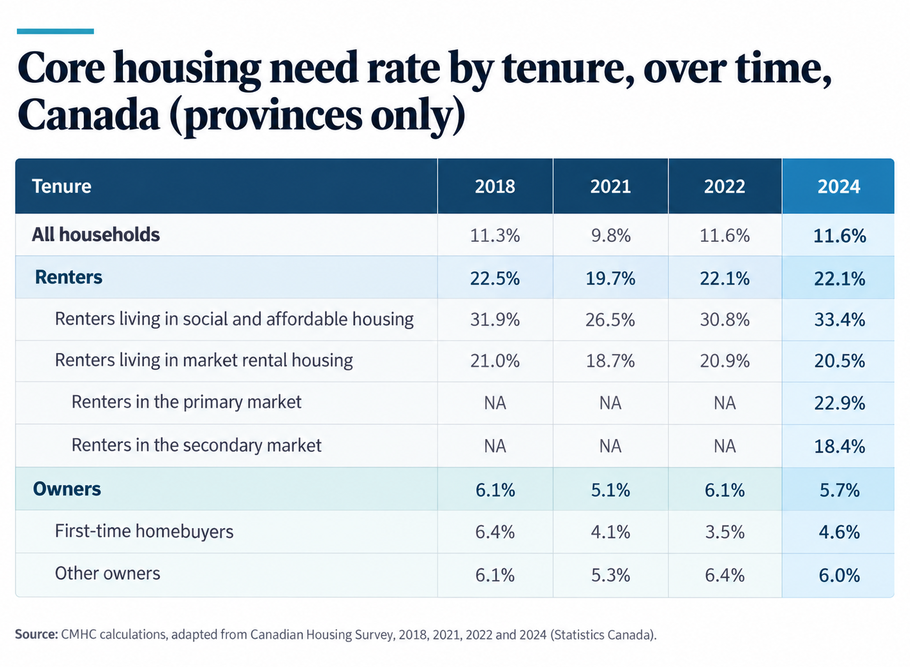
Unlike the 30% affordability threshold, core housing need also considers housing adequacy and suitability, as well as whether a household could afford suitable alternative housing in its community.
CMHC noted that recent first-time buyers tend to be 25 to 34 years old, have relatively high incomes and have an employment rate of about 91%. They are also more likely than other mortgage consumers to receive financial help from family or friends for a down payment.
Mortgage costs drove the latest affordability deterioration
Mortgage holders drove much of the deterioration in housing affordability between 2022 and 2024.
Across all Canadian households, 23.2% were living in unaffordable housing in 2024, up from 22% two years earlier. Statistics Canada said the increase was driven by homeowners with mortgages, while the unaffordability rate among private-market renters was unchanged over the same period.
Homeowners with mortgages also recorded the sharpest increase in dissatisfaction with affordability. Some 28.2% said they were dissatisfied or very dissatisfied in 2024, nearly matching the 28.9% rate among private-market renters, a group that has historically reported higher levels of dissatisfaction.
The survey period captured the impact of borrowing costs that remained well above the ultra-low rates available during the pandemic. Statistics Canada noted that fixed-rate mortgages due for renewal in 2025 had originally been taken out when the Bank of Canada’s policy rate was at or below 1%.
“Higher rates may continue to have an impact on affordability perceptions of mortgage holders in the future,” the agency said.
Visited 6 times, 6 visit(s) today
affordability affordability crisis Canada Mortgage and Housing Corporation canadian housing survey CMHC Dashboard statcan statistics canada
Last modified: September 21, 2026