
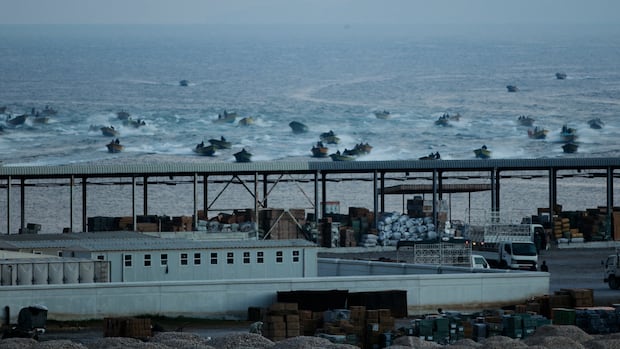
In Rouzhbeh Akhbari’s new film, Of Wool and Diesel, an armada of small speed boats pull into port. Dozens and dozens of the craft keep coming. It looks like an editing trick, or maybe AI. Where on Earth could this flotilla of small boats be landing, and why?
The answer is the Port of Khasam, in the Omani exclave of Musandam, on the Strait of Hormuz. And the reason is black market sheep.
Akhbari is a man with a couple different vocations. On one hand, he’s an artist, who originally went to school for sculpture before moving to filmmaking. But he’s also a geographer, working on his PhD at the University of Toronto. Of Wool and Diesel, an art film being shown at Mercer Union, combines both of those disciplines. As a geographer, the Tehran-born, Toronto-based Akhbari studies “infrastructural corridors” and trade routes that connect parts of the former Soviet Union, like Southern Russia, Central Asia and the Caucasus, to the Persian Gulf and onward into India. But he didn’t discover the trade in illicit sheep between Iran and Oman through his academic work. He discovered it when he was running errands with his mother.
“My mom is a pensioner from Iran, and because of sanctions, you can’t really get your pension in a bank account here in Canada, so you have to work through these intermediaries that are currency exchange shops,” he says. It was at one of these shops where he first learned of the world of sheep smuggling.
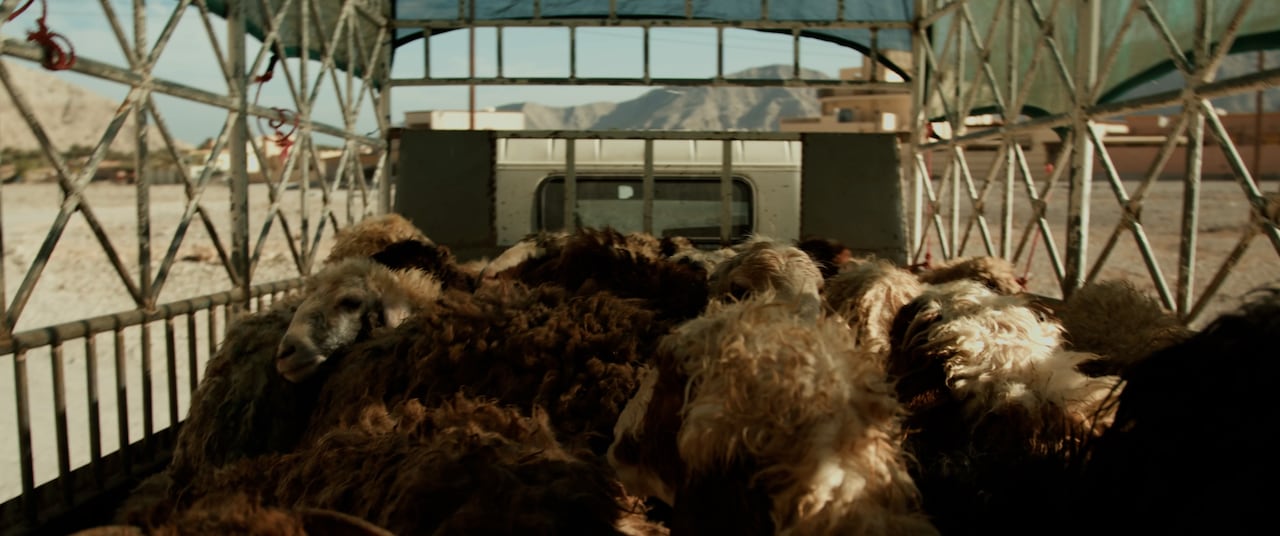 Sheep in transit in Rouzbeh Akhbari’s Of Wool and Diesel. (Rouzbeh Akhbari)
“The woman just said it in a very joking way… ‘Oh, you want your hawala, your transaction, to go through Kuwait or Georgia?’”he says. “I said, ‘What’s the difference?’ She kind of half-joking said, ‘The ones that go through Kuwait are as an exchange of sheep.’ I was like, ‘What do you mean?’”
He never got a complete answer on the specific mechanics of how a sheep trade in the Strait of Hormuz becomes cash at a counter in suburban Toronto, but the big beats of the illegal sheep game are as follows: because of state subsidies on things like livestock feed and diesel fuel, sheep are cheaper in Iran than in many of its Arab neighbours. You can buy a sheep in Iran for the equivalent of about $50. In Kuwait — the final destination for most sheep illegally leaving Iran — that sheep can sell for around $500. As a result, sheep smuggling has become a lucrative industry in the south of the country. Around 2,000 speedboats a day, and approximately three million sheep a year, made the voyage prior to the current conflict in the region, crossing the straight near its narrowest point, landing at Khasam.
The smugglers themselves are mostly young, in their late teens or early 20s at the oldest, and they’re recruited via Instagram.
“I follow a lot of accounts where it’s just upbeat music and promises of not only cash, but also prestige in the sense that if you are a good sailor and you can smuggle well, then you get girls or whatever,” he says. “A lot of the intrigue of smuggling and this obsession with speed.”
It’s also dangerous, the shooti, as the smugglers are known, are in a high stakes game of cat and mouse with the Iranian Navy and Coast Guard, who are trying to keep the subsidized sheep in the country and will open fire on the smugglers. At one point in the documentary, a voice over tells the story of how a group of shooti were killed by a navy ship.
 Filmmaker Rouzbeh Akhbari (Courtesy Rouzbeh Akhbari)
Akhbari made a documentary about the strait’s illegal sheep trade, Crossings, which came out last year, but felt like “there’s still this itch inside of me that there’s all these poetics of infrastructure, of space, that needs to be told in a way that a documentary like Crossings simply cannot do.”
He adds that when he talks about “the poetics of infrastructure,” he means the “the story of a railway or a highway or a maritime corridor from the perspective of people who actually use it.”
Mercer Union curator and head of exhibitions Aamna Muzaffar started talking seriously about the project with Akhbari when he was still going back and forth between Toronto and Oman, doing fieldwork in late 2023 and early 2024.
He told her “there were so many aspects of his research, his fieldwork that were not going to make the cut” for being in the documentary, she says, and that there were parts of the story that “he couldn’t attend to in the space of like an experimental documentary, that maybe require space or that maybe require more time.” She commissioned him to make an art film about the straight to help fill in some of those gaps
Alison Glenn, the curator of the Toronto Biennial, says that this year’s theme is “rupture as an ontological tool,” or a way to explore the nature of being. As soon as she read Akhbari’s proposal, she knew it “was in complete alignment with the curatorial team.”
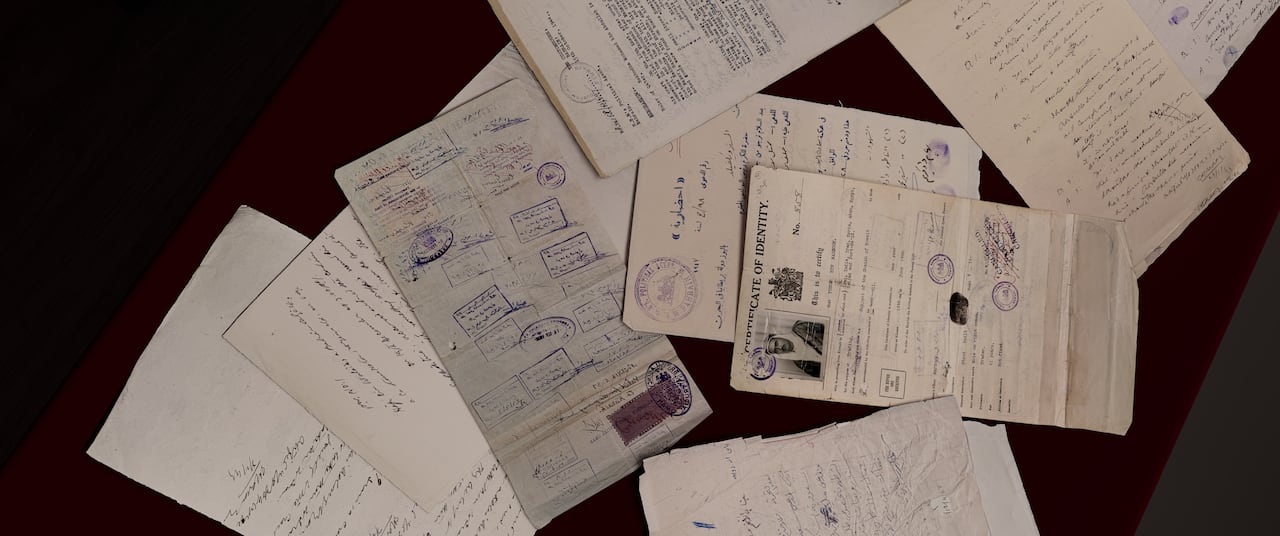 A still from Rouzbeh Akhbari’s film Of Wool and Diesel. (Rouzbeh Akhbari)
She says that the way he came across the story, while picking up his mother’s Iranian pension at a money changer in North York, “just felt so potent.” It’s a way that people in the Iranian diaspora have managed to work around the rupture between Iran and the U.S. She adds that “knowing that she could get [her pension] in sheep, and understanding that that was kind of the impetus for Roozbeh to dive into the kind of research project, which is so exciting for me.
And while Crossings looked more at the mechanics of the trade, Of Wool and Diesel places it in the broader history of the Strait of Hormuz, and tries to recreate the emotional tenor of the trade.
“I became really interested in this idea of being almost lost in the horizon,“ he says, adding that because the shooti operate in radio silence to avoid coast guard detection, they communicated with each other using light beacons.
“I wanted this film to feel that way, that between this transmission of light, between this rhythm of sunrise and sunset, between the rhythm of the lighthouses, a lot of all these activities are happening,” he says. “So I wanted the film to have that vibe, that it’s about being lost in navigation lights in the middle of a dark maritime space.”
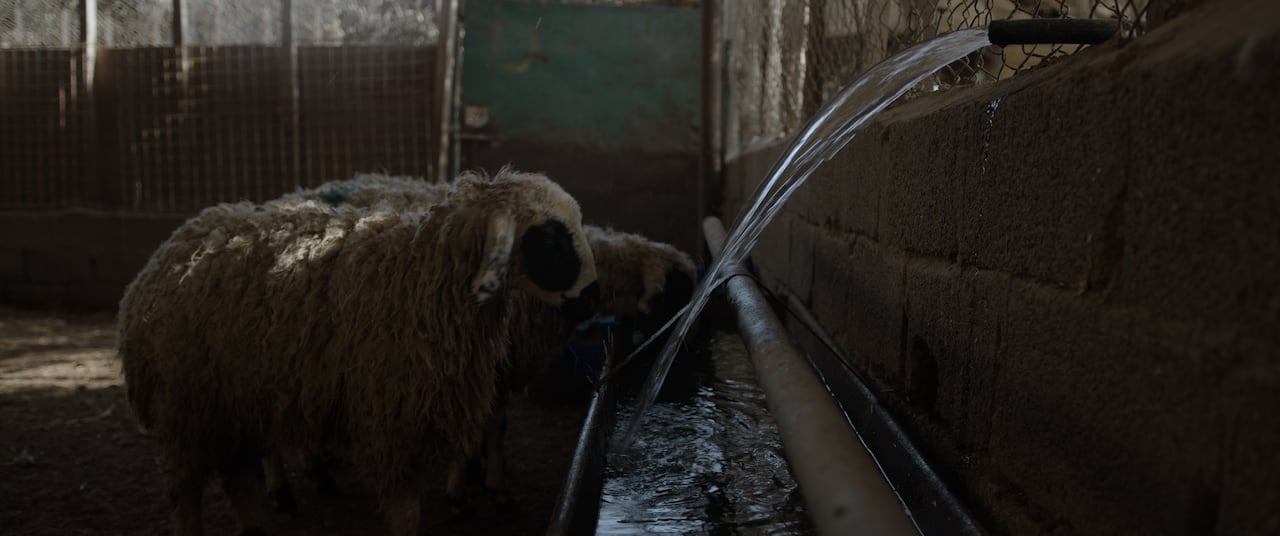 A still from Rouzbeh Akhbari’s film Of Wool and Diesel. (Rouzbeh Akhbari)
Those same light patterns will be surrounding the film when it shows at Mercer Union. The space where the film is shown will feature a series of traditional namad, or felt rugs, depicting the standard code of maritime navigation lights.
“When you see them, they seem familiar in terms of their aesthetic quality, but also a bit odd because they’re diagrams and not these kind of very ornate um sort of motifs that you might typically find in a namad,” says Muzaffar.
The space will also feature 36 postcards, based on drawings of the strait by a 19th century British naval officer and hydrographer.
Akhbari has been studying the strait for years, long before it became a flashpoint in the simmering hostilities between Iran and the United States. One might think that given the tension and occasional bouts of serious violence, the smuggling routes would be shut down. But instead, the opposite has happened. Khasam is the only foreign port accessible to Iran. The navy and coast guard have totally backed off enforcement, and for the shooti, it’s a bonanza.
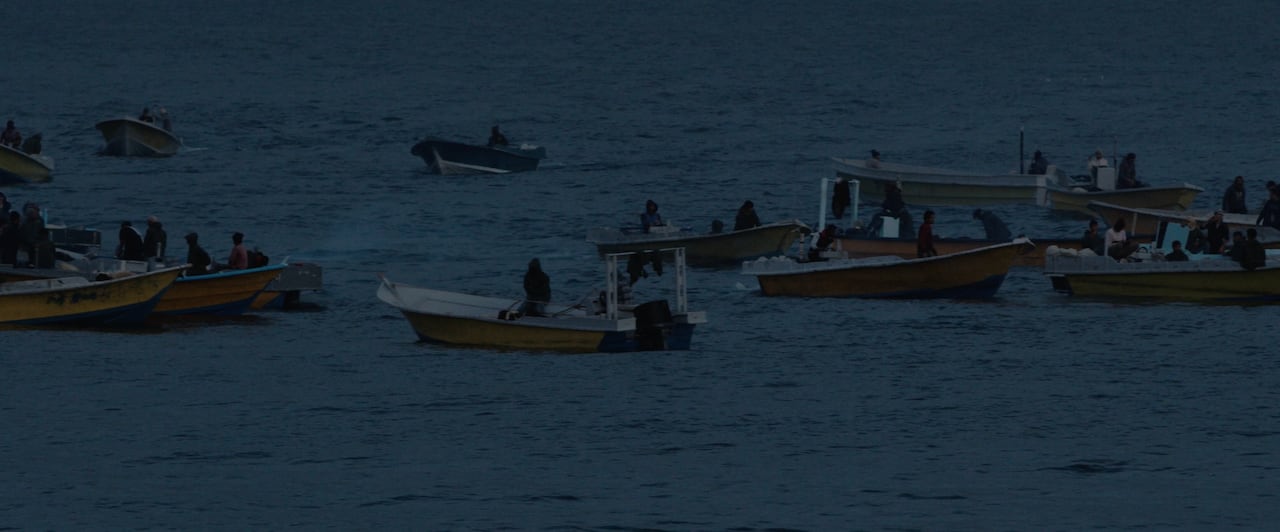 A still from Rouzbeh Akhbari’s Of Wool and Diesel. (Rouzbeh Akhbari)
“Now, instead of 2,000 boats a day, maybe there’s 10,000,” he says. “Most of my friends that I talk to who are in this line of business, they used to get around $10 to $15 per trip, so they would make three trips maybe per day. Now that number is almost $70 … they’re making a lot of money, and that’s the kind of reward you can get. If you risk learning a passage, you’re going to be an expert on it, and when comes a crisis like now, suddenly it explodes.”
Still, he says, everyone knows the smuggling gold rush won’t last forever.
“That’s how states usually take advantage of informal work,” he says. “When they need it, they tolerate it, and when the mafia of the state wants to make money, then they start clamping down again. So it’s really easy to take advantage of people’s lives and livelihoods when you need them, and then when you don’t, you just discard them again.”
Of Wool and Diesel runs from Sept. 26, 2026 – Jan. 23, 2027 at Mercer Union Gallery (1286 Bloor St. W.) in Toronto as part of the Toronto Biennal of Art.