
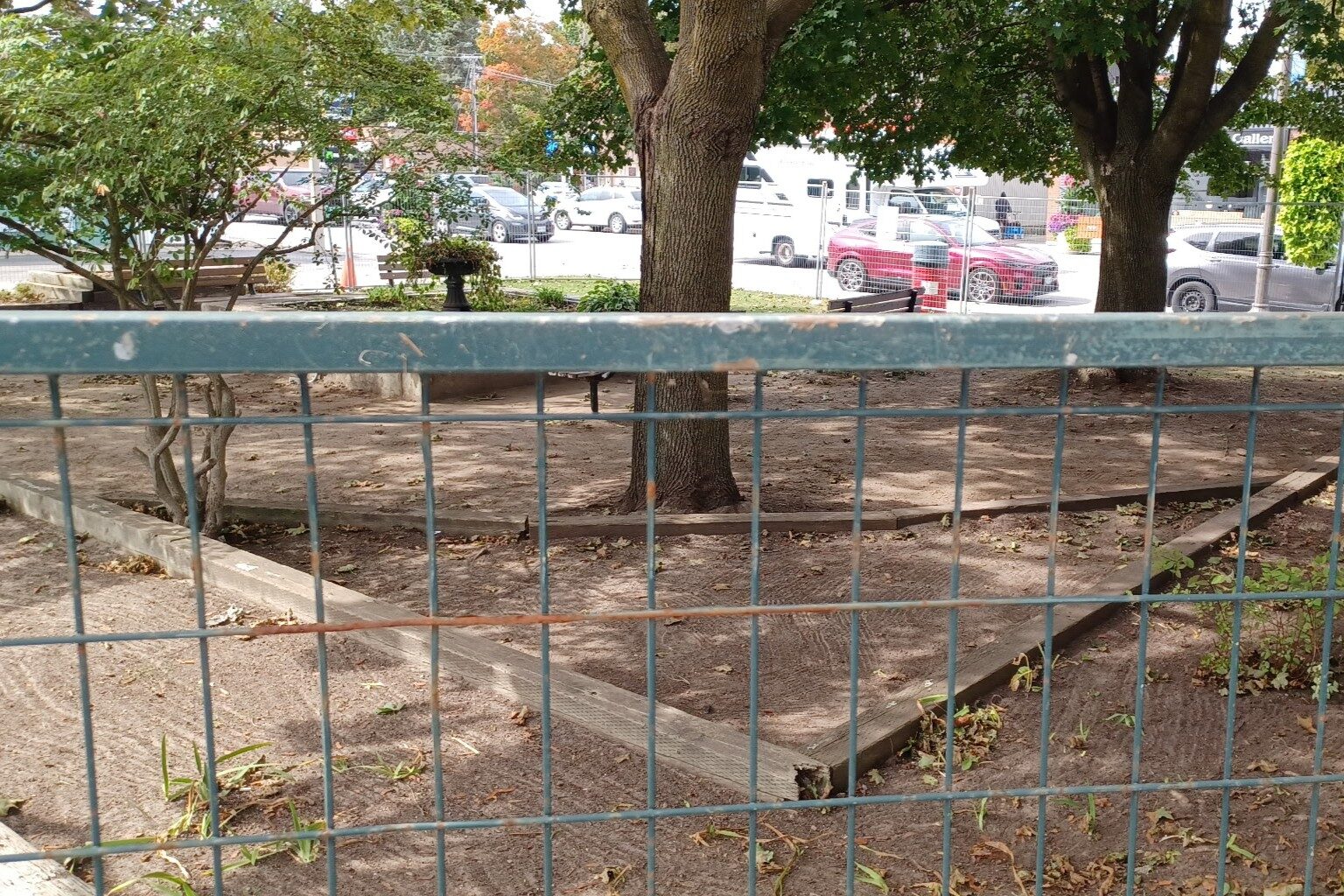
A Port Elgin parkette, which until this summer had been best known as a place to eat an ice cream or spend an idle moment under shade trees, is now clear of a homeless encampment and fenced off.
As many as a dozen tents sprang up in Police Parkette starting around July 1. There have been encampments elsewhere in the community but never on the main street and never the focus of such disorder, said Jon Fee, whose office is beside the parkette.
Fee, CEO of the Saugeen Shores Chamber of Commerce, said in an interview that he watched what started with one woman who pitched a tent in peaceful protest for homeless rights in Saugeen Shores eventually become a party zone with open drug use.
Saugeen Shores announced Sept. 18 that the park was closed while the town “undertakes necessary repairs, maintenance, and improvements at the parkette. At this time, the length of the Police Parkette closure is unknown as the town considers further improvements to the parkette through the 2027 business plan process.”
It didn’t mention the homeless encampments which Fee said have been the focus of concern among downtown business operators and tourists all summer. Fee said after seeing the problem getting worse, he reached out to the mayor and the county.
“I just felt they weren’t doing anything about it,” he said. While people regularly brought food and water and paramedics visited often, “It was a go-to place, a stop-off place to do drugs. That’s what it ended up being.”
He said the initial woman’s protest involved posting signs, including one that said “’More tents coming.’ And they were putting up empty tents in some cases,” he said. He thinks the prominent downtown location and decision to pitch empty tents was itself a statement.
“It literally was becoming a party central because then it seemed like, it was OK for everybody under the sun to come in and start doing drugs and whatnot and I saw it first-hand.” He shared a picture of a man bent forward over the back of a bench in the parkette.
Fee runs the chamber office and also the Service Ontario office in the same building. Tourists and those visiting the government office frequently remarked on the disorder in the parkette, he said.
“It was devastating hearing every other person walk into the Service Ontario complaining about the smell and the foulness and the drugs — all the stuff that was going on in that encampment,” Fee said.
He said he started noticing fewer members of the business community dropping by his office, deterred by of what was going on in the parkette. He said the encampment problems got worse amid uncertainty of what could be done, given the rights of homeless people.
In May, the Superior Court of Justice in Ontario confirmed a 2023 Ontario Court decision involving Waterloo Region that said municipalities cannot clear homeless encampments if they don’t have adequate alternative housing for them.
“Solutions to the homelessness crisis will require increased resources from all levels of government and other stakeholders, time to implement the required strategies, and a clear recognition of and focus upon the constitutional rights involved,” the decision said.
Fee said “we all understand that. We all empathize and what seemed to be going here though is a whole lot of us were wanting to do something to help out and just feeling that there wasn’t anything to be done.”
He also said “People are more concerned about doing the wrong thing and trying to do the right thing.”
Fee said businesses around the parkette saw fewer customers due to the encampment. Tourists who visited the chamber office would talk about “how did this ever happen? How did Port Elgin ever have an encampment. How’s it ever been that this encampment is in the downtown?”
Near the end of August, Saugeen Shores Police Chief Kevin Zettel issued a statement about homelessness.
“We recognize the growing concern surrounding homelessness and the visible encampments in our community,” he said. He noted homelessness is a complex issue and it’s a provincial responsibility, managed by the county.
And while enforcement “may sometimes be necessary to address immediate risks or safety concerns, our focus remains on working with our municipal, county, and provincial partners to provide compassionate, coordinated, and effective solutions that respect the dignity of all individuals.”
Fee said the town fenced the parkette on Friday and workers were back Monday to do some raking. He said there’s little of the grass that used to be there, the flowers are gone and the ground is mostly dirt.
He understands authorities have been trying to find housing for people living in the encampment for the past four to six weeks.
By the lunch hour Monday, Fee had begun hearing expressions of relief that the encampment was gone and the park was back. He feels it too. “I mean, just having the evidence of what was there gone is a huge change,” he said.
“I’ll tell you that there’s this massive feeling of relief to actually come into the office and see the park there. Even though it’s nothing but dirt,” Fee said. “It’s a major relief to come in and see that there’s something being done about that.”
A Saugeen Shores spokesperson said the town didn’t clear the parkette but it closed it once a lone occupant vacated the site. More than a dozen people “were supported by finding safer, more stable housing.”
Those who had been there earlier “either accepted support through Bruce County or moved on prior to the decision to close the parkette. Bruce County and its service partners delivered frequent, coordinated outreach at the location.
“The Outreach team worked closely with each person to connect them with immediate, short-term solutions. This includes emergency shelter, health care, food programs, and outreach services such as housing, legal and income support.”
Saugeen Shores offered to store encampment dwellers’ belongings, she said.