
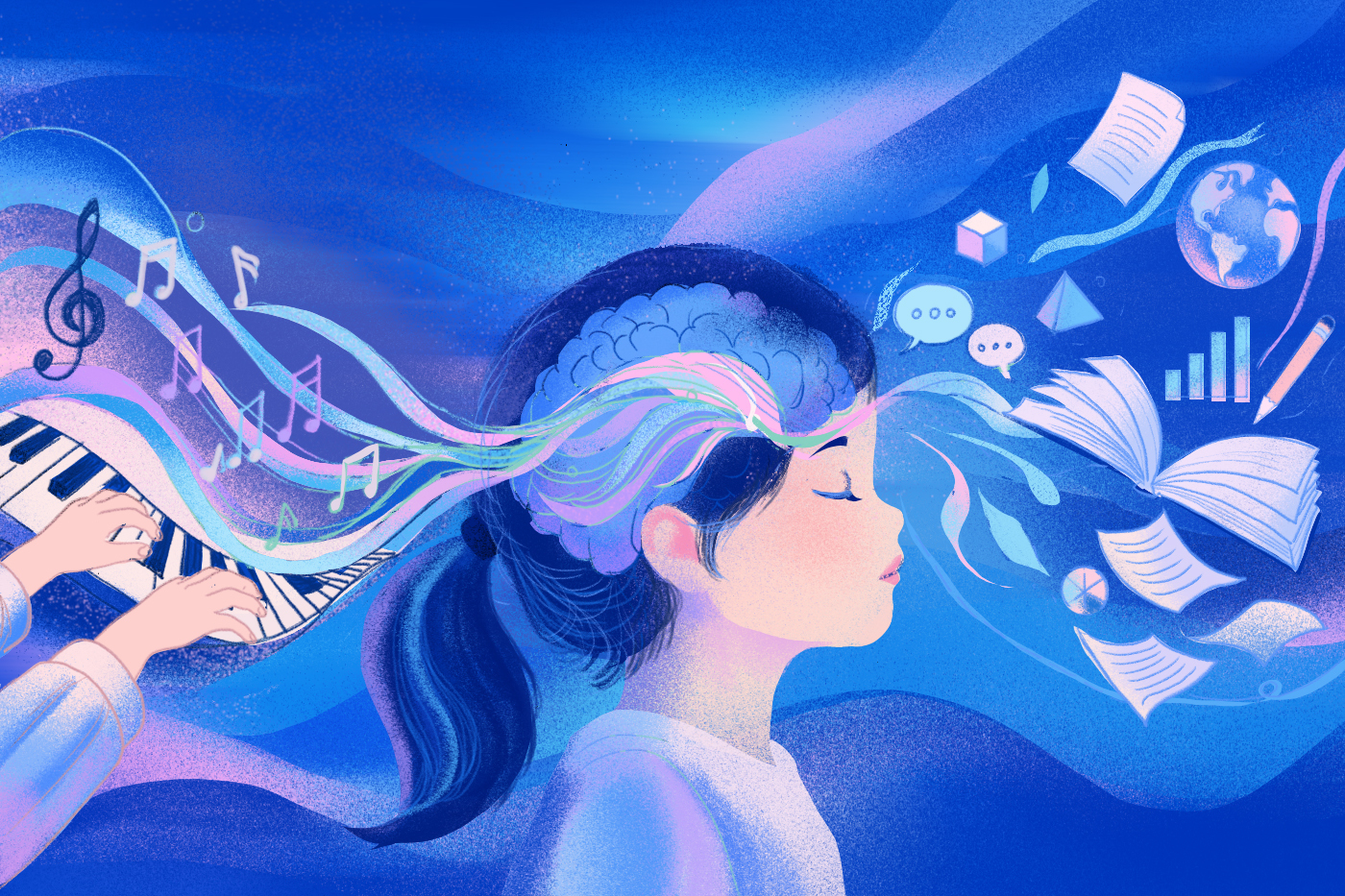
Sitting through an eight-year-old’s shaky rendition of Christian Petzold’s “Minuet in G” may be music to a proud parent’s ear. To everyone else at the recital, it might not sound like encore material.
Behind those wobbly notes, however, a far more complex mental production is underway — and the skills it exercises may reach far beyond music.
A new study by Northeastern University researchers titled “Musical training is associated with cognitive outcomes and white matter microstructure in middle childhood” suggests that regular music practice leaves a distinct signature in a developing child’s brain. The young musicians, aged 7 to 9, also outperformed their peers on tasks involving vocabulary, math and working memory.
The idea that “music makes you smarter” has a long history in science, said study leader Northeastern music professor and director of the MIND (Music, Imaging, and Neural Dynamics) lab Psyche Loui.
“That culminated in findings that people called the Mozart effect,” she added.
A slew of baby Mozart CDs that promised to cultivate geniuses and prenatal tapes that offered a head start right in the womb followed in the decades after.
Research did suggest that all those hours of piano practice don’t go to waste, even if you don’t end up being the next Liberace. Some past studies linked musical training to stronger cognitive skills, while others connected it to differences in the brain.
Loui’s team wanted to see how all the pieces fit together in the same children.
“We were trying to address how music training shapes the brain,” she said.
The team turned to existing data from 76 children — 38 of whom practiced an instrument for at least 30 minutes a week, while the other 38 did not. Most played piano or a string instrument.
The children first completed three sets of tests. The first measured general intelligence, language skills, spatial reasoning, and visual and auditory learning. The second tested working memory. The third covered reading, spelling and math.
Northeastern Global News,
in your inbox.
Sign up for NGN’s daily newsletter for news, discovery and analysis from around the world.
On the whole, the musical bunch knocked it out of the park on a broad range of measures, achieving much higher test scores all around, the researchers found.
“We’re seeing these benefits even at such an early stage,” said Kelsie Lopez, a Northeastern psychology postdoc and co-first author of the study. “It’s not like you need to have 20 years of experience.”
“It’s really quite striking,” Loui added.
The study can’t prove that the music lessons caused the differences. To do that, the researchers would need to assign children to music training at random and compare the results. But it does raise questions. What’s going on behind the scenes in the brain? Could differences in its structure help explain the higher test scores?
 Northeastern University professor Psyche Loui studies the cognitive benefits of music and its connection to the brain. Photo by Matthew Modoono/Northeastern University
To get a closer look, the researchers turned to existing brain scans from 50 of the children. The scans used a method known as diffusion tensor imaging, or DTI. It tracks how water moves through various types of brain tissue and maps the organization of white matter — bundles of long nerve fibers that carry signals between various parts of the brain. The fatty coating called myelin wrapped around the strands gives white matter its color and helps signals travel more quickly, kind of like insulation around an electrical wire.
Because water flows more easily along the fibers than across them, its movement reveals the direction and organization of white-matter pathways.
“It’s a way to look at the flow of water through the brain,” Lopez said.
The team focused on the arcuate fasciculus, a bundle of white-matter fibers connecting regions involved in listening with those that help produce speech and movement.
Damage to the pathway can cause language problems, including difficulty repeating spoken sentences, Loui said.
When the research team analyzed the scans, they found a possible difference in the right arcuate fasciculus. Among the musical group, water diffusion followed a more linear, tube-like pattern rather than a flatter, pancake-like one.
Lopez described the finding as consistent with a stronger connection between the brain regions that process sound and those that coordinate speaking and muscle movements.
However, it remains to be seen if the difference can explain the higher test scores.
Whatever future studies reveal, playing an instrument is quite the mental juggling act.
“Learning music repeatedly exercises attention, working memory, planning, self-management, listening and adapting,” Anita Collins, founder of the musical education and advocacy organization Bigger Better Brains, told Northeastern Global News.
“These are skills children use across their whole school day, not just when they are learning music,” she said.
Many of those abilities are known as executive functions — the mental skills used by the brain for focusing, remembering instructions, planning and shifting between tasks.
The intricate finger acrobatics involved in playing a run of spiccato strokes with a violin bow or rippling across a piano keyboard with both hands provide an excellent training ground for honing attention, task switching and similar skills.
“I think music training really helps executive function because of the demands that it places on your brain,” Loui said.
Researchers also agree that music brings people together and creates social motivation.
“Playing in an ensemble is great practice for how to be part of a positive community,” said Jessica Zweig, executive director of Play On Philly, a music education organization.
“Kids must come prepared to do their part and rely on others in the section to do the same,” she added.
Katya Poltorak is a science reporter at Northeastern Global News. Email her at e.poltorak@northeastern.edu.