

Listen to this article
Estimated 4 minutes
The audio version of this article is generated by AI-based technology. Mispronunciations can occur. We are working with our partners to continually review and improve the results.
A committee of Red River Valley municipalities is proposing farmers who don’t follow best practices to protect their soil from erosion could pay for cleanups after future storms hit.
The cleanup from May’s windstorm is still not done, after municipalities ran out of money.
Four rural municipalities in southern Manitoba are still waiting to hear whether they will qualify for provincial disaster financial assistance after topsoil blew off fields, clogging hundreds of kilometres of drains.
“I think most farmers realize what the solutions are, but if there’s no consequence, they’re going to continue doing it the way they’ve done it in the past,” Montcalm Coun. Harold Janzen said.
He has been farming for over 50 years and owns Marsh River Farms east of Morris.
Janzen’s fields held onto most of their topsoil because he leaves crop residue in the ground, even adding shoulder crops in the fall to let small roots take hold before planting his cash crop in the spring.
Having a law similar to Alberta’s, putting the onus on property owners to prevent soil loss, would be good for Manitoba, he said.
 Harold Janzen is a Montcalm councillor. The RM is part of a committee of municipalities proposing farmers who do not take steps to mitigate soil erosion be held responsible for the costs of cleaning up dirt blown or flooded into drains. (Christopher Gareau/CBC)
“If we can expect more of these two-day windstorms, any of our municipalities can’t afford to subsidize, (and) the ratepayer can’t be subsidizing the cleanout of the ditches,” Janzen said.
The rural municipalities of Montcalm, Morris, Emerson-Franklin and Rhineland all asked for disaster financial assistance after May’s windstorm. None have received a reply from the province.
“The province has no further update at this time,” a spokesperson said in an emailed statement.
“Manitoba continues to review municipal requests related to the windstorm, a decision to establish a program has not yet been made.”
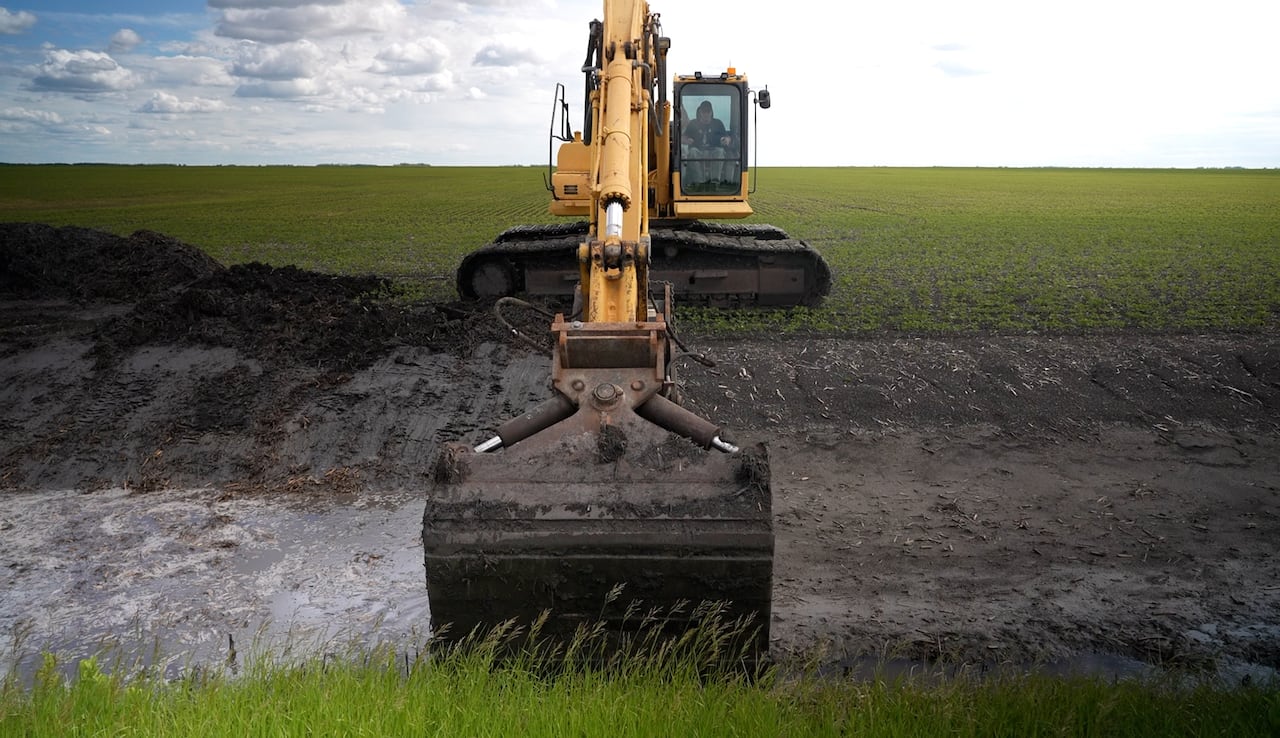 An excavator digs thick mud and debris out of a Montcalm ditch on June 22. (Christopher Gareau/CBC)
Each RM has spent hundreds of thousands of dollars, which they said is a huge hit to their budgets because of their small populations.
Emerson-Franklin has a population of 2,500 people. The RM paid $200,000 that wasn’t in its budget to get only three-quarters of its drains cleared before it halted the work, chief administrative officer Tracey French said.
Rhineland’s CAO, Michael Rempel, said it has paid $350,000 to remediate 136 separate sites in a municipality with 6,000 people.
Most agriculture producers adjust to changing climate conditions. More farmers are burning off less residue and planting shoulder crops to hold onto the exposed soil in fall and spring.
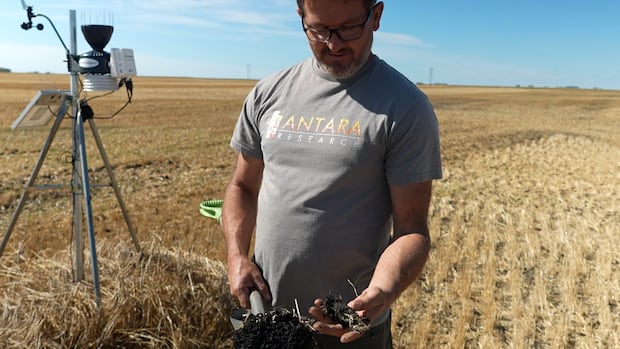
Brunelle Sabourin’s data-gathering company in St. Jean Baptiste, 75 kilometres south of Winnipeg, is helping farmers prepare for El Niño, which could produce a warm, dry winter and set up conditions for another dust storm.
WATCH | Potentially putting onus on property owners to prevent soil loss: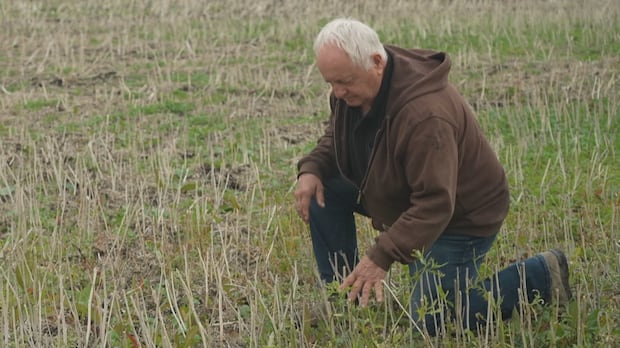
Farmers could pay for future cleanups after storm blows RM budgets
A committee of Red River Valley rural municipalities is proposing that farmers who don’t follow best practices to protect their own topsoil could be held responsible for paying to clean up messes left by soil erosion.
Antara Agronomy is telling its farmers to leave more crop residue to protect the topsoil from a freeze-thaw effect that breaks up dirt.
“All of those soil aggregates and leaves kind of a fine powder on top of the soil surface. And that’s what we saw this spring with those really extreme winds, is a lot of that soil started moving,” Sabourin said.
Antara has a series of small weather stations measuring wind, precipitation, soil moisture and more throughout fields in the south Red River Valley.
Combined with new cultivation equipment, Sabourin said farmers he works with are able to adjust how they treat their soil, field by field.
 The Montcalm, Morris, Emerson-Franklin and Rhineland municipalities all asked for disaster financial assistance after May’s windstorm. None have received a reply. (Chelsea Kemp/CBC)
He said that affects more than only yields and profits.
“We don’t want to do anything that has a negative effect on the land because when a farmer looks at their legacy that they want to leave and pass down to the next generation, we want to leave everything in better condition than when we took it on,” Sabourin said.