
Legendary Radio-Canada news anchor Bernard Derome is synonymous with the iconic phrase “Si la tendance se maintient …” (“If the trend continues”), which he would use in prefacing who appeared headed toward election victory.
With just over a week to go, it looks like the polling trend of the past three years is maintaining, with the separatist Parti Québécois led by Paul St-Pierre Plamondon headed toward victory on Oct. 5.
PQ support sits at only 29 per cent overall but 36 per cent among francophone voters — crucially, 13 points ahead of the closest rival — in a province where 90 of 127 ridings are more than 80 per cent francophone.
With four main parties dividing the rest of the vote, the péquistes — like the Coalition Avenir Québec before them — could win a majority despite a very low popular vote total.
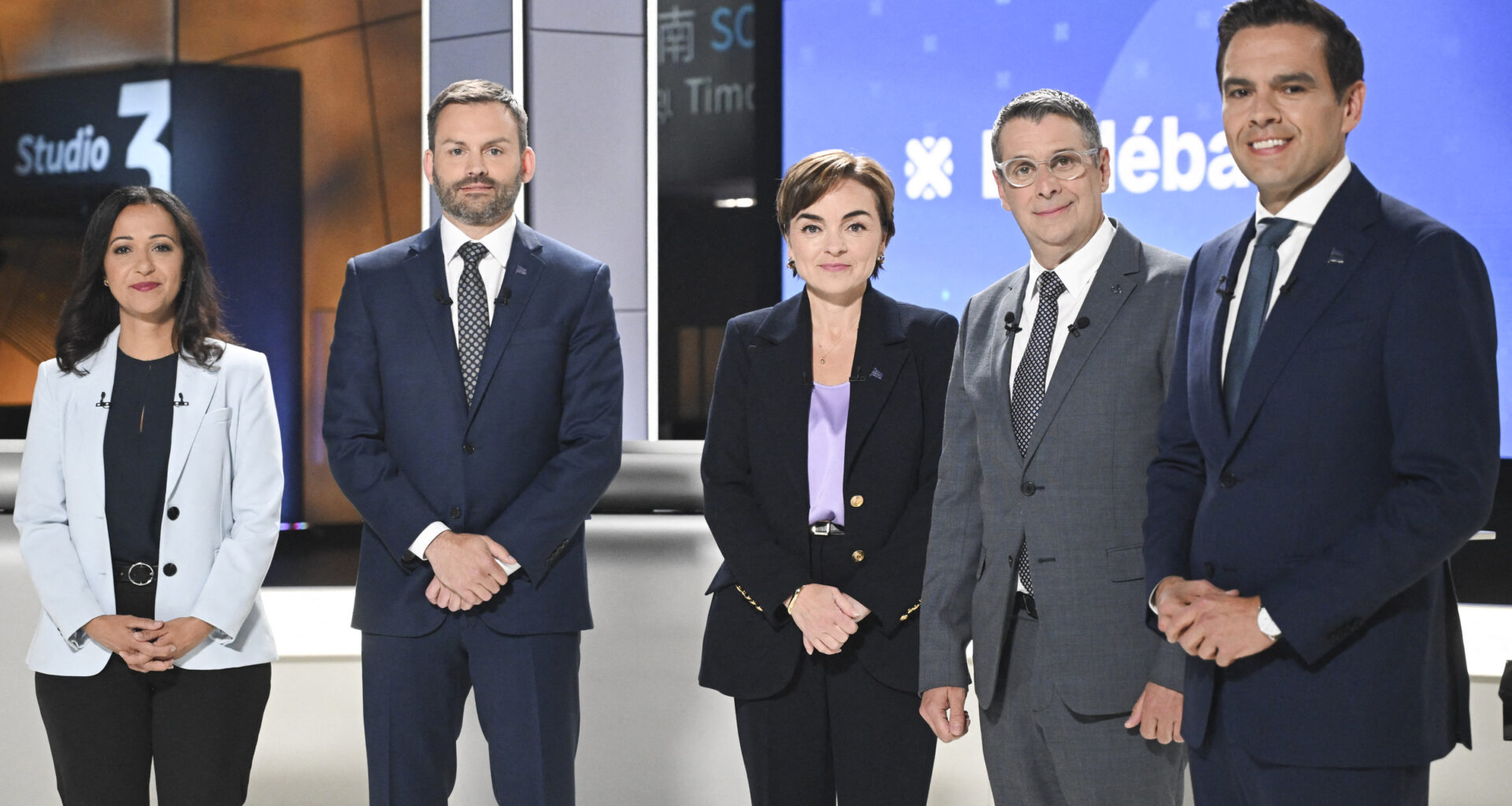
 The five main party leaders pose before their third and final debate at Radio-Canada this week. From left: Ruba Ghazal (Quebec solidaire), Paul St-Pierre Plamondon (Parti Québécois, Christine Fréchette (Coalition Avenir Québec), Éric Duhaime (Conservative Party of Quebec), and Charles Milliard (Quebec Liberal Party). GRAHAM HUGHES / POOL/AFP via Getty Images
Many potential PQ voters don’t necessarily want the party’s promised sovereignty referendum, and may have figured they could vote it down later — or presumed a PQ win would fall short of a majority, making a referendum unlikely. Now that polls show the party is flirting with a possible majority, will the sobering experience of the voter booth cause many to back off?
And what about the 40 per cent of still undecided voters?
There is still time for some movement in the final week, with so many variables, parties and vote-split scenarios at play. If so, is it enough to change la tendance? And who would benefit?
An overwhelming majority of the electorate want a change of government and seemingly can’t bring themselves to vote again for the CAQ. New leader Christine Fréchette doesn’t have one of those “neuralyzer” devices from the Men in Black movies to zap Quebecers’ memories of the past eight years.
Conservative Leader Éric Duhaime has benefited from this existential dilemma for francophones, solidifying his standing considerably and seemingly poised to win seats around Quebec City. Can he make gains elsewhere?
According to polls, Liberal Leader Charles Milliard hasn’t yet been able to break through. Despite his personal attributes and experience in health care and the economic sector, as well as the strength of his team, it seems much of the francophone electorate still associates the Liberals as le parti du West Island.
Although affordability, health care and the economy are top of mind, perceptions about who is best placed to protect Quebec’s identity seemingly remains an Achilles heel for the Liberals and a factor for many francophone voters.
But the polls could be underestimating Milliard’s numbers. Some francophones are shy to tell pollsters they support the Liberals, who often get a bounce at the ballot box. His name recognition is ascending, and one must also consider the ground games of the parties, which can count for a few points.
In any case, the Liberals are pretty much guaranteed at least 20-25 seats, enough for official opposition status. Maybe the best scenario for Milliard would in fact be a second-place finish. Fiscal and economic difficulties in governing, for any party today, are almost insurmountable.
A PQ government would face significant challenges in delivering positive change, and over the next few years PSPP’s brand would undoubtedly get dented. He would be hard pressed to convince electors that independence would be the solution at that point. In the meantime, it would give Milliard time to further establish his name, put his stamp on the party and hone political skills as opposition leader in the legislature.
Editor’s Picks
The last PQ election win was 2012. Pauline Marois formed a minority government with the Liberals as official opposition, and the CAQ and Québec solidaire also winning seats. Marois called an election two years later and was soundly defeated by Phillippe Couillard, who had become Liberal leader a year earlier.
Couillard initially trailed badly among francophone voters, but he hammered away at the government and its raison d’être of separation, which eventually took centre stage in the campaign. Polls ultimately swung dramatically toward Couillard — helped along by Pierre Karl Péladeau’s infamous fist-pump — and started a PQ downturn.
A PQ win may be disconcerting and breed uncertainty for a few years. But it would also severely test the party’s ability to make good on its promises to improve the lives of Quebecers and likely expose the vulnerabilities of its overall vision.

Robert Libman is an architect and planning consultant who has served as Equality Party leader and MNA, mayor of Côte-St-Luc and a member of the Montreal executive committee.