
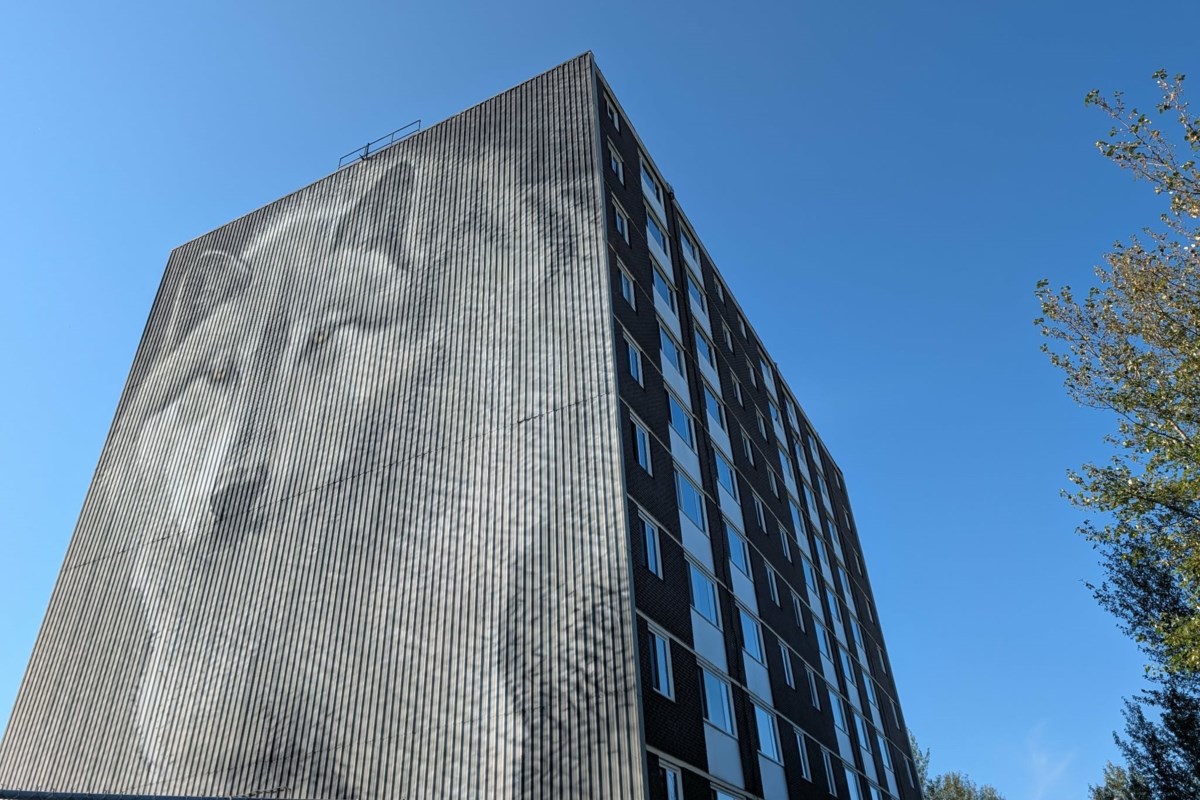
Thompson’s wolf-themed attractions—ranging from a 10-storey mural to Canada’s largest rockface sculpture—remain prominent landmarks, even as signage is removed and maintenance needs grow across the trail and statue network
We know about the fall of the Roman Empire.
A community champion is a passionate advocate who drives a project forward, works with others, secures resources, and removes roadblocks from conception to completion. These opening statements are part of the following guessing game.
Where am I?
The coordinates: -97° 51′ 19″ W, +55° 44′ 36″ N, or better still use the UTM system Zone 14U Easting 418800, Northing 6178200.
I went there recently because I have a strong connection and affection for them.
How do “big idea community projects start anyway?
For the nickel mining community, it began with a 10-storey side of an apartment building, a reproduction of a wildlife painter Robert Bateman sketch.
Completed in 2005, it was one of many wolves on the Spirit Way, the two-kilometre walking and biking route in the fourth largest and most northern city in the “Friendly Manitoba.” It has about13,000 residents; it is the hub of northern Manitoba.
Google: Wolf Capital of the World.
It was well on its way to having the bragging rights.
You have the answer, and this story is about the rise and fall of a tourism concept in that community.
Wolves and Mining
In many places, tourism is not considered a real industry. They have been mining and smelting nickel in Thompson (the stack ceased in 2018) since 1956. It’s a mining town.
The wolf mural is definitely a landmark like no other. The image of the wolf looking down on travellers as they leave Thompson driving south on Mystery Lake Road (provincial highway #6) is one you won’t soon forget.
The idea was to create the largest mural in Canada on the north side of the Highland Tower apartment building.
The mural is a copy of a painting by the famed wildlife artist, Robert Bateman, ten stories 86 feet (26 m). It remains the largest photorealistic mural, meaning it is from an original work of art, in Canada.
But when the mural was finished in 2006, “Thompson was not ready for what was to transpire,” says Volker Beckmann, author of The Spirit Way Story – A Showcase of Thompson’s Assets. He has real passion for Thompson. He came to the community early in life, when his father was a plumber, and there was a surge of housing starts to serve the mine.
As a graphic designer, he did not go to Montreal or Toronto; he stayed in the north. He became one of a number of community advocates who took on the task of moving the wolf concept forward through a master plan that he authored. In the original plan, the word “wolf” was not mentioned.
On my way to York Factory for a new adventure, I sat on his front deck to hear some of the story.
Volker said, “The idea of building the Spirit Way Pathway began with a few Thompsonites who wanted to showcase our community in a positive light to increase community pride and to draw in tourists heading to Churchill each year.” (It is one of the world’s destinations to see polar bears, and you can get on the train in Thompson, which I did recently, actually in Gillam more than 200 km up the line.) In Thompson, they created a non-profit – Spirit Way Inc. It was created to help transition Thompson’s economy toward ecotourism as traditional nickel mining faced downturns.
He was referring to a deluge of wolf-related media, research, and wildlife enthusiasm that was initiated by the tall building on the hill, one of the most recognizable tourism icons perhaps anywhere.
The mural is just one of the wolf stories, but it is important to the flurry of economic initiatives that would transpire and remain a testimonial to past efforts.
By accident in June of 2004, Volker was driving down Portage Avenue in Winnipeg when he saw a “beautiful baby’s face on a large mural, four stories high.”
Could that be replicated in Thompson? The next question would be: what image? And who is best to do it? It was the type of question(s) that did not dismay Spirit Way Inc. They were determined.
Chapter Fourteen tells the story in detail. Four images were photoshopped onto the building. These were sent to Bateman for review and approval.
Then significant funding was the challenge. Manitoba Hydro was identified as a potential sponsor, and they came through; it’s not a straightforward story. Fortuitous.
In August 2005, selected Canadian mural artist Charles Johnston started at night to project the Bateman sketch onto the building. Back and forth, using a hydraulic lift with the high-resolution projector to individually paint the eyes, nose, ears and all the animal’s details. There were trials and tribulations; it became the most difficult mural that he had ever painted.
“Charles Johnston’s mural painting of Bateman’s art has become Thompson’s landmark decades after INCO’s spewing 585 ft high smokestack icon fell out of favour in the digital world.” Wherever the viewer stands, close or far away, you think the wolf is looking at you.
Thompson had a zoo too; more on that as the story unfolds, it would change its focus to wolves.
The immense public popularity of the mural kicked off a progressive series of wolf-centric projects.
Shortly thereafter came the Howling Wolves rockface, located near the mural on Mystery Lake Drive. It is a prominent carving of wolves howling at the moon integrated directly into a natural rock face along the Spirit Way trail.
“This job,” Volker stated, “Would require explosives, jackhammers and diamond-tipped saws to shape the sculpture.”
Reading the book for details, the first blast went sideways. “It was much bigger than expected. Spectators felt a massive surge of air hit their chests. The heavy rubber mat blew off the wall and landed on the road. One lamp post on the highway median was seen flying into the air. Large football-sized rocks were propelled a hundred feet into the sky and landed in the grassed area of the park like meteorites.”
The eventual sculptor imported 55,000 pounds of Indiana limestone to his monument studio in Belleville, Ontario. Three months later, and at a weight of 19,000 pounds, the tandem of howling wolves was ready to be bolted into the new rock face.
Plans were also considered to start a Canadian Centre of Aboriginal Art, which Volker says is still part of the plan, phase two, to create more carvings along the remaining rock face.
If you are there at sunset, the wolves come alive with a beautiful glow from the cream coloured limestone.
It stands as Canada’s largest rockface sculpture, celebrating the community’s identity as the self-proclaimed “Wolf Capital of the World”
Then came the statues.
The moulded concrete sculptures were not originally in the plan. The idea came from 62 painted bears in Winnipeg in 2005.
But each bear weighed 10,000 pounds and cost each sponsor $10,000
Spirit Way took a different approach, pared down the weight and the price and the project took off, twice over, two offerings.
Apart from one break, over 13 years, 56 statues were poured and moved. Sponsorship and painting followed. A provincial GPS treasure hunt evolved with a passport book. Really neat.
Each statue has a plaque and a short story. (The ravens are my favourite.) They are everywhere in the small city, outside the mall, schools, seniors’ homes, the RCMP, the municipal centre and on it goes.
There’s the Tom Jackson story. In 2015, the well-known Indigenous actor and singer came to town for a benefit concert to support the wolf capital initiative. He asked about the statues and requested to have his photo taken beside each one, all 37 of them. More promotion. More fundraisers, more links to wolf researchers ensued.
Momentum
Back in 2009, Thompson’s then mayor declared the city the “Wolf Capital of Canada.”
Meeting weekly, the Spirit Way volunteer team examined how the city could be formally recognized as the Wolf Capital of the World – it became the objective. Wolf researchers at the time, from major wolf organizations (such as the International Wolf Centre in Ely, Minnesota) and many other scientists, supported Thompson’s idea.
What followed was a wolf development strategic plan (frequently referred to as the initiative to build Thompson’s “wolf economy”) that was started in February 2012.
Headed by Spirit Way, it was designed to formally transition the northern mining town into the “Wolf Capital of the World,” a wolf research center of excellence, including an enclosed wolf habitat.
In short order, the following timeline.
In 2004, the master plan was developed, followed by the iconic wolf mural in 2005, then the first 26 wolf statues in 2006. The wolf mural lighting was completed in 2008, and the provincial GPS wolf statue hunt began in 2009. In 2010, the Friends of Spirit Way formed, and the next year there was a Thompson Zoo analysis. In 2012, a wolf sighting reward program started, and the next year there was some wolf habitat preparation and a USA wolf habitat presentation in Minneapolis. In 2014, the wolf pond and dens were created. Tom Jackson performs in Thompson, and his endorsement builds more momentum. In 2017, there is a UK promotion in Wolverhampton; their civic symbol is the wolf, and the football team is known as the “wolves,” a twinning process was considered. There is a wolf-howling Guinness Book of Records initiative in the community. On September 21, 2017, the city broke the record for the largest number of people howling like a wolf simultaneously.
Along the way, the Thompson Zoo in 2013 announced its transition and rebranding into the Boreal Discovery Centre. The new entity focused on environmental education, local ecology, and outdoor recreation rather than traditional animal captivity. It was intended that a litter of wolf pups would arrive from Ontario’s Haliburton Forest Wolf Centre.
Wolf tourism, research, education, special events and arts and culture became part of living up to the title. “At the time, the wolves here have never been studied,” said Volker. “We didn’t have the conflicts that other areas had, like the Wolf Centre in Ely, Minnesota. We’re a mining town; there are no farmers or ranchers up here.”
In 2018, there was a new highway sign – Wild or Tame – Thompson: Wolf Capital Region. In 2019, the architectural drawings for the Wolf Learning Centre are underway. In 2020, a wolf statue was donated from the UK. In 2021, Spirit Way Inc. ceased.
COVID came along as we know it, and our regular lives stopped.
“If it had been anything else, we probably would now be hosting wildlife conferences (the first International Wolf and Carnivore Conference was held in Thompson in 2012) and drawing wolf researchers from all over the world to come to our wolf habitat and educational centre. The tourism impact would be immense, much like the International Wolf Center in Ely, Minnesota – “Teaching the World About Wolves.” That’s where Thompson was headed. Close but no cigar is the idiom.
“As of this publication, the Wolf Centre of Excellence project sits in waiting and lies in the hands of the City of Thompson and the Boreal Discovery Board of Directors.”
(The Thompson vision is familiar. I have been to Ely, Minnesota twice, taking tourism professionals on a tourism economic junket with FedNOR. Through a Canadian Ecology Centre consulting project, initiated by Liberal MP Benoît “Ben” Serré (French River-Timiskaming was the riding; he served from 1993-2004), some of the Cochrane Polar Bear Habitat (now called) potential visitor statistics evolved. The polar bear facility in Cochrane originally opened as the Polar Bear Habitat & Heritage Village on August 25, 2004. It was at the same time the Canadian Ecology Centre started the Timber Train, the tourism excursion train from Mattawa to Témiscaming, Quebec.)
After the pandemic, one Spirit Way President suddenly passed away, another left, and there was a change in municipal political leadership along with municipal senior managers. The momentum waned.
Upon a visit, the Boreal Discovery Centre and the wolf enclosure look derelict; the chain-link fence remains, and nature is starting to reclaim what was to be.
Close inspection of the wolf sculptures – some are chipped, with concrete pieces missing. Painting is required to restore their prominence. The Spirit Way trail is in need of some tender loving care.
The mural will last for some time, and so will the howling wolves rock face. The wolf capital sign on Highway 6 is no more; they sold the lease.
Tourism defined
The question was why tourism is not considered a real industry.
Laurie Marcil knows she started with NOTO on June 17, 1999, and she became the Executive Director in 2014. Other than ownership, she has a long tourism resume.
Founded in 1929, NOTO is dedicated to promoting a strong nature and outdoor tourism industry. It has two names: Nature & Outdoor Tourism Ontario and its long-standing legacy name: Northern Ontario Tourist Outfitters Association.
But there is this perception when compared to mining, forestry, and agriculture. It is a significant industry in northern Ontario, generating over $3 billion in visitor spending and supporting local businesses and jobs. However, local perceptions are mixed: while recognized as an essential economic driver, the sector historically faces wilderness protection issues, career-perception challenges among youth and ongoing labour shortages.
“Tourism is often overlooked as an industry because it consists largely of independent small and medium-sized businesses without the licensing structures common in forestry and mining. Yet it operates across Ontario and Canada—from urban and rural communities to wilderness areas—supporting jobs and local businesses while generating tax revenue for all levels of government. Its economic contribution clearly establishes tourism as an industry.
“Tourism may also be overlooked because it spans diverse sectors: from accommodations, culinary, skiing, fishing, hunting, and camping experiences to events and attractions. Each of these sectors has an association serving its specific needs, but this sectoral structure may prevent tourism from being recognized as a unified industry.”
Thinking about it, can you name any detailed tourism-themed towns in northern Ontario where the theme is the destination? In Canada, there is Churchill, further north of Thompson on Hudson Bay. I was train-bound after my visit, and there will be a story; there’s a real dichotomy emerging there between polar bear tourism and the proposed mega shipping port.
Tourism is considered “second fiddle,” then. It is treated as less important, secondary, or subordinate compared to another industry, economic sector, or priority. Thompson was on their way to something special.
Nickel currently trades at roughly $16,125 per metric ton (USD) on global markets, driven by its vital role in stainless steel, an important component in lithium batteries for electric vehicles and the “green transition,” and as a critical mineral for renewable energy storage and low-carbon technologies.
Finally
How did I find Volker? Looking at the mural, then the howling wolves, walking the Spirit Way trail, finding all of those wolf sculptures, and the Heritage North Museum, which was closed on the holiday Monday, I knew there was an organized initiative here; someone was behind it. The hunt to find more than 30 (my tally) painted wolf sculptures became an obsession.
On the September holiday Monday, the fire hall bay was open, and I engaged one of the younger firefighters on duty. He had only been in the community for a short while. I was persistent; he went away and found someone who then came out and knew of the Spirit Way book. Presto. He texted Volker, and the next thing I knew, I was looking at the champion of Spirit Way.
You can listen to Volker tell more of the story on the Back Roads Bill podcast episode.
The fall of the Roman Empire took some time. It was the loss of central political control, particularly in the West, a process in which the Empire failed to enforce its rule, and its vast territory was divided among several successor regions. Things change; time and history tell us so, in Thompson and other places.
Within about 17 years, the initiation of a unique eco-tourism community initiative went from promise to demise. The champion volunteers dwindled, as did the political will.
If I were teaching resource-based tourism, and I did at Canadore College, I created the ecotourism course; this Spirit Way book would require reading. It is more than a memoir; it is a case study. It’s the anatomy of a tourism project; you learn from the dots that intersect and those that diverge. The community story is fascinating. You can order it at [email protected]. Each chapter is story after story, the details of progress. You can feel the momentum and the pride.
But Volker won’t go away. He may try again after the next municipal election; theirs is on October 28. New interest and champions are needed. The architectural plans for the wolf enclosure are tender-ready. A new blood infusion is needed; Beckmann knows this very well.
You find community champions by looking for active, trusted individuals who naturally help others and drive local projects forward. We all have them, unsung heroes.
Volker is one of the recipients of the Senate of Canada 150 Medal. The Senate celebrated the 150th anniversary of its first sitting by awarding commemorative medals. The medals were awarded to Canadians actively involved in their communities who, through generosity, dedication, volunteerism and hard work, make their hometowns a better place to live. There were a total of 1500 Senate 150 Medals handed out, including 12 from Manitoba.
The 2025 Spirit Way published book was presented to the Mayor and Council this year; there were no questions.
Back Roads Bill tip when you are in Thompson. Go to the Nelson Road viewing location; there’s a curved structure (canoe or toboggan symbol) made from recycled car plastic, so you can see the wolf mural from top to bottom. The mural is well lit at night. It is those piercing eyes that are the showstopper.
Thompson has the most northern Tim Hortons accessible by road location. The Vale/Exiro smelting stack (500-foot -152 m) remains dormant but is seen on the eastern horizon. There were19,000 residents in the city in 1971; the 2021 population dropped to 12,329 (a 4.7% decrease from 2016).
I have journeyed north to Thompson four times; I drove away from the wolf capital wondering why. Also, still trying to find out who took away the unique tribute to Tom Cochrane, Life is a Highway’ road sign, at the top of the hill, near the wolf mural? The Canadian rocker was born in Lynn Lake. Volker is on it.
Community priorities and projects. Look around; there’s an election forthcoming in our backyards on Monday the 26th.