
We need your consent to load this EBU contentWe use EBU to manage extra content that can set cookies on your device and collect data about your activity. Please review their details and accept them to load the content.Manage Preferences
With winter approaching, should we be concerned about the current situation on the energy markets, particularly for gas and oil? Could Belgium run out of either of these commodities?
Oil and gas: essential to Belgium
In Belgium, the share of renewable energy in total energy consumption is increasing year on year. Whilst it stood at 8.2 per cent in 2016, this share rose to 12.5 per cent in 2025, according to statistics published by the FPS Economy in its “Belgian Energy Data Overview”.
However, fossil fuels still account for the lion’s share of Belgium’s energy sources, at nearly three-quarters. In 2025, oil and petroleum products accounted for 43.3 per cent of primary energy consumption. Natural gas accounted for 24.3 per cent of energy consumption. Other solid fossil fuels were also used, accounting for 5.8 per cent.
We have no choice but to import the oil and gas we need
It goes without saying that Belgium has virtually no natural fossil fuel resources. So, given that petroleum products and gas account for the lion’s share of Belgium’s energy consumption, imports are inevitable.
In 2025, Belgium’s energy dependency stood at 78.6 per cent.
As regards crude oil, Belgium’s three main suppliers in 2025 were Norway, accounting for 23 per cent of total oil imports, Kazakhstan (16.6 per cent) and the United States (15.3 per cent). OPEC countries (11 per cent) followed. The remainder of Belgium’s crude oil was sourced from Guyana, Brazil, the United Kingdom, Angola, Azerbaijan, Canada, Mexico and certain African countries. Since 2022, following the war in Ukraine and European sanctions against Russia, Belgium has been forced to diversify its sources of crude oil supply to compensate for the loss of volumes previously imported from Russia.
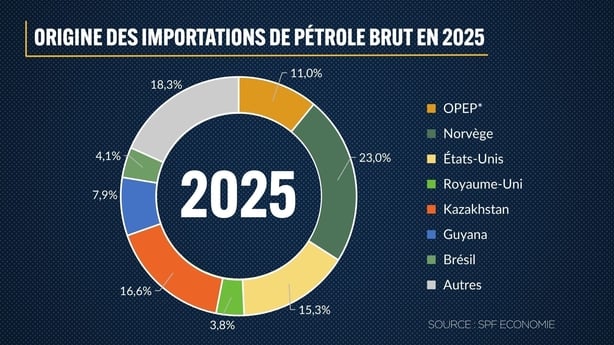
Origins of importation of petrol in 2025
In terms of gas consumed in Belgium, Norway was the country’s largest supplier in 2025. 36.1 per cent of the gas imported into Belgium came from that country. Next came France (16.9 per cent), Russia (11.6 per cent) and the United States (10.8 per cent), with these three countries supplying us in the form of LNG (liquefied natural gas). The United Kingdom, the Netherlands and Qatar were other suppliers.
Russia’s invasion of Ukraine has also prompted Belgium to diversify its natural gas imports. In particular, this has meant importing more LNG, which is shipped by vessel to Belgium. 2027 will mark a further turning point as the European Union has, in principle, planned for a complete halt to Russian gas imports by the end of 2027.
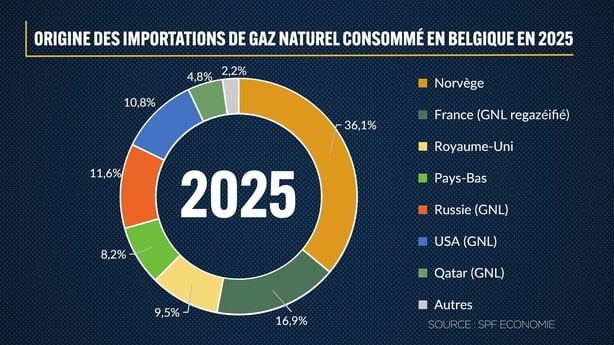
Origin of importation of natural gas consumed in Belgium in 2025
A 90-day supply of oil and petroleum products
If there were a shortage of gas or oil on the world markets, would Belgium have enough to cope?
Belgium maintains emergency oil reserves. This is a requirement it must meet as a member of the International Energy Agency (IEA) and the European Union. These reserves are equivalent to 90 days’ worth of net imports of crude oil and petroleum products.
This crude oil and these petroleum products can be used to address supply issues in Belgium. They may also be mobilised at the request of the International Energy Agency to assist other member countries or to increase the global supply of oil. For example, last March, the IEA asked its members to release part of their strategic oil reserves with a view to curbing the rise in crude oil prices. Belgium, however, did not comply with this request, arguing that the primary role of strategic reserves is to guarantee supply.
When questioned on Monday by Le Soir and De Morgen, Federal Energy Minister Mathieu Bihet (MR) confirmed that Belgium is complying with this obligation to maintain a 90-day strategic stock. “The strategic reserve is sufficient for three months’ consumption,” confirmed Jean-Benoît Schranz, spokesperson for Energia, the Belgian oil industry federation.
This strategic stockpile includes, in particular, diesel. “Our refineries in Belgium produce more diesel annually than we actually need for domestic consumption,” says Jean-Benoît Schranz, which, in his view, rules out any shortage of this type of fuel.
For his part, Francesco Contino, a professor at the UCLouvain Polytechnic School, is less optimistic. Strategic stocks and the proximity of a refinery in Antwerp may not be enough, he believes. “It is a globalised market – or at least a regionalised one – and, as far as refined products are concerned, it will certainly come under pressure in the coming weeks and months. There is a major risk, particularly for the heaviest fractions, such as fuel oil and diesel,” says Francesco Contino.
Gas reserves and a central location
When it comes to gas supplies, Belgium can first and foremost rely on its ideal location at the heart of Western Europe’s natural gas network. The country is therefore connected to various sources of natural gas. Pipelines link Belgium to Norway, the Netherlands and Great Britain. Belgium can also source LNG (liquefied natural gas) via the LNG terminals at Zeebrugge and Dunkirk.
According to the Federal Public Service for the Economy, Belgium’s natural gas import capacity exceeds the country’s needs. This also makes Belgium a transit country for natural gas destined for other neighbouring countries.
In addition to its import capacity, Belgium also has storage capacity. It can therefore rely on a natural gas reserve in an underground facility at Loenhout, north of Antwerp. This facility can store the equivalent of the amount of gas required by Belgium for eight consecutive days of extreme cold. At present, this reserve is not full. Its current fill rate is 59.79%, below the European average (69.62%), with around ten countries reporting gas storage fill rates of over 70%.
The pipeline network managed by Fluxys in Belgium is also regarded as an additional reserve. It is organised “to guarantee peak capacity on a day of exceptional demand, such as occurs once every 20 years”, explains the Federal Public Service Economy.
Based on all this information, the supply of oil or gas should therefore not currently be a cause for concern. That, at any rate, is the message that the Minister for Energy, Mathieu Bihet, conveyed in the interviews he gave to *Le Soir* and *Le Morgen*.
For his part, Francesco Contino of UCLouvain offers a more nuanced view. “It is true that our country is a point of entry, a hub that allows far more gas to pass through our territory than we consume. We consume around a third of what passes through our territory,” he points out. The remaining two-thirds of this gas is destined for neighbouring countries. This leads the expert to argue that having these capacities for gas storage or transit does not necessarily mean that shortages can be avoided. “If you have a pipeline through which you transport a product – like a motorway on which vehicles travel – you cannot simply choose and requisition what is passing through for your own use if you have not ordered what is supposed to be transported,” explains Francesco Contino. “There is a difference between the capacity to transport gas and what we have ordered,” he continues, whilst acknowledging that Belgium’s gas infrastructure “limits logistical risks”, particularly thanks to the various gas entry points across Belgian territory. However, “if there were to be a shortage across the whole of Europe tomorrow, we would not be immune and we would need to show solidarity with all our neighbouring countries,” says Francesco Contino.
An article written by Jean-François Noulet, initially published on 21 September 2026, 17:08 (CEST)