
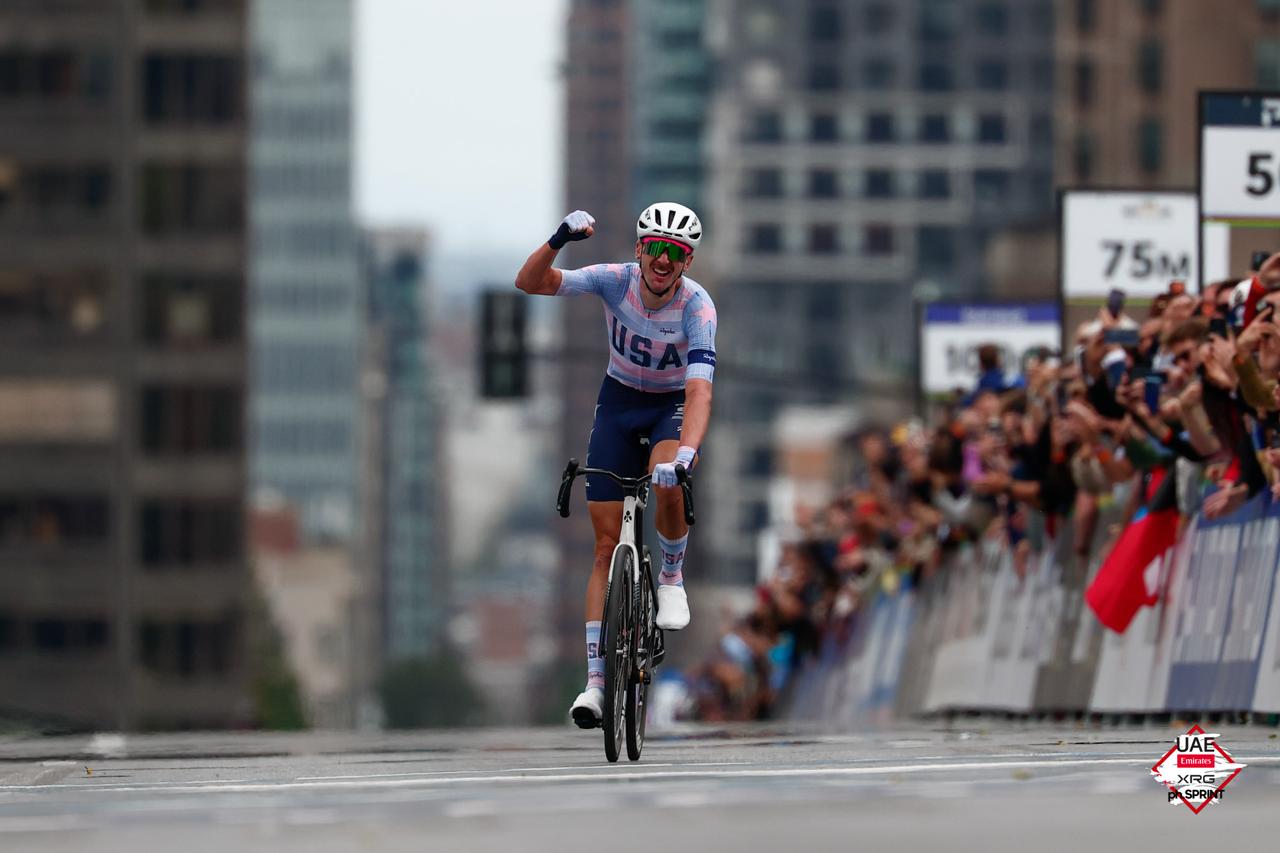
Demi Vollering and Brandon McNulty closed out the 2026 Road World Championships with rainbow jerseys won on nerve. One was caught on the final lap and refused to accept it. The other survived 33 kilometers alone to end America’s 33-year wait.
Brandon McNulty didn’t believe it until the last 300 meters. Twenty-four hours earlier, Demi Vollering didn’t dare look back. Across the final weekend of the 2026 UCI Road World Championships, held in Montréal from September 20 to 27, the two elite road races turned on the same fragile thing: a rider out front, a chase closing in, and a stubborn refusal to accept what the time gaps kept saying.
Both races ran on the same stage. The Mont-Royal circuit, 13.4 kilometers of park road wrapped around the mountain at the heart of the city, carried the riders up the Voie Camillien-Houde on every lap. The climb measures 1.67 kilometers at an average of 7.4 percent, with pitches of 10, and it looks manageable on paper. Ride it eight times, or 12, and it becomes the whole race. Neither winner could hide from it, and neither tried.
A Worlds without its patron
The men’s race arrived with a hole in it. Tadej Pogačar had won the last two editions and would have started as the overwhelming favorite, but injury kept him away, and for the first time in two years the rainbow jersey belonged to nobody in advance. On Sunday it went to his UAE Team Emirates-XRG teammate and friend. McNulty soloed the final 33 kilometers of the 273.4-kilometer race and crossed the line 13 seconds clear of Australia’s Michael Matthews, with Mathieu van der Poel of the Netherlands third.
The history arrived in layers. McNulty became the first American to win the elite men’s road world title since Lance Armstrong in Oslo in 1993. He added the jersey to one he already owned, won exactly 10 years earlier when he took the junior road title in 2016. And by succeeding Pogačar, he ensured that UAE Team Emirates-XRG will have the world champion in its ranks for a third consecutive season. Now 28 and in his seventh professional season with the team, he has spent most of those years as a support rider and a time trialist of real class. On Sunday evening he took the biggest win of his career, in a race perhaps second only to the Tour de France in prestige, and he will carry its jersey for the next 12 months.
Eight riders, one objective
The American squad came to Montréal with more depth than any US team in memory. McNulty, from Phoenix, lined up alongside Quinn Simmons of Durango, Colorado, and Lidl-Trek; Matteo Jorgenson of Boise, Idaho, and Visma | Lease a Bike; Sean Quinn of Los Angeles and EF Education-EasyPost; McNulty’s trade teammate Kevin Vermaerke of Rancho Santa Margarita, California; Artem Shmidt of Cumming, Georgia, and Netcompany INEOS; Larry Warbasse of Traverse City, Michigan, and Tudor Pro Cycling; and Riley Sheehan of Boulder, Colorado, and NSN Cycling.
Depth only matters if riders agree on how to use it, and on the eve of the race they did. “We made a plan last night,” Jorgenson explained afterward. “We set our egos aside a little bit, and we decided, we just wanted an American to win this race.” The plan was simple in outline and demanding in execution. Simmons would follow the heavyweights when they moved and neutralize whatever they started. Jorgenson and McNulty would sit tight, let the rest of the favorites spend themselves, and wait for the race to come back together. McNulty said the team had been telling anyone who would listen for weeks. “We’ve said for weeks now that we have a super strong team, and that is possible,” he said. Few outside the team had taken the claim seriously.
The long way around
The race began the way the women’s race had the day before, rolling out of Brossard, south of Montréal. The 184 riders from 61 nations crossed the river and covered a loop of roughly 100 kilometers before they reached the circuit, where 12 laps waited. The total came to 273.4 kilometers, 169 miles, and the repeated trips up the Camillien-Houde pushed the day’s climbing to 3,803 meters.
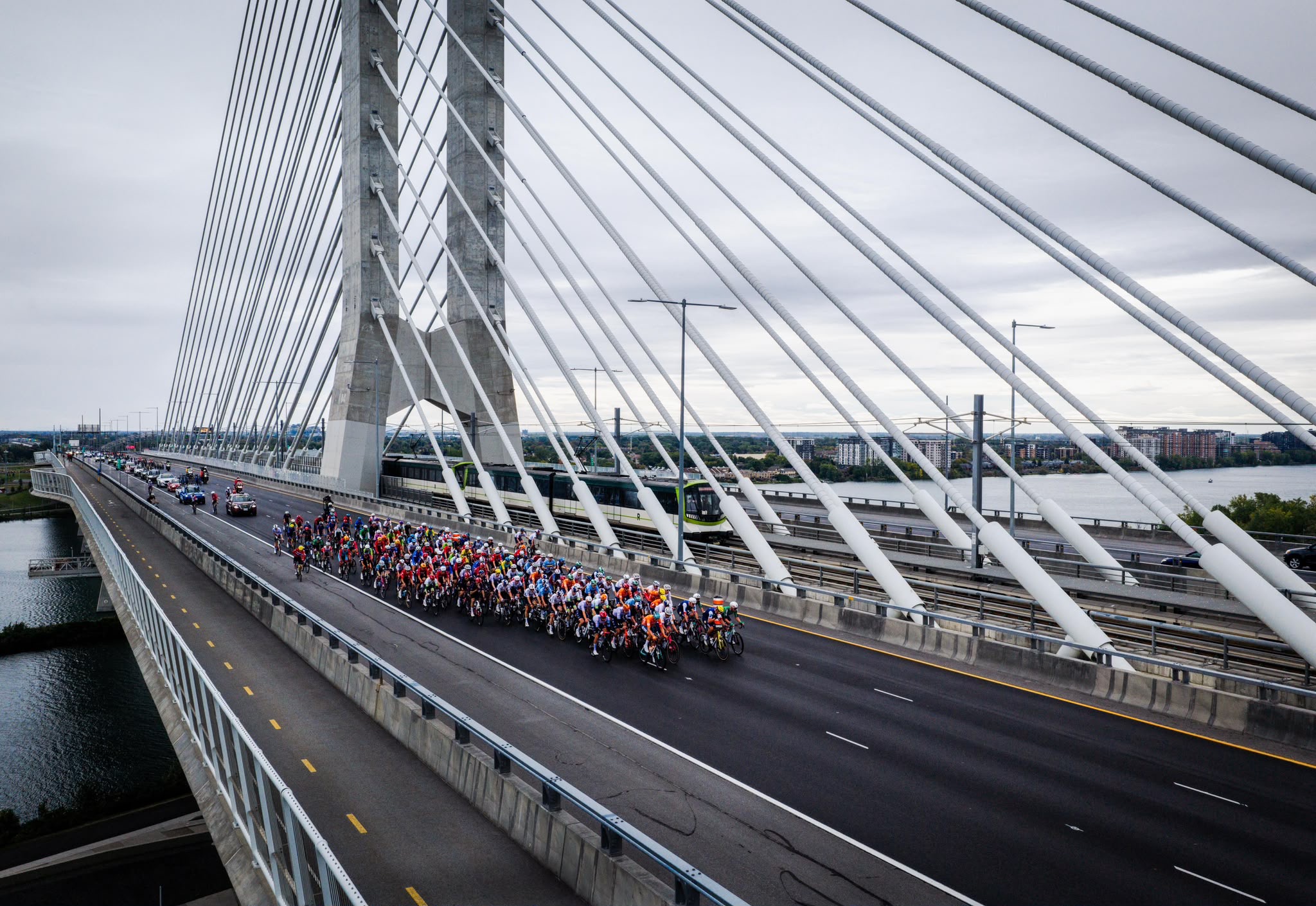 The men’s peloton crossing the Samuel-De Champlain Bridge. UCI Road World Championships, Montréal, Quebec, Canada, 27 September 2026. Photo courtesy of Mondiaux2026/David Marcotte
A 16-rider break went clear early, carrying familiar faces including Canada’s Guillaume Boivin, Eritrea’s Biniam Girmay and Norway’s Andreas Leknessund. The peloton let them go, and their lead stretched to eight minutes. That was as far as France would allow it. The French had come to Montréal with a clear idea of how to race for Paul Seixas: make it hard, make it long, and wear down the field until only the strongest remained. As the peloton returned to the circuit, Bruno Armirail went to the front and began to grind. Over the first five laps he closed the gap almost single-handed, and when the break came back, the race was ready to break open.
The favorites move early
It broke open early. Wout van Aert of Belgium launched the first serious attack with 87 kilometers remaining, and the move drew a heavy group: Denmark’s Anthon Charmig, Van der Poel, Slovenia’s Primož Roglič, Great Britain’s Oscar Onley and Simmons. For a championship race, this was the favorites committing at an unusual distance, and the American plan was already paying off. Simmons was exactly where he needed to be.
Van der Poel was not content with company. He lifted the pace again and split the group, and only Simmons and Onley could stay with him. Roglič fought his way back across 65 kilometers from the line, forming a leading quartet, and with 39 kilometers to go Ireland’s Ben Healy made the junction too, passing a fading Onley on the way. Through all of it Simmons sat on, doing his job, following without driving and giving the others no reason to hope he would help.
Behind, the chase was relentless and ragged. Mexico’s Isaac del Toro and Seixas were the most active riders in a series of reduced groups that changed shape with every acceleration, and the pair spent heavily trying to keep the front of the race within reach. Del Toro, in particular, helped drag the chasing group back into contention. Their effort was exactly what the Americans had counted on. “I really think that we played the perfect race,” Jorgenson said, “with Quinn able to follow that move with Wout and Van der Poel to neutralize it, and then Brandon and I were able to take advantage of Seixas and Del Toro, who spent a bunch of energy.”
Alone and audacious
With about 35 kilometers remaining, a group of 12 came back together at the front. Most of the riders in it had burned matches either attacking or chasing. Two of them had not. “As soon as it all came back together,” Jorgenson said, “we could get one of us solo, which was the ultimate goal.”
McNulty went almost at once. He sprang from the elite group with 33 kilometers left, and no rival immediately followed his wheel. It was a moment of hesitation that would decide a world championship. Within 10 kilometers he had a minute. He settled into the rhythm of the time trialist he has always been, and by the time two laps remained he had stretched his advantage to 1:08.
The group behind him was stacked. Seixas was there, and Van der Poel, and Great Britain’s Tom Pidcock, and Remco Evenepoel of Belgium, who had won the individual time trial title the previous Sunday. On pure horsepower, they should have closed a minute on a lone rider over two laps of a circuit this hard. They never quite managed it, because they never quite rode together. Every acceleration broke whatever cooperation had formed, and the attacks kept coming. Evenepoel launched a major move just before the bell. Even so, McNulty entered the park for the final time with 53 seconds in hand over a 10-man group led by the time trial champion.
Jorgenson made sure the chase stayed disorganized. Whenever a rider tried to escape the group, he followed. When Van der Poel went, Jorgenson went with him. When Switzerland’s Mauro Schmid tried, Jorgenson closed that down too. He sat on wheels, refused to pull, and turned every chaser’s effort into a free ride for himself. “From there, thankfully, I had crazy legs,” he said, “and I was able to follow a bunch of moves, and make some guys a little bit frustrated, which really helped.”
The last lap
The final lap nearly undid everything. Pidcock took over the chase, and his repeated surges began to bite on the Polytechnique climb. Once McNulty crested the Camillien-Houde for the last time and entered the final 10 kilometers, his lead had collapsed to barely 10 seconds. He was well and truly in view. For the first time all afternoon, the chasers could see the man they were hunting, and for a rider alone at the end of 270 kilometers, that sight usually signals the end.
It wasn’t. As the riders behind began looking at one another, waiting for someone else to close the final gap, McNulty kicked again. The gap swung back out toward half a minute. He had managed his effort perfectly, the way a seasoned time trialist does, and while his chasers threw everything at the finish, they never reeled him in.
Into the final kilometer, the road ramped up toward the line, and McNulty surged once more. Pain was etched across his face. By his own account he had almost nothing left. “Up the last climb I was only doing zone two,” he said. “I was just dying, but I kept just pushing.” He kept pushing the pedals all the way up the rising finish straight and crossed the line 13 seconds ahead of Matthews, who led the chasers home with Van der Poel on his wheel. The rest of the group trickled in a second later, and Evenepoel, who had led the chase at the bell, finished outside the top 10.
Only then did the pain on his face turn to disbelief. “Until the last 300 meters, I really didn’t even believe it,” he said. “I was so tired.”
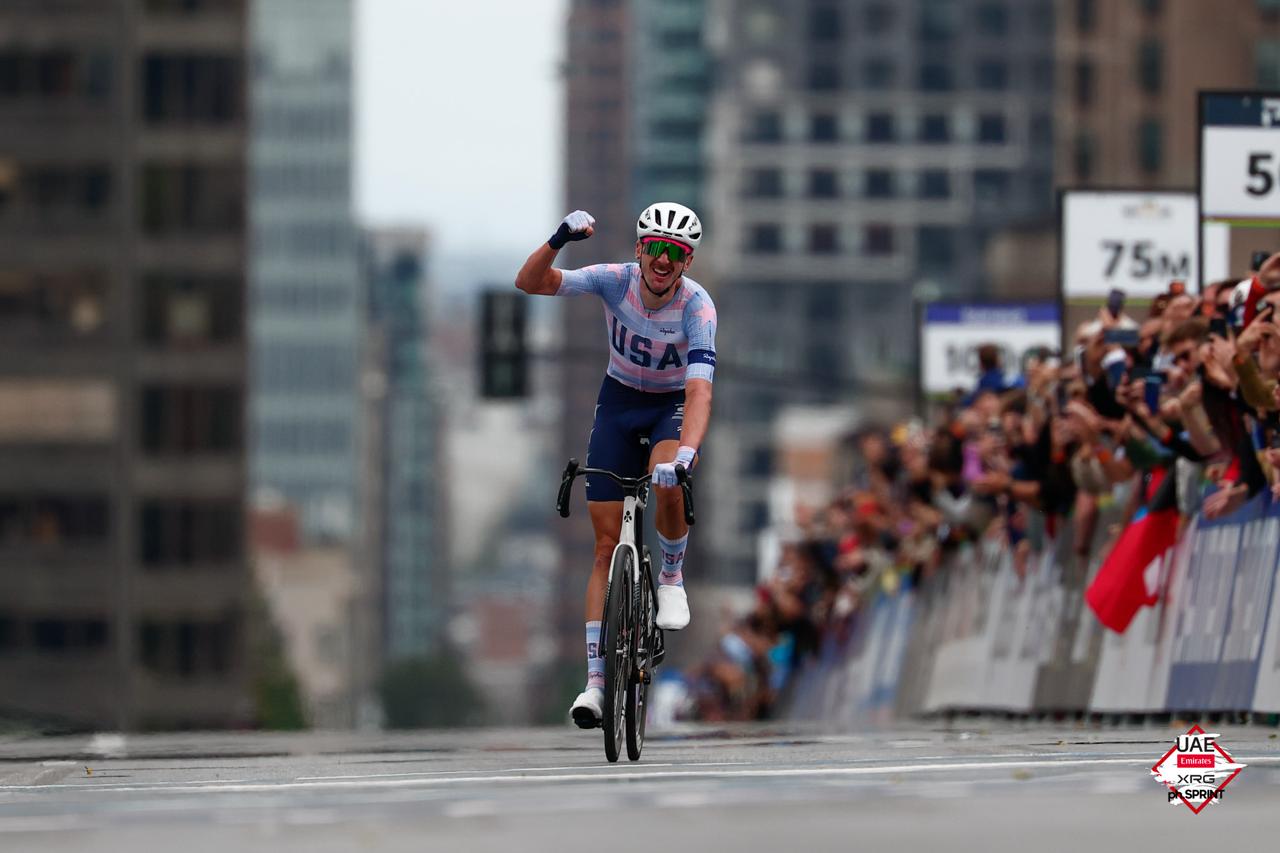 Brandon McNulty (USA) wins the 2026 UCI Road World Championships in Montréal, Quebec, Canada on September 27, 2026. Photo courtesy UAE Team Emirates-XRG
“Today, miracles happen”
McNulty crossed the line and ran straight to his wife, then disappeared into the finish corral and a scrum of American jerseys. The result belonged to all eight of them, and the result sheet showed it. Simmons, who had spent the afternoon in the early moves marking Van Aert and Van der Poel, still had enough left to finish fourth, one place off the podium. Jorgenson, after an hour of closing down attacks, took eighth. Three Americans finished in the top 10. When he finally found words, they were mostly about his teammates. “I think we rode, I mean, crazy well,” he said. “We marked everything, had guys ahead. I’m seriously at a loss for words.” He added that he was “super grateful for that and how they helped me.”
Asked whether he had truly believed he could become world champion, he was honest. “No, I mean, we thought about it,” he said. That morning he had joked about it with his wife. “In the end, I knew something could happen, but it would take a miracle. And, I guess, today, miracles happen.”
Jorgenson saw less mystery in it. To him the day was a plan carried out to the letter by riders who had agreed to put the result ahead of themselves. Simmons had covered the dangerous early moves. Seixas and Del Toro had spent their strength closing the gaps. When the race came back together, the Americans had two fresh riders in a group of tired ones, and they used them. It was, Jorgenson said, “the perfect race.”
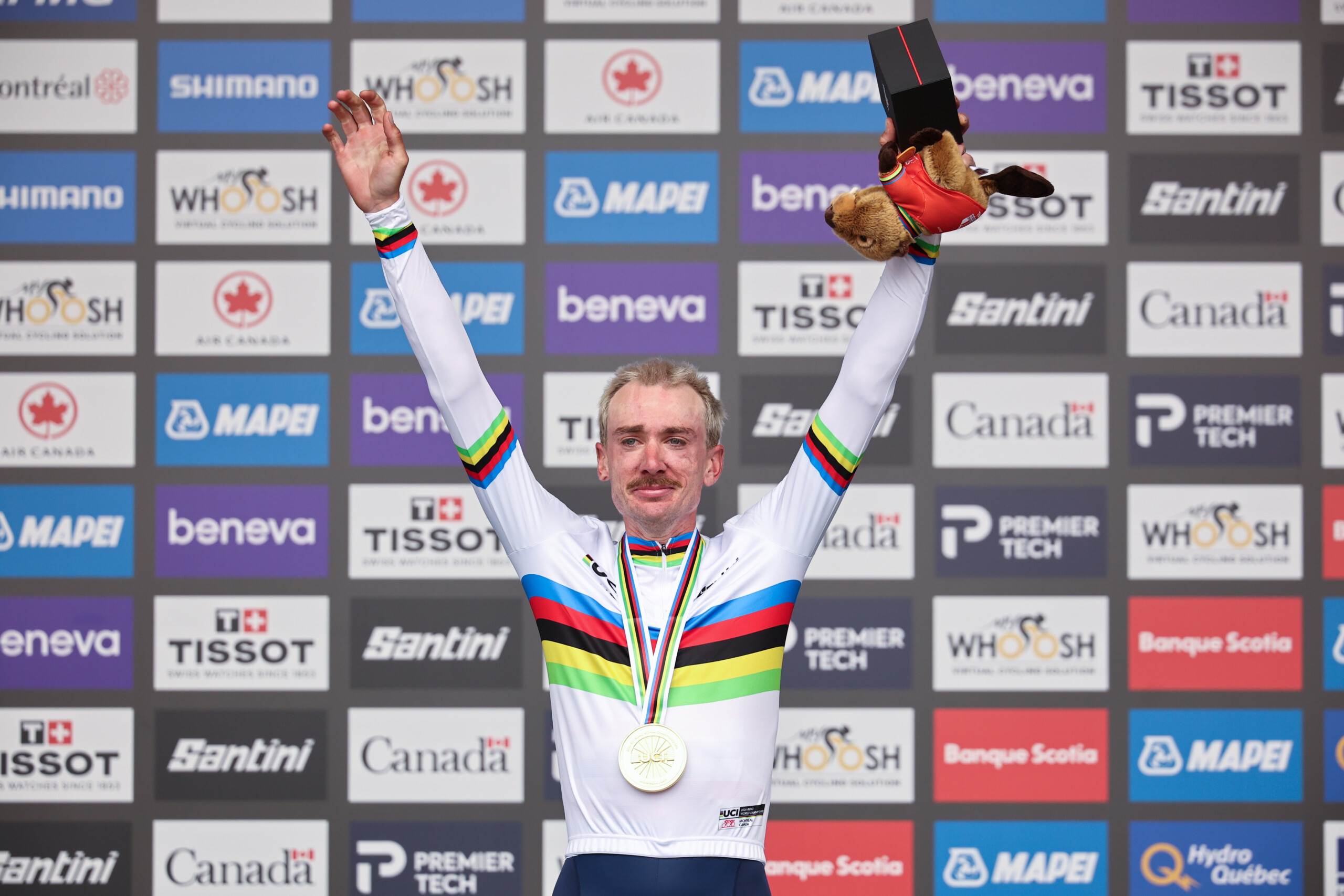 Picture by Alex Whitehead/SWpix.com – 27/09/2026 – Cycling – 2026 UCI Road World Championships – Montréal, Canada – Men Elite Road Race Podium – Brandon Mcnulty (USA) wins the Gold Medal to become World Champion. Photo courtesy USA Cycling
McNulty’s ride also completed a remarkable week for American men in Montréal. Earlier in the championships Ashlin Barry won the under-23 road race with his own 33-kilometer solo, a near mirror image of Sunday’s winning move, and between them the two riders gave the United States a pair of road race gold medals.
MEN ELITE ROAD RACE, 273.4 KM: TOP 10
Position
Rider
Nation
Age
Time
1
Brandon McNulty
United States
28
6:17:04
2
Michael Matthews
Australia
36
+0:13
3
Mathieu van der Poel
Netherlands
31
+0:13
4
Quinn Simmons
United States
25
+0:13
5
Isaac del Toro
Mexico
23
+0:14
6
Mads Pedersen
Denmark
31
+0:14
7
Tom Pidcock
Great Britain
27
+0:14
8
Matteo Jorgenson
United States
27
+0:14
9
Giulio Ciccone
Italy
32
+0:14
10
Ben Healy
Ireland
26
+0:14
Source: UCI. Gaps in minutes:seconds; s.t. = same time.
The women: “No, no, it’s mine”
Demi Vollering’s rainbow jersey came through a finale that twisted three times, and it filled the one conspicuous gap in a collection of jerseys few riders of her generation can match. The Dutch rider has won the yellow jersey of the Tour de France Femmes twice, in 2023 and 2026, the red jersey of La Vuelta Femenina in 2024 and 2025, the pink jersey of this year’s Giro d’Italia Women, and the European champion’s jersey in 2025, along with a long list of classics and stage races. Her 2026 season has been extraordinary even by her standards: 15 victories, including the Ronde van Vlaanderen, La Flèche Wallonne, Liège-Bastogne-Liège, the Giro and the Tour.
The world title had always slipped away. She had taken silver in the individual time trial in 2024 and bronze in 2025, and a bronze at the 2023 UCI Gravel World Championships, but never the road race stripes. Saturday’s race, over 180.1 kilometers with eight laps of the Mont-Royal circuit and eight ascents of the Camillien-Houde, was built for her. That didn’t make it simple.
The Dutch take control
The Oranje squad took charge of the race from the start, riding at the front behind the early attackers. The day’s main breakaway included Bulgaria’s Gergana Stoyanova, Portugal’s Beatriz Roxo, Norway’s Marte Berg Edseth and the USA’s Natalie Quinn, and it reached the final circuit with a lead of around three minutes. Behind it, the race lost one of its central figures. A mass crash in the peloton brought down the defending world champion, Canada’s Magdeleine Vallières Mill, racing on home roads, along with Spain’s Paula Blasi.
Once the race reached Mont-Royal, the intensity rose lap by lap. After a series of attacks, France’s Maeva Squiban powered clear with 52 kilometers remaining. The Dutch organized a hard chase behind her, and on the next ascent of the Camillien-Houde, 38.5 kilometers from the finish, Puck Pieterse launched her leader. Vollering caught Squiban quickly, went past her, and rode on alone. Squiban fought on and still finished ninth.
Too early?
A solo from nearly 40 kilometers out is a statement of confidence, and Vollering’s rivals refused to let it become a procession. The chase behind her held a strong pace and kept her on a short leash. The gap never grew into the kind of lead that lets a rider relax, and Vollering felt every second of that pressure. “There were so many moments I thought I went too early,” she admitted. “They stayed so close the whole time and I didn’t dare to turn around and look back because I felt like they were almost in my wheel already. It was 20 seconds, 22, 15…”
Then they were on her wheel. Poland’s Kasia Niewiadoma-Phinney, Italy’s Elisa Longo Borghini, Switzerland’s Marlen Reusser, crowned time trial champion the previous Sunday, and France’s Juliette Berthet made the junction just before the final lap. The bell that sent them into it was rung by Geneviève Gambillon, the Frenchwoman who won the women’s world road title in Montréal in 1974, a reminder of how long the city has been writing this race’s history.
For most riders, being caught after a long solo means the race is over. The legs have been spent and the rivals smell it. Vollering refused to see it that way. “At one point, they came back,” she said. “But it still wasn’t over, I had to still believe in it. I just dared, tried again and never gave up to the finish line. I was not planning to give it away anymore, I was like: ‘No, no it’s mine.’”
Berthet could not hold the pace on the final lap and finished fifth, 39 seconds down, which left four women to decide the title. Pieterse, whose lead-out had launched Vollering two laps earlier, had given everything by then and rolled in sixth, more than a minute and a half back. Vollering was on her own. The tension peaked on the uphill finishing straight, and she stayed cool, timed her effort and held off Niewiadoma-Phinney by the narrowest of margins, both riders given the same time. Longo Borghini took bronze four seconds back, and Reusser finished fourth at eight seconds.
Guts and belief
Vollering spoke with visible emotion moments after the finish, and most of what she said concerned the women who had worked for her. “I worked so hard towards this goal,” she said. “It takes guts to truly believe with your whole heart and, together with the team around you, with such strong girls. They all sacrifice for you. It’s a lot to ask from them, but I’m so proud of everybody from the team.” The Dutch, she said, “took the whole race in their hands; they rode the whole race in the front and then Puck did an amazing lead-out; and I could just not not finish the job!”
She becomes the ninth Dutch woman to win the elite road race world title, and the list she joins reads like a history of the women’s sport. Keetie van Oosten-Hage won in 1968 and 1976. Tineke Fopma won in 1975, Petra de Bruin in 1979, and Leontien van Moorsel in 1991 and 1993. Marianne Vos took three titles, in 2006, 2012 and 2013. Chantal Blaak won in 2017, Anna van der Breggen in 2018 and 2020, and Annemiek van Vleuten in 2019 and 2022. Few of them won it after being caught on the final lap and deciding, simply, that the jersey was still theirs.
WOMEN ELITE ROAD RACE, 180.1 KM: TOP 10
Position
Rider
Nation
Age
Time
1
Demi Vollering
Netherlands
30
4:45:09
2
Kasia Niewiadoma-Phinney
Poland
32
s.t.
3
Elisa Longo Borghini
Italy
35
+0:04
4
Marlen Reusser
Switzerland
35
+0:08
5
Juliette Berthet
France
28
+0:39
6
Puck Pieterse
Netherlands
24
+1:36
7
Célia Gery
France
20
+2:55
8
Dominika Włodarczyk
Poland
25
+4:16
9
Maeva Squiban
France
24
+5:48
10
Franziska Koch
Germany
26
+5:51
Source: UCI. Gaps in minutes:seconds; s.t. = same time.
Two kinds of nerve
Taken together, the two races made a fitting close to a week in Montréal. Vollering won with the strongest team in the race behind her and a finish she had to earn twice. McNulty won with a team that set its egos aside and a lead he nearly lost and then rebuilt. Both went long, both were close to caught, and both kept believing when the numbers said they shouldn’t. On Saturday that meant a sprint won from a position that looked lost. On Sunday it meant a rider on his limit, doing zone two up the last climb, holding off the best one-day racers in the world by 13 seconds.
For the United States, the weekend ended a drought measured in decades. For Vollering, it ended a wait measured in near misses. And for both, it began a year in the rainbow stripes.
(Visited 26 times, 26 visits today)