
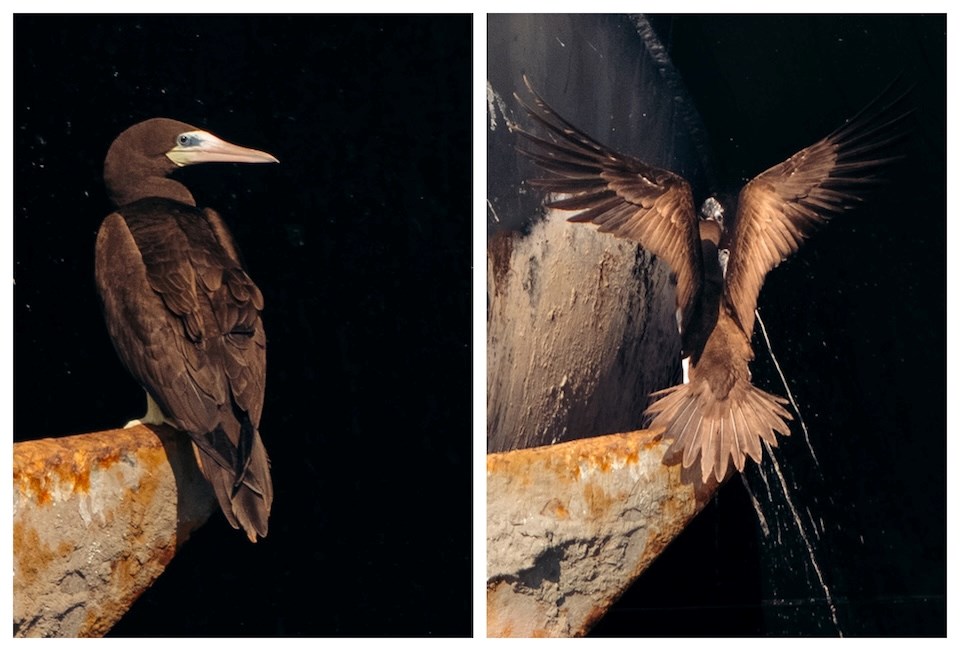
The tropical bird flew much further than it usually does.
Rare seafaring birds are popping up in Vancouver thanks to a supercharged weather phenomenon.
Local whale-watching tour guide Tobin Sparling spotted a Cocos booby in the Burrard Inlet last week (Sept. 23), which is typically hard to spot animal locally.
The Cocos booby (see gallery above) is a tropical seabird, named after the volcanic Cocos Island off Costa Rica’s Pacific coast. As “shorebirds,” they don’t migrate like other birds, but sometimes leave nesting colonies after breeding season. Breeding seasons also vary between islands, and their range has expanded to Hawaii and California, according to Eastside Audubon.
But the birds’ latest expedition to British Columbia isn’t exactly within their routine.
“It’s quite unusual for B.C. to get any kind of booby, but we do have a few different species around at the moment,” he tells Vancouver Is Awesome.
Why are unique tropical birds congregating in our cooler climate?
Climatologists have recorded above-average sea surface temperatures in the east central and eastern Pacific Ocean, and El Niño conditions are present. But this year’s El Niño isn’t considered normal.
“El Niño is strengthening, with a greater than 90 per cent chance of a very strong event during the Northern Hemisphere fall and winter 2026-27,” according to an advisory.
Scientists say this year’s El Niño has already become the warmest on record and hasn’t even reached its peak. And the expected impacts have been felt globally, with unusual droughts, floods and unusual animal behaviour, according to the BBC.
In other areas, such as the Atlantic, the weather phenomenon actually decreases hurricane risk. So far, that demographic hasn’t experienced any in 2026.
How does El Niño impact the Cocos booby and its tropical feathered friends?
“So the water temperature in, especially like South America and sort of Central America, is a lot warmer than it otherwise should be, and that’s not going to affect the boobies,” Sparling says.
“Like they don’t care about the temperature of the water, but their food does, and since all the fish are now dispersing because the water is too warm for them and the zooplankton that they’re going to be eating, the fish have all dispersed, so that means that tropical birds are dispersing a lot more,” he says.
And it isn’t just one Cocos booby that’s chased its dinner north. Several other individuals have been spotted along the B.C. Coast, with estimates around five or six. In the area, ornithologists and birdwatchers have spotted at least one juvenile and one adult — you can tell them apart by their plumage.
“We’re expecting to see a lot of weird birds coming up here,” Sparling adds, noting that he’s seen several pelicans in the harbour, although those are a bit less weird.
From feathers to blowholes to krill
The 27-year-old wildlife enthusiast works as a guide for Price of Whales, taking locals and visitors on whale watching tours out of Granville Island. But he and his colleagues are always on the lookout for wildlife, although the whales are stars of the show. Thankfully, the region’s humpback whale population has made a tremendous comeback in recent years, providing ample fodder for tours.
Sparling was raised on Bowen Island and completed his undergraduate degree in biology at UBC and plans to return to do a master’s. He’s also spent several months in Africa taking awe-inspiring wildlife photos.
And the local nature lover is enthusiastic about the prospects for at least some marine life in Vancouver’s waters.
“The whales are getting better and better each year as their humpback population is going back,” Sparling says. “And the transient orca population is increasing as well. And with more humpbacks comes more humpbacks poop, and that poo fertilizes the algae that feeds the krill that feed the fish.
“And so the whole ecosystem is doing better with our increasing population of humpbacks, which I think is really exciting.”
Follow him on Instagram to see his latest photos and videos.