
Ontario Premier Doug Ford said he is prepared to use taxpayer dollars to deliver on his proposed pipeline from Alberta to Ontario within the next four and a half years.
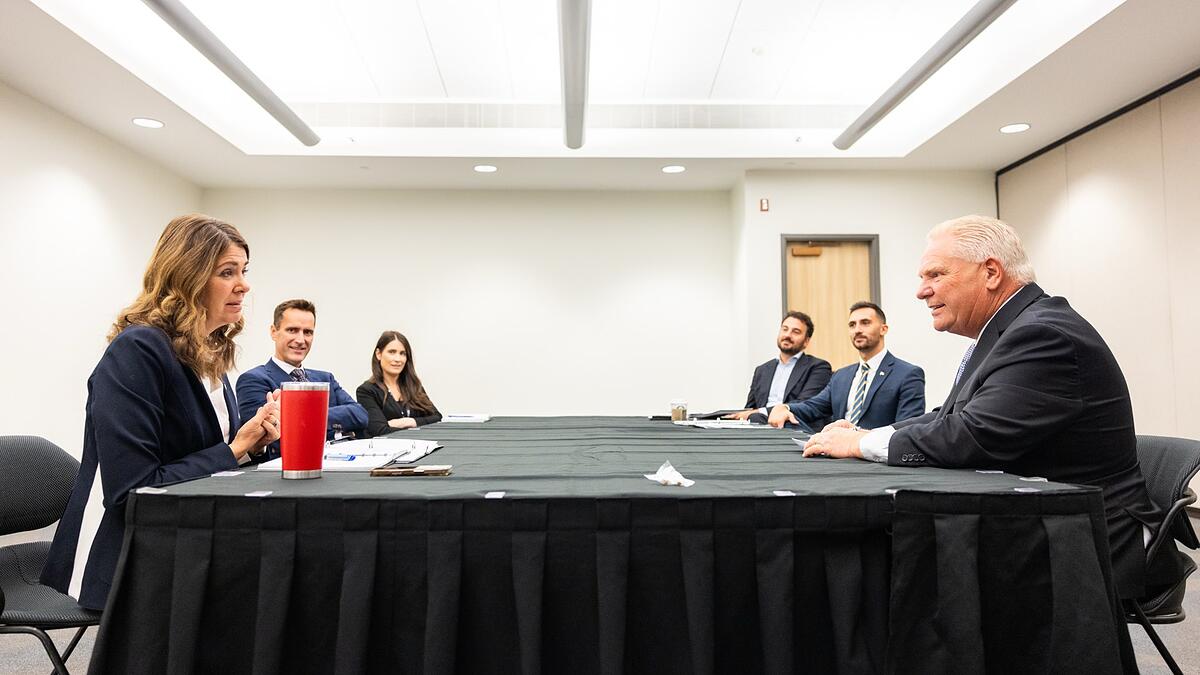
At an event in Calgary on Monday alongside Alberta Premier Danielle Smith, Ford provided an ambitious new timeline for the Northern Shield Energy Corridor pipeline, a project first announced by Ford and Smith at the Calgary Stampede in July.
“If John A. MacDonald, before Confederation, can build a railroad from one end of our country to the other in four and a half years, why can’t we build a pipeline even quicker with the technology we have?” said Ford during his address.
Smith agreed, illustrating her point with another historical anecdote about TC Energy’s Canadian Mainline, which was first pitched in 1951.
“They went from debate in 1954 to commissioning and opening in 1956. If they could do it in 18 months back then, four and a half years or less should absolutely be possible today,” said Smith.
The Ontario premier also confirmed that his government was prepared to use public money to get the project off the ground.
“Our government is ready to step up with the capital necessary to build the Northern Shield pipeline. I want to be clear: what I’m talking about is government providing the patient capital needed to invest in our future so critical infrastructure gets built,” he said.
A route for the eastbound pipeline was revealed in July. No formal projections have been drawn up regarding the potential cost of the project, but independent estimates expect a price tag between $40 and $50 billion.
Experts have raised doubts about the need for the eastbound pipeline and the economics of using public money to fund it, with several citing competition from Enbridge’s Line 5 as a key hurdle.
Ford raises strategic petroleum reserves, Canadian port option as he promotes pipeline as a sovereignty project
Ford framed the project through the lens of energy sovereignty as the trade war with the United States grinds on.
He also raised the prospect of Canada establishing a strategic petroleum reserve during Monday’s event.
“That will provide a secure, domestic and sovereign stockpile of fuels like diesel, gasoline, and jet fuel to protect the economy of workers and jobs in strengthening Canada’s long-term energy security,” he said. “As Canadians, we need to be in full control of our economic future.”
Canada, a net exporter of oil, is the only one of the G7 countries that does not maintain a strategic reserve.
The proposed pipeline would span 3,300 kilometres between Hardisty, Alta., and Sarnia, Ont., all on Canadian territory. Sarnia’s refineries are already fed with Alberta oil — however, that oil is moved using the Enbridge Mainline, which passes through parts of the United States.
Ford revisited the prospect of adding a port option on Canadian territory to maintain all aspects of the supply chain north of the American border.
“Like the pipeline’s main route, this port will keep Alberta’s oil within Canada’s borders, ensuring no other country can stop our natural resources from reaching new markets around the world,” said Ford.
When the project was announced this summer, the scope included a possible extension to the Port of Churchill in Manitoba.
Manitoba Premier Wab Kinew has endorsed plans to build a pipeline to Churchill generally, but has withheld his endorsement of the Northern Shield project, in particular, pending further consultation with Indigenous and environmental partners.
New oil production objectives for Alberta
Alberta’s premier also made some announcements at Monday’s event.
Smith was met with applause when she told the audience that she was stretching her existing production targets after a conversation with oil tycoon Adam Waterous.
“Our oil production is closing in on 5 million barrels per day, and I set a goal back in 2023 that we would double our production. So that means getting to 8 million barrels by 2035,” she said.
“Adam Waterous let me know he thought that we were going to be doubling it from today’s level of 5 million production, so he keeps saying 10 million barrels per day. So what the heck? Let’s increase it to 10 million.
Smith also shared new estimates of the province’s proven and probable natural gas reserves. The new study yielded a result six times higher than previous estimates, putting the figure at 144 trillion cubic feet.
“We’re sitting on an ocean of natural gas, and we’ve got a lot of need for it,” said Smith.
According to talks with industry leaders, Smith said the expanded oil production planned to fill the proposed pipelines will require a massive increase in natural gas production. She said meeting the target of 8 million barrels of oil per day would require an additional 18 billion cubic feet of natural gas above what current production provides.