
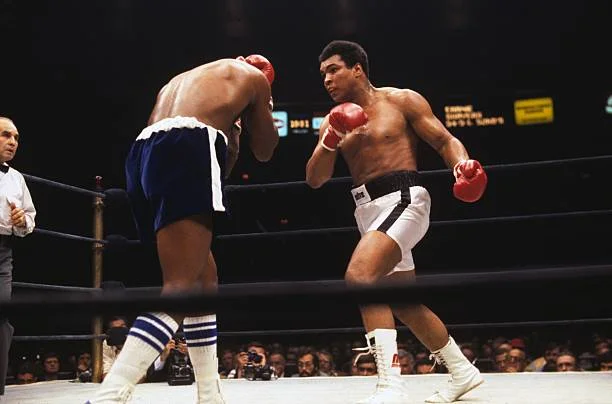
September 29, 1977, produced one of the more memorable heavyweight title fights of Muhammad Ali’s later career.
At Madison Square Garden, the 35-year-old Ali defended his WBA and WBC heavyweight championships against Earnie Shavers, the hard-punching challenger who entered the ring with a 54-5-1 record and 52 knockouts. Ali’s record was 54-2 with 37 knockouts. The champion survived 15 rounds with one of the division’s most feared punchers and won a unanimous decision. The official cards favored Ali 9-5, 9-6 and 9-6, with referee Johnny LoBianco scoring the fight along with judges Eva Shain and Tony Castellano.
But the result was only part of the story.
The NBC prime-time telecast featured something unusual for boxing in 1977: viewers were shown the official scoring after each round. It was an experiment in open scoring designed to give television viewers an idea of how the judges were viewing the fight before the final bell. The system also produced an unintended wrinkle when Ali’s trainer, Angelo Dundee, received the scoring from a television in the champion’s dressing room while Shavers’ corner did not have the same access.
That raised an obvious question: Should a fighter and his corner know where they stand on the scorecards while a fight is still unfolding?
The answer was hardly simple.
Shavers was dangerous enough that a decision was never a certainty until the final bell. Ali would later praise the challenger’s punching power, describing Shavers as the most powerful puncher he had faced.
For Ali, the victory was his 10th successful defense of the heavyweight championship since reclaiming the title from George Foreman in 1974 and his last successful defense before his first loss to Leon Spinks in February 1978.
The fight also produced a piece of boxing history when Eva Shain became the first woman to officiate a major heavyweight championship fight, serving as one of the judges.
What followed was an intriguing debate about open scoring. Years later, the subject resurfaced as boxing continued to wrestle with controversial decisions and the question of whether judges’ scores should be revealed before the final bell.
Bernard Fernandez examined that question in detail in his original story, using Ali-Shavers as the starting point for a fascinating look at open scoring, the controversy surrounding the fight and the arguments for and against telling fighters exactly where they stand.
We invite you to revisit Fernandez’s story HERE and take another look at Muhammad Ali vs. Earnie Shavers—a fight that remains much more than a 15-round decision on a September night in New York.
To comment on the post in the Fight Forum CLICK HERE.