
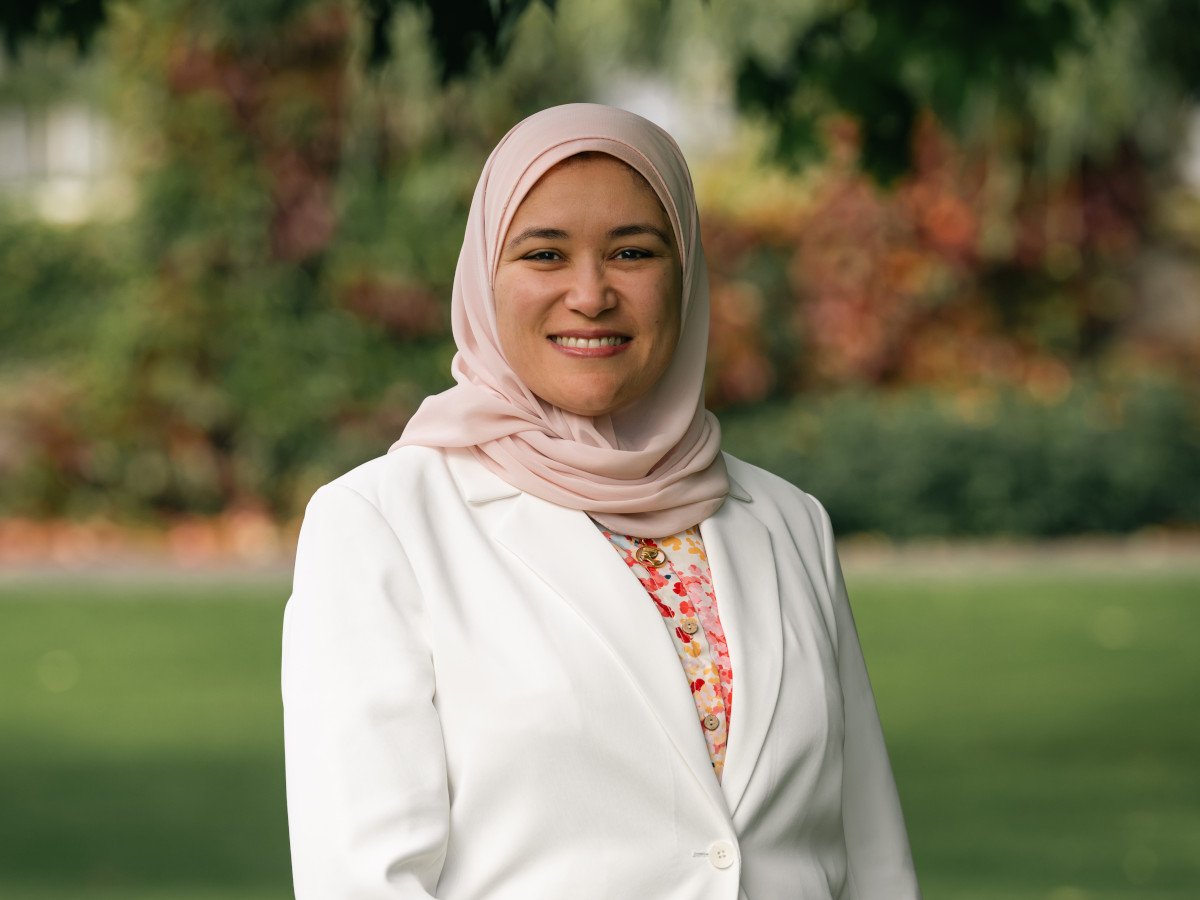
Maynooth University’s Dr Abeer Eshra discusses how computation and its potential is not tied to a particular machine or material.
From an early age, Dr Abeer Eshra, a principal investigator and assistant professor, for the Hamilton Institute and computer science department at Maynooth University, was curious not just about how things worked, but what else might be possible.
After her education, she found herself increasingly drawn to questions that had no clear answers, rather than to work that would have seen her apply solutions to what was already known.
Eshra told SiliconRepublic.com, “Research gave me the freedom to keep learning, question assumptions and explore ideas that might or might not work and that was what attracted me to an academic career. I trained in computer engineering, so I naturally thought of computation in terms of electronic hardware.
“During my Masters, that curiosity led me to DNA computing and I became fascinated by the idea that computation is not tied to a particular machine or material. Discovering that molecules themselves could be programmed to process information completely changed the way I thought about what a computer could be.”
At the time Eshra did not have access to a wet lab, that is, a facility designed for work involving chemicals, liquids, biological materials, samples and other physical substances. She collaborated with researchers at an agricultural institution, so she could carry out her own experiments.
She said, “I always wanted to be able to do those experiments myself, not just design the computations theoretically. During my PhD, I finally had the opportunity to work hands-on with DNA systems, particularly renewable DNA computers that could be reset and reused.
“That combination of computer science and molecular experimentation has shaped the direction of my research ever since.”
Computational change
Recently, Eshra was involved with a project at Maynooth University that saw her and colleagues work on what the college calls a ‘first of its kind’ DNA computer. DNA computers are devices that depend on bio-molecular components to complete tasks, rather than the silicon or electronic components typically used in standard computing.
Eshra and her team have a particular interest in renewable DNA circuits and reusable molecular systems, with much of their research focused on how molecules can be programmed to process information robustly and how these systems can be reused.
She explained, “The scaffolded DNA computer consists of a long DNA strand that acts as a scaffold, together with many shorter DNA strands, or ‘tiles’, that compete to bind along it.
“The particular tiles we add encode both the program and its input. As the system is heated and cooled, the tiles bind, unbind and replace one another, while also interacting with neighbouring tiles. The key idea is to design the system so that the answer to the computation is also its most energetically favourable state.
“As the DNA strands compete, bind and replace one another, the system naturally relaxes towards equilibrium and the final arrangement represents the answer. In that sense, the computation happens by moving energetically downhill.”
Using this method, Eshra said her and her team were able to demonstrate 10 different programs and more than 700 computations, including multiplication, division, parity detection and the addition of two 25-bit numbers, representing 100 bits of computation. Small computations could be completed in under a minute, she noted.
Institutionalised renewability
Of particular importance to Eshra is making renewability a core feature of her work. It is a personal and professional goal that her group contributes to making renewability a fundamental design principle within molecular computing, as opposed to an action taken only after a system has been built.
She said, “Renewability became a particularly important direction, building directly on my expertise in renewable DNA computers. This was a direction I initiated and led, exploring whether the system could be reset and reused rather than consumed after a single computation. That work eventually demonstrated that the same molecular computer could be reused repeatedly with different inputs.
“I would like to see reset, reuse and reprogramming become core capabilities in the design of future molecular computing systems. More broadly, we are interested in engineering molecules to process information rather than simply store it.
“In the longer term, this could contribute to new molecular technologies that can process information directly within chemical or biological environments, where molecular computation may offer capabilities that are difficult to achieve in other ways.”
Current and future stakes
When asked what her work might mean to the wider STEM community, Eshra explained that molecular computing can broaden how people think about the topic of computation itself.
She said, “Information processing can be embodied in molecular interactions, which opens up scientific questions that sit at the intersection of computer science, mathematics, chemistry, physics and biology. That interdisciplinarity is particularly valuable because it allows ideas and tools from one field to reshape how problems are approached in another.
She added, “I also find it exciting that the field is still young enough for experiments to genuinely surprise us. Unexpected results can reveal something new about the system and sometimes open up entirely new directions of research.”
Don’t miss out on the knowledge you need to succeed. Sign up for the Daily Brief, Silicon Republic’s digest of need-to-know sci-tech news.