
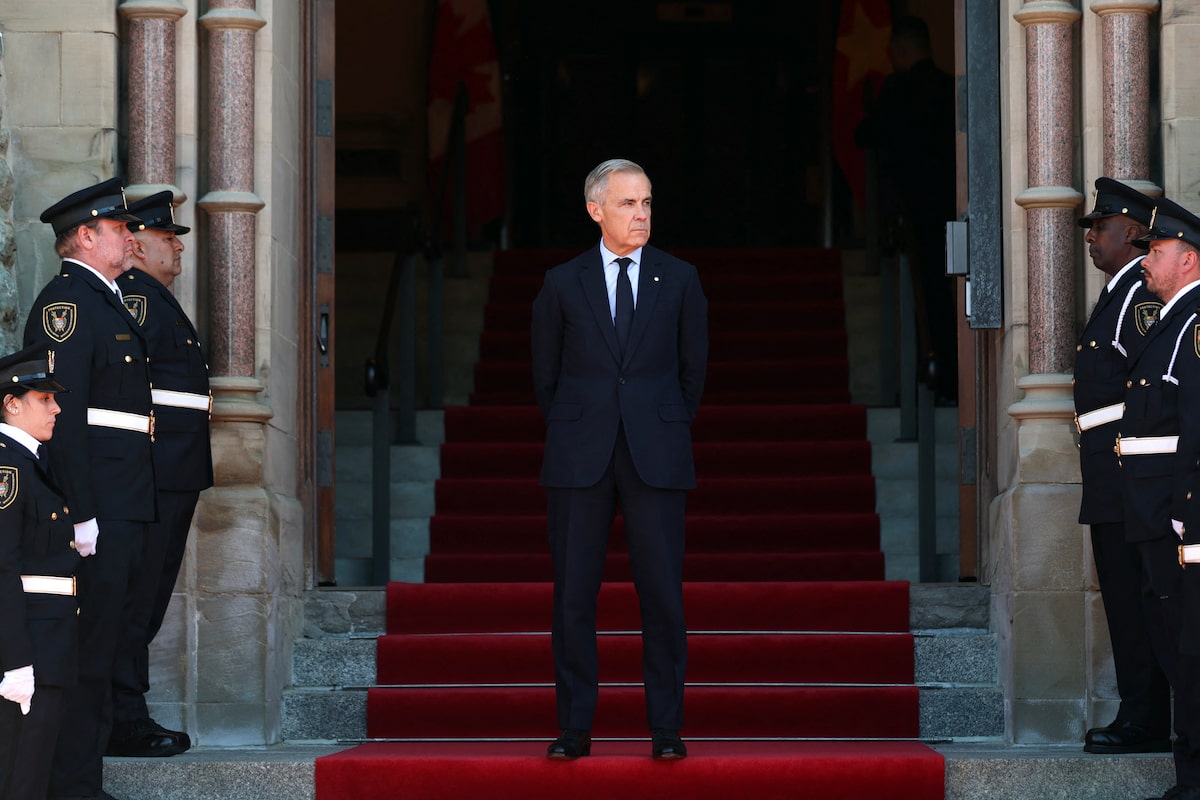
Prime Minister Mark Carney before a welcoming ceremony for Vietnamese President To Lam at the Parliament of Canada in Ottawa on Thursday.DAVE CHAN/AFP/Getty Images
Come together
Re “The next generation of leaders must be ‘in-betweeners’ ” (Opinion, Sept. 26): I appreciate contributor Jody Wilson-Raybould’s recognition of “the integrated and interconnected nature of so much of what humanity must grapple with,” but I hope many will see a stronger common foundation.
She speaks of Indigenous and non-Indigenous people as having “distinct ways of talking and viewing the world,” but my experience is we also have many similarities and common ambitions. As noted, “traditions are not static; they evolve.”
Many of us have identities and worldviews that draw on different backgrounds; there are many ways we can group ourselves around shared values and ambitions. As we work to address historical injustices and deal with the global issues of today, I hope more of us will think simply of living together rather than “side-by-side together.”
We can celebrate and draw from our ancestries without that being our only anchor. I believe this is how we will best break down harmful silos.
David Clarry Toronto
No pain…
Re “Mark Carney’s long-term plans and Canadians’ immediate pain” (Sept. 26): Only a little reflection is needed to recognize that our challenges – climate change, health care, housing, defence, reconciliation, productivity, trade, sovereignty, take your pick – have been decades in the making and are deeply rooted. Never were quick fixes going to be the answer.
In Mark Carney, we finally have a leader who understands this and acts accordingly. Yes, there can be short-term wins. But in the main, the national project of repairing, stabilizing and building a prosperous, modern Canada is a long-term endeavour.
And, as difficult as it is to acknowledge, it won’t come without some “immediate pain.”
Donald Hall Ottawa
Strike out
Re “Ottawa strikes a better balance on labour” (Editorial, Sept. 28): Why does it always seem that governments deal with the symptoms, and not the diseases, of unionization?
Governments should consider adopting “flexicurity,” an approach successfully used in Denmark. Under this methodology employers, instead of unions or strict seniority rules, have the flexibility to select and manage staff. In return workers receive strong social protections, including generous unemployment support and retraining opportunities.
Giving employers the ability to hire and fire would strengthen the overall work force. It would boost productivity, improve compensation and benefits and build more resilient organizations. Morale rises, collective bargaining becomes more constructive and the entire system works better for everyone, employers, employees and the public alike.
The only losers would be the chronically disruptive or unproductive employees (appropriately so) who drag down performance. What are we waiting for?
John Budreski Whistler, B.C.
You applaud the Building Canada Strong Act because the legislation “rebalances” the power between unions and employers. Needless to say, employers are unanimously in favour of these reforms.
The new law would empower the government to terminate a lawful strike and impose arbitration by ministerial fiat, from behind closed doors. One would have thought any “balance” of interests would start with the fact that the government proposes to curtail a Charter right in favour of business efficiency and profit.
Moreover, the government already has the power to enact back-to-work legislation in Parliament after full public debate and discussion. Surely the existing parliamentary process brings far more transparency and accountability rather than a minister’s direction initiated by an employer’s initiative.
To borrow a phrase from the Prime Minister who proposed this new law: Charter rights are not “written in pencil” to be negated by government upon the request of big corporations.
Paul Cavalluzzo CM, O.Ont, LSM; Toronto
In your support for the government’s proposed labour law reforms contained within Bill C-39, you argue that they would “only apply for disruptions with significant national impact.” Therein lies the rub.
Who gets to determine whether a strike has “significant national impact?” Presumably, the federal government will define “significant” as it sees fit.
That you cite, with approval, measures to limit the right to strike in the United States, where successive administrations have for decades rolled back the rights of both unions and workers, is downright scary.
David Bright St. Catharines, Ont.
Re “Labour Code changes will increase transparency amid high-profile bargaining disputes, Hajdu says” (Report on Business, Sept. 23): Workers and management of businesses protected by regulation, or which have significant market share, should face damages through class actions for strikes and lockouts. The costs should be borne proportionally by the variance of the last offer to the final settlement.
The right to strike exists, but the costs today are borne by the customers of a business and often multiply through the economy. Litigation is slow and expensive.
Government action seems reasonable to keep the overall economy functioning. If unfairly used, the reckoning would be at the ballot box.
The economy, workers and companies are better off when cooler heads prevail, not unlike our judicial system ultimately ruling on private contract disputes. It should be rare, and it is far more civilized.
Canada would be a better place to invest, work and operate business.
Richard Vanderlubbe Milton, Ont.
Bright side
Re “Blue Jays are handcuffed to underperforming Vladimir Guerrero Jr. for 13 more years” (Sports, Sept. 25): Many fans have complained about Vladimir Guerrero Jr.’s performance, particularly given the size of his paycheque. But there’s an overlooked upside.
Even after agents, fees and sophisticated tax planning take their share, his enormous salary still sends a sizeable sum into Canadian government coffers through taxes.
So, even when he isn’t delivering at the plate, his salary is still making a substantial contribution to Canada.
Mark Agro Burlington, Ont.
Re “The Blue Jays’ failed 2026 season confirms it: The 2025 run was a fluke” (Sports, Sept. 28): Hey, nobody promised a rose garden.
For around $50, I can sit in the 500s at Rogers Centre with my friends. I can have a beer, popcorn and a soggy hot dog – all overpriced, of course. With the sun shining and a view of the CN Tower, there’s no where I’d rather be on a summer day.
The score? Who cares? This is heaven on Earth. Maybe there will be a home run, stolen base or wicked slider, and maybe all those things will happen for the opposing team. But, again, who cares?
I could pay $200 to sit on my hands and watch the National Ballet of Canada perform Swan Lake (again), but why? Baseball is the beautiful game, and I know the other 40,000-plus people in the stands would agree with me.
Mary Lou Ditta Calgary
Letters to the Editor should be exclusive to The Globe and Mail. Include your name, address and daytime phone number. Keep letters to 150 words or fewer. Letters may be edited for length and clarity. To submit a letter by e-mail, click here: letters@globeandmail.com