
WARNING: This story contains details of experiences at residential schools.
A city-owned agency will soon place signs to mark the site of a former residential school in southeast Calgary.
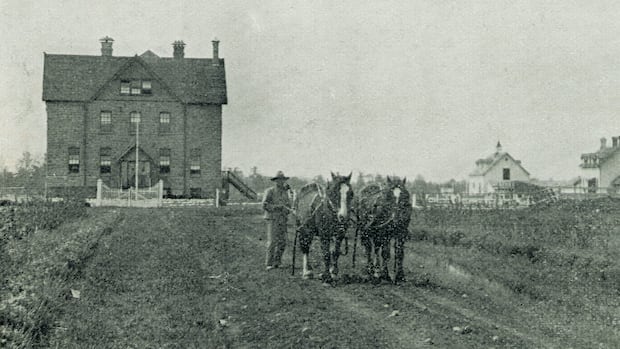
St. Dunstan’s school, also known as the Calgary Indian Industrial School, operated from 1896 to 1907. Back then, it was located a few kilometres southeast of the city.
The Anglican Church ran St. Dunstan’s and boys between the ages of 10 and 18 were sent from several reserves in southern Alberta.
Besides receiving daily religious instruction, the students were taught carpentry, raised cattle and crops and learned other skills. They also did laundry, cleaning and kitchen duties in the school.
As part of its response to the Truth and Reconciliation Commission (TRC), which examined the residential school system, the City of Calgary committed to commemorating the school site.
The TRC concluded residential schools were designed to assimilate Indigenous people and that many former students were sexually or physically abused while attending those schools.
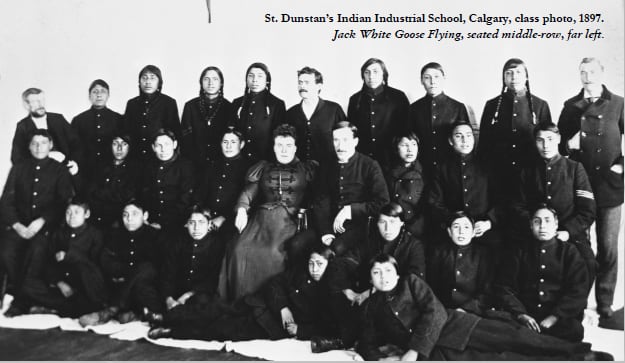 An archive photo of students at St. Dunstan’s Indian Industrial school, taken in 1897. (City of Calgary/White Goose Flying Report)
The task of memorializing St. Dunstan’s has been taken on by Calgary Arts Development, a civic partner agency.
A project specialist with its St. Dunstan’s school memorial project, Jared Tailfeathers, said they have been consulting extensively with Indigenous communities in recent years about how to ensure the site’s history is not forgotten.
“I would say it is probably by far the most sensitive project for Calgary Arts Development,” said Tailfeathers.
This fall, signage will be placed at the field where the school once stood, which is just east of Deerfoot Trail and north of Glenmore Trail, near the Bow River.
Tailfeathers, who is a member of the Blackfoot Confederacy, said the temporary signage will outline the school’s history and feature some artistic elements done by a descendant of a former St. Dunstan’s student.
More permanent commemorations will be added in future years, depending on the wishes of the community.
He said that could include public art and perhaps a seating area or gathering space.
“I’d say the majority of the community members I’ve talked to want to make sure that it’s remembered and that we do something that is thoughtful but also doing justice to the students who went there,” said Tailfeathers.
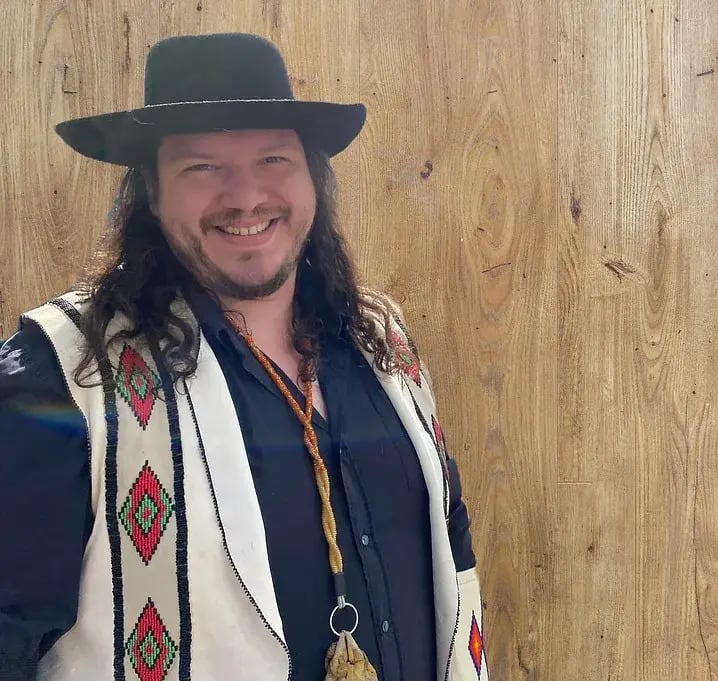 Jared Tailfeathers with Calgary Arts Development says determining how to mark the St. Dunstan’s school site has proven to be a most sensitive project for the organization. (Werklund Centre)
The placement of the final commemorations will depend on the Green Line LRT project, which will be built across the city-owned land over the next few years.
Access to the site can be a challenge. It is steps away from the Bow River pathway but there are no roads to the green space.
“People [on Deerfoot] drive by the site all the time and have no idea it’s there,” Tailfeathers said.
Something that has not been previously acknowledged is the City of Calgary had a role in the establishment of St. Dunstan’s.
In 1894, the head of the Anglican Church in Calgary, Bishop Cyprian Pinkham, wrote a letter to city council seeking a donation of land for a new industrial school.
Council voted to buy and donate 160 acres of farmland outside Calgary’s boundary for that purpose.
Calgary Mayor Jeromy Farkas said he is shocked to learn the city played a direct role.
“I certainly look at an event like that — the council of the day complicit in providing the land for a residential school — I personally think that an apology is warranted,” said Farkas.
He plans to consult with Treaty 7 leaders, elders and knowledge keepers as well as city council on what should happen next.
“Of course we can’t erase what occurred at the turn of the century, but we can better recognize it and acknowledge it. I think the worst thing that could happen is if this were to be buried, if this were to be ignored.”
The city actually donated the land to the federal government which then paid to build the facilities. This included a three-story sandstone school, a residence and a carpentry shop.
Ottawa then turned over the school to the Anglican church.
St. Dunstan’s was located in Calgary despite efforts by the mayor of Fort Macleod to convince the Department of Indian Affairs to open the facility near his community, citing its proximity to nearby reserves.
However, a department official rejected the idea, noting in an 1894 letter to the mayor that Calgary was a better location because it was further away.
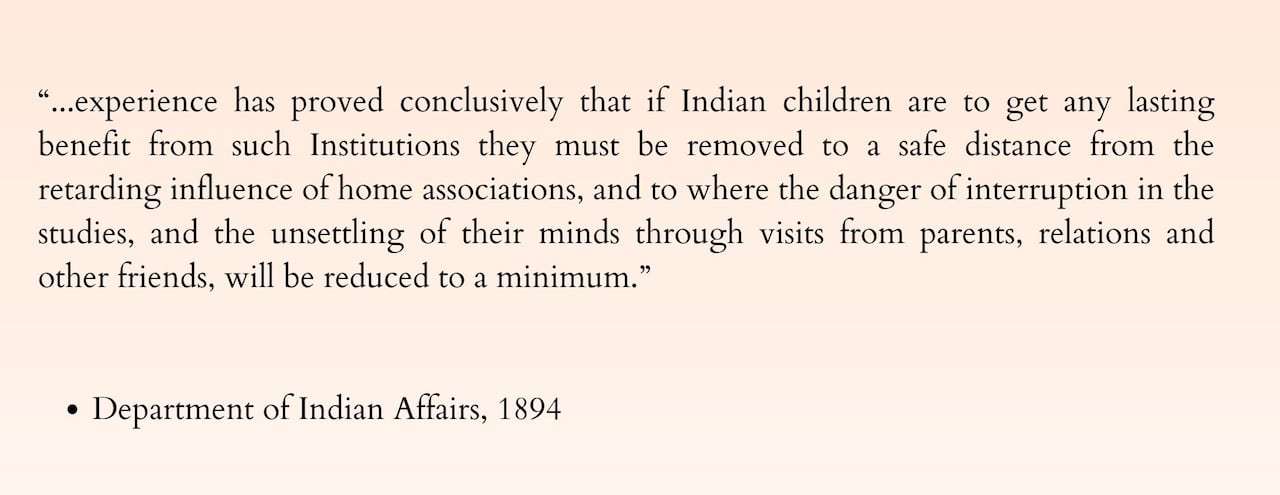 An excerpt of a letter from the then-Department of Indian Affairs sent to the mayor of Fort MacLeod in 1894. (Letter via Library and Archives Canada/CBC)
On Dec. 9, 1896, Canada’s governor general, the Earl of Aberdeen, officially opened the school in the presence of several Blackfoot and Tsuut’ina chiefs.
In its coverage, the Calgary Herald reported the governor general said the new school was an important work and that education was part of the nation’s responsibility to Indian people.
However, St. Dunstan’s saw low attendance over the decade it was in operation.
It never had more than 46 students in any year. The issue was an ongoing concern for the government, given the cost of keeping the school running for such a small number of pupils.
Ultimately, the Indian Affairs department closed the school in December 1907 when its enrolment had plunged to just six boys.
The end was summed up in the department’s annual report in 1908: “It had seemingly outlived its usefulness in the eyes of the Indians.”
Heating conditions in the school were poor, especially in cold winter months. Illness plagued the school’s students and staff over the years.
One 17-year-old boy from the Piikani Nation, Jack White Goose Flying, died in 1899 due to tuberculosis. Other St. Dunstan’s students who became ill were either isolated or sent home.
Tailfeathers said Calgary Arts Development intends to place a sign at the boy’s original burial site, which was a short distance away from the school.
In the 1970s, the city moved White Goose Flying’s remains to Queen’s Park cemetery as industrial development crept closer to his grave.
In spite of its history, Tailfeathers noted some students from St. Dunstan’s went on to future success, including James Gladstone who became Canada’s first Indigenous senator.
A national 24-hour Indian Residential School Crisis Line is available at 1-866-925-4419 for emotional and crisis referral services for survivors and those affected.
Mental health counselling and crisis support are also available 24 hours a day, seven days a week through the Hope for Wellness hotline at 1-855-242-3310 or by online chat.