
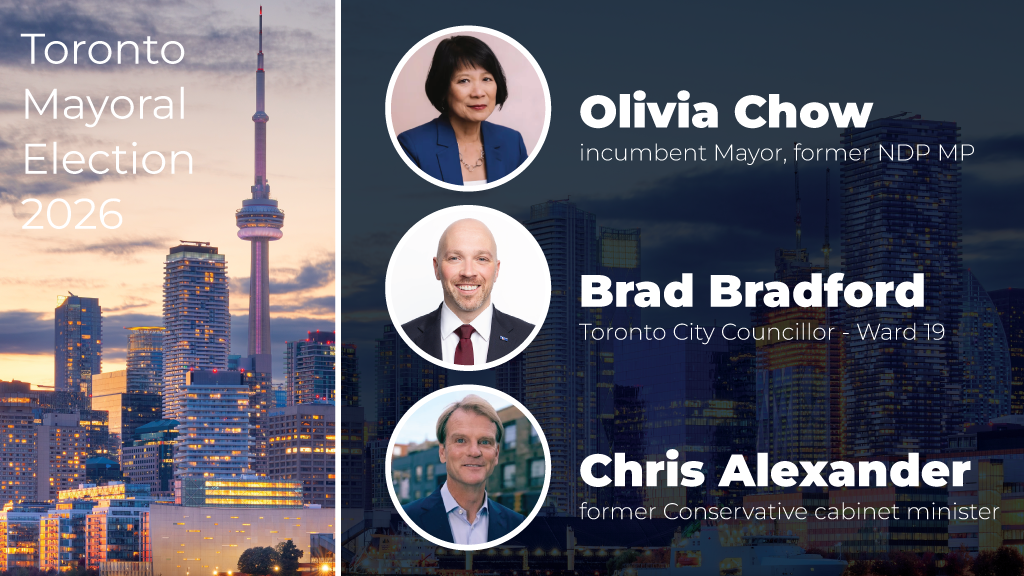
GTA construction stakeholders say they are keen onlookers intent on keeping lines of communication open as Toronto’s mayoral race enters its final month.
The contest is shaping up as a two-horse race according to polls with former mayoral challenger Brad Bradford gamely staying within reach of incumbent Olivia Chow.
A Liaison Strategies Toronto Pulse survey of voters released Sept. 22 showed Chow leading Beaches–East York Coun. Bradford by seven points among decided and leaning voters.
The survey had Chow, mayor since 2023 and formerly a city councillor and NDP MP, at 47 per cent voter support, Bradford at 40 per cent and former federal Conservative cabinet minister Chris Alexander third with 10 per cent.
Election day is Oct. 2
Stakeholders say they are refraining from open declarations of support for any candidate.
“We get involved as an industry, in trying to make sure the candidates are aware of the issues that matter most to us,” said John Mollenhauer, CEO of the Toronto Construction Association.
“We remain bipartisan. That’s always been our approach. We stay out of politics.”
The TCA relies on its board members and staff to connect with candidates to ensure they understand the issues that matter most to the industry, Mollenhauer said. Procurement issues including Buy Canadian efforts and also construction bylaw restrictions are among the current top priorities of the TCA, he said.
“We would love to see buyers of construction encourage the use of Canadian products and materials and services but that’s not always possible,” explained Mollenhauer. “At least in terms of the way it’s drafted, that sometimes creates some challenges that they need to be aware of.”
As for regulations, he said, “If I were looking back over the last five or six years, there’s been lots of legislation around that, that addresses traffic congestion downtown, noise levels downtown.
“It’s really designed to appease all these folks that have moved into the high-density, highrise buildings in the core but sometimes at the expense of the much-needed infrastructure and construction.
“Any new regulations around things like that drive the cost of construction up.”
RESCON focuses on approvals efficiency
Richard Lyall, the president of the Residential Construction Council of Ontario (RESCON), said permitting and approvals remain a major barrier to getting necessary housing built, and he points the finger at both the provincial government and the City of Toronto. Chow argues the approvals process has been streamlined, Lyall said, but the industry is not seeing major improvement.
“I can tell you that the general view in the industry, and it’s not just Toronto, is that we’re still inundated with red tape and delays,” he said. “Some people in the City of Toronto say all this housing has been approved. Well, a lot more has been approved than is getting built.”
Lyall said Alexander demonstrated “refreshing” vision during the Daily Bread Food Bank mayoral debate on Sept. 14. Chow, meanwhile, has shown she can work with other levels of government to obtain housing and other infrastructure funding, he said.
But the city is still resistant to change, commented Lyall.
“It’s the as-of-right zoning,” he said. “We’re still fiddling around with things like the single staircase issue.
“Why? Why does it take us so long to change?”
PCA targets restrictions on procurement
Karen Renkema, Ontario vice-president for the Progressive Contractors Association of Canada (PCA), said via email voters are looking for candidates committed to controlling costs and delivering better value.
“The PCA has long criticized the City of Toronto’s restrictive construction procurement system, which prevents most contractors and workers from bidding on and performing public construction work in their own city simply because they are not affiliated with the city’s preferred unions,” she stated. “By shutting out qualified local companies, restrictive procurement policies reduce competition and drive up costs for taxpayers.”
Renkema said research suggests Toronto could save $347 million annually by opening its bidding process.
OGCA advocates for improved procurement regime
Giovanni Cautillo, president of the Ontario General Contractors Association (OGCA), says the association will not support any mayoral candidate, focusing instead on planning to work with the winner on Toronto’s infrastructure and ICI requirements.
Cautillo noted the City of Toronto has received a report from KPMG with 31 recommendations to improve the procurement process. The measures include many the OGCA has been advocating for for years, he said, and that will remain a focus of its advocacy after the election.
The OGCA would also like to see improvements to Toronto’s capital pipeline projects forecasts.
“Keeping a pending project on a forecast year-over-year does not instil any form of believability or trust,” Cautillo stated. “Accurate timelines for these proposed projects are always welcomed.”
GTSWCA fights for greater spending certainty
Like the other stakeholders, the Greater Toronto Sewer and Watermain Contractors Association (GTWCA) is focusing on communication of its priority issues in the run-up to the election.
“Our overarching priority is for greater certainty and consistency in municipal infrastructure investment,” said GTSWCA executive director Patrick McManus in a statement.
“Our industry is plagued by boom-and-bust cycles of investment, and over the last 18 months we have been trending towards the bust end of that cycle. Making these investments more predictable year-over-year would allow the industry to confidently invest in people, equipment and capacity.”
The next step, he said, is focusing on getting approved capital programs into the market as efficiently as possible, looking at reforms such as earlier tendering, co-ordinated capital planning, standardized specifications and contracts, appropriate risk allocation and fewer unnecessary procurement delays.