

Listen to this article
Estimated 4 minutes
The audio version of this article is generated by AI-based technology. Mispronunciations can occur. We are working with our partners to continually review and improve the results.
WARNING: This story contains information about abuse suffered by survivors of residential schools in Canada.
Survivors of Canada’s residential school system spoke in Toronto Wednesday to mark the sixth National Day for Truth and Reconciliation and share their hopes for a better future for Ontarians.
At Nathan Phillips Square, an orange flag waved in the wind, as Indigenous elders led a sunrise ceremony, accompanied by a sacred fire, drumming and stories from residential school survivors.
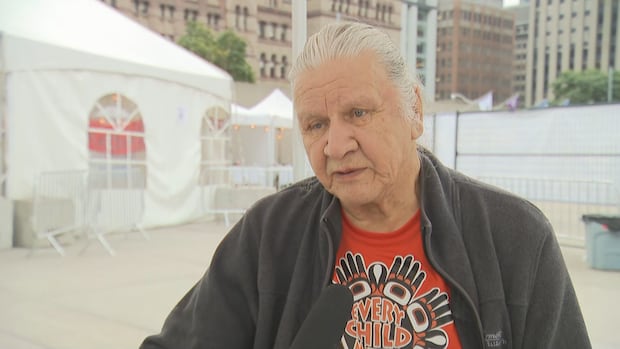
Cree Elder Thomas Louttit, who grew up in Moose Factory, Ont., is one of those survivors. He told CBC News he attended four different residential schools — the worst of them being St. Anne’s Indian Residential School in Fort Albany, Ont.
There, he said diseases were rampant and children, including him, were forced to forget their language, become estranged from family members and deal with sexual and physical abuse.
“We became violent,” he said Wednesday. “We weren’t taught to be nice.”
“I was angry,” he added.
WATCH | Carney makes his remarks at Ottawa’s National Day for Truth and Reconciliation: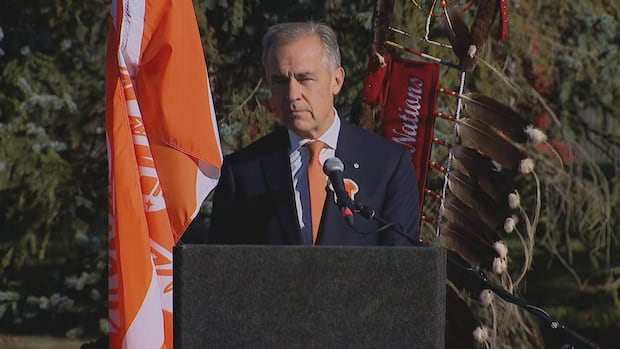
Work of reconciliation ‘far from finished,’ Carney says
Prime Minister Mark Carney, speaking from Edmonton, marked the sixth National Day for Truth and Reconciliation with a call for deeper learning and action, saying ‘our job is to move together as far and as fast down the path as we can.’
Louttit was in the residential school system for 10 years, starting at the age of five. He wasn’t allowed to speak with his siblings — something he says he carried with him even when they returned home. He added he didn’t see his sister for 30 years, which is why it’s important to spend as much time together as possible now.
“It took me a long time to say I love you,” he said. “It’s not an easy journey.”
As for non-Indigenous people, Louttit said his ask is simple: listen.
“We listen to you people for too long,” he said. “That’s enough hurting.”
“Canadians need to remember that it’s not too far in our past,” he said. “[Residential schools] were very real. And the hurt that [children] suffered in those schools [is] very real.”
Speaking with reporters at Nathan Phillips Square Wednesday, Toronto Mayor Olivia Chow said truth and reconciliation must not be practiced on just one day, but rather over a lifetime.
“It is both our spirit but also our action. It’s not just about learning the truth. The recognition, reconciliation part is really that collectively we take action,” she said. “Taking good care of each other, connecting with each other. That is what we need in this city, in this country, in this world.”
In a statement Wednesday, Ontario Premier Doug Ford and Minister of Indigenous Affairs Greg Rickford said the National Day for Truth and Reconciliation is about honouring survivors of residential schools and remembering the children who never returned home.
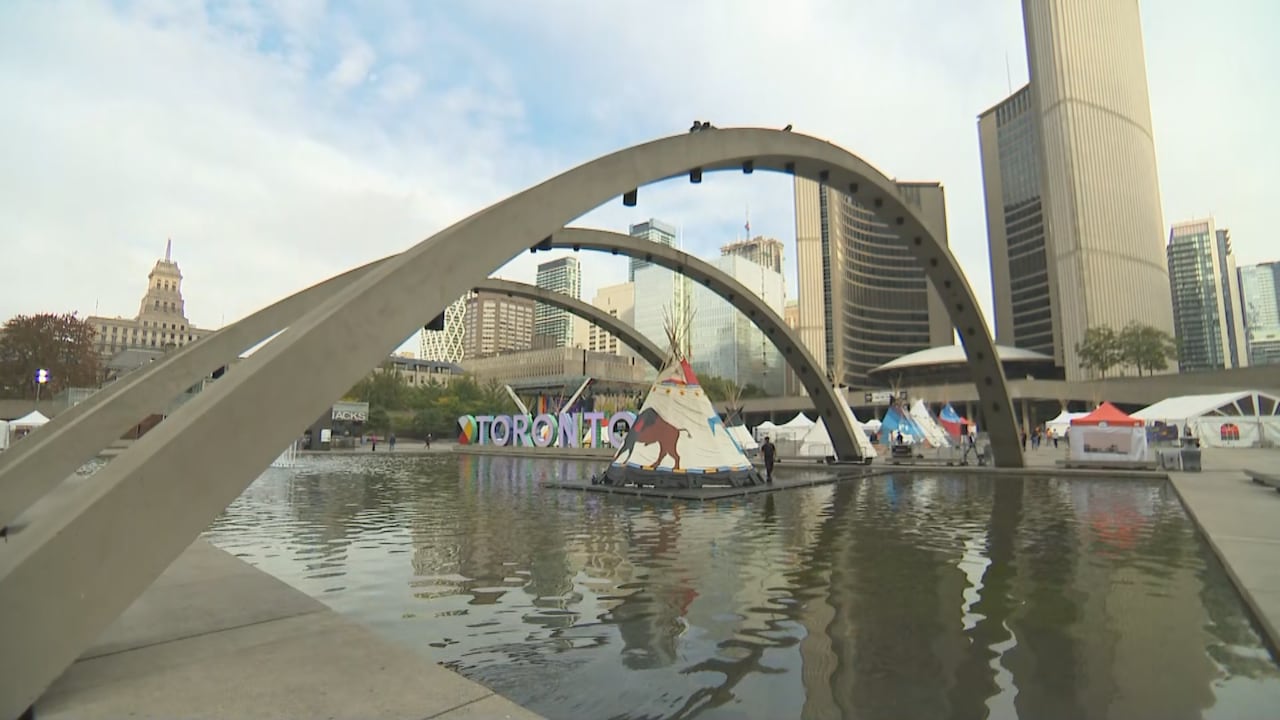 At Nathan Phillips Square, an orange flag waved in the wind, as Indigenous elders led a sunrise ceremony, accompanied by a sacred fire, drumming and stories from residential school survivors. (Ivan Arsovski/CBC)
“While some might think of residential schools as distant history, Canada’s last Indian Residential School only closed 30 years ago,” the statement says. “By listening to and learning from Survivors, we can build a path forward rooted in mutual respect, awareness and action.”
Darren McGregor, who was at Nathan Phillips Square Wednesday, is a firekeeper, meaning he ensures the fire is kept as a safe prayer space, clean and pure.
“When we go to that fire … we could talk to [the] creator … we can talk to our ancestors,” he said. “Some people have come with heavy hearts.”
McGregor told CBC News the fact that there is a National Day for Truth and Reconciliation is a step in the right direction, but it’s only a percentage of the way there.
Changing someone’s behaviour is easy, altering someone’s attitude is doable but modifying someone’s values is a lengthy process, he said.
“The whole process of residential schools, we’d say, is watered down over the years,” McGregor said. “It makes it a little easier for people to hear those stories. But the actual truth of what had happened to some of these survivors is absolutely horrendous.”