
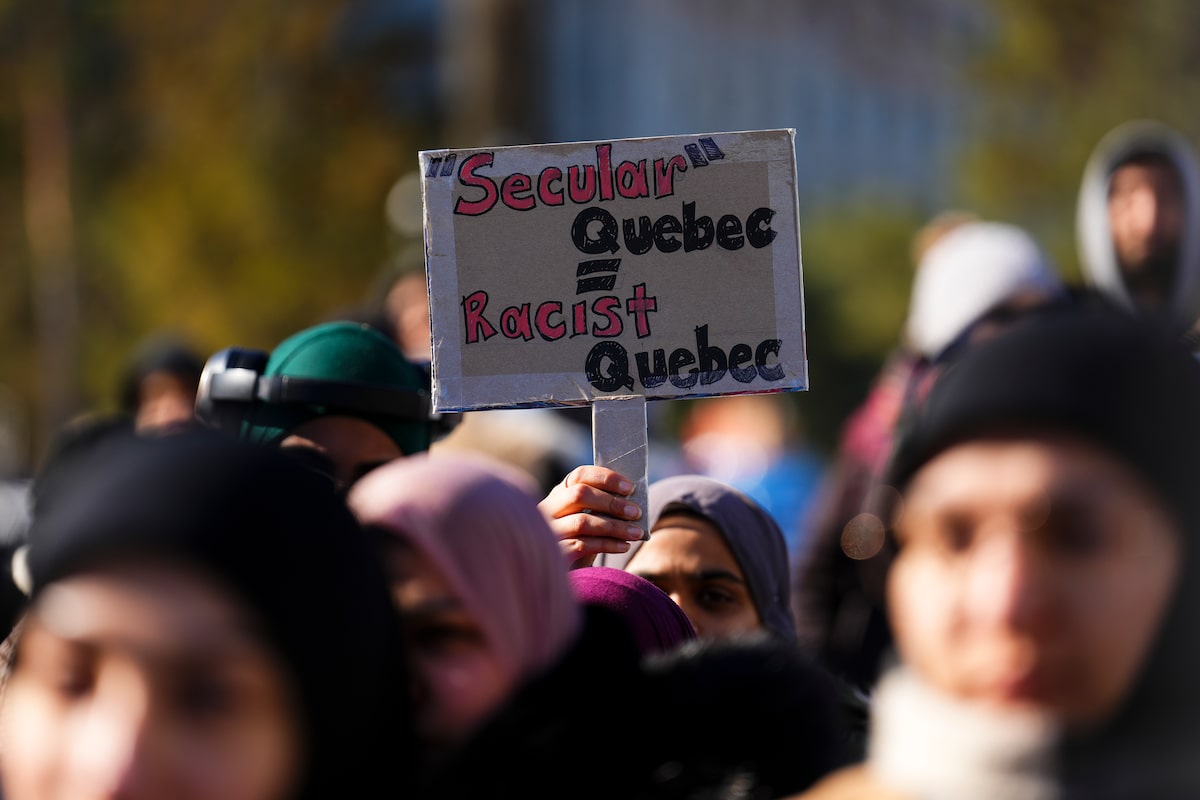
People congregate outside the Supreme Court of Canada as the court hears appeals regarding Quebec’s secularism law (Bill 21) in Ottawa on March 23.Sean Kilpatrick/The Canadian Press
David Winch is an opinion columnist at the Sherbrooke Record who writes on culture and politics.
In the summer of 1969, I was a young language-exchange student from Ontario, living in suburban Ste. Foy, near Quebec City. The family there who hosted me also attended the local Catholic parish. One day, as we filed into the church for mass, I remember being a bit shaken by what I saw in the parking lot next door: what appeared to be a motorcycle gang, looming ominously around their Harleys. I moved briskly inside.
But as I peered behind us somewhat nervously after the service started, I saw that they had entered the sanctuary. They were attending mass, too.
And of course they were. Looking back years later, I realized these were likely just guys out riding their motorcycles on a Sunday. What’s more, this was also the very tail end of a time when virtually everyone in French Quebec society attended some kind of Catholic service: rich and poor, worker and farmer, young and old, casual cyclist and beefy biker.
That culture imploded throughout the 1960s and 1970s – or, as commentator Lysiane Gagnon recalled wryly, the Church in Quebec “evaporated.” The Quiet Revolution prompted a backlash to the nearly monolithic control of the conservative Roman Catholic Church in the province, transforming Quebec culture to the point that secularism became its own kind of religion.
Today, in 2026, Quebec society appears to many English Canadians to have gone even further in that shift, veering jarringly toward becoming a place that barely tolerates religion in public. Headlines highlight restrictions that mimic secular France: limits on public prayer, on religious dress in public employment, and on any hint of proselytizing in schools. Its nationalist parties compete to distance themselves from any signs of religiosity. And secularism is often a reliable issue on parties’ agendas. “Quebeckers are generally very favourable to the idea that the state and church need to be separate, and that’s been the case for decades,” pollster Sébastien Dallaire of Léger Marketing told CBC in 2025.
Judgment on Quebec secularism law may land by end of November, Supreme Court chief justice says
Yet, in this year’s pivotal provincial election campaign so far, there has been little sign that secularism is a key concern. Tariff wars have largely overshadowed social issues. TV news panels mostly discuss Mark Carney, Donald Trump and Premier Christine Fréchette’s strategic investments. Leaders’ debates often focused on the possibility of a referendum. Even nationalists’ warnings in anticipation of a high-profile Supreme Court ruling on Bill 21, which bans certain religious symbols for civil servants, have not been prominent in any news cycle. The Parti Québécois’ loud push for extending the CAQ government’s secularism laws, meanwhile, does not appear to be resonating with the electorate.
It turns out, the drive to laicité – translated imperfectly as “secularism” – might just be about which religion you belong to. The recent push looks to be more of a specifically anti-Muslim reaction, following a wave of immigration in the early 2000s from North Africa and the Middle East. Indeed, at the same time, religious activity in Quebec overall actually appears to be on a modest upswing. The 2021 federal census reported that, even while most were non-practising, 73 per cent of Quebeckers identified themselves as religious adherents, while about 26 per cent indicated “no religion and secular perspectives.”
Making Quebec secular may also be increasingly a preoccupation of boomer-age voters. Indeed, the secularist and sovereigntist Parti Quebecois decisively lost the 2014 election, due in part to outrage among young voters over the Pauline Marois government’s proposed secularism charter in 2013, “a project that repelled a generation moving beyond identity-based politics,” as commentator Chantal Hébert wrote in l’Actualité magazine. While the PQ’s youth wing rejected the idea of banning religious symbols for public-sector employees in 2017, the rift only grew in the 2018 election, reducing the party to a historic low number of seats in the National Assembly.
In the 2020s, there has been more generational pushback to secularism. The number of baptisms among Quebec teenagers and young adults – especially women – has steadily risen. Back in 2001, just seven new adherents were baptized over the Easter weekend in the Quebec City archdiocese; by 2025 that number had jumped to 104. Montreal parishes have also seen a sharp rise.
Gen Z stands out here, with 45 per cent of baptisms initiated by people in the 15-to-25 age bracket. While first- and second-generation immigrants are disproportionate among the newly baptized, children of boomer-age francophone Quebeckers who had rejected religion are also very visible. The baptism trend has mirrored a rise in France, where the number of adult baptisms each year has tripled since 2016, hitting 13,000 this year.
Of course, a bounce in religious interest has been showing up in unlikely locales throughout the West: among Silicon Valley techies, in bohemian lower Manhattan, and on the Left Bank of Paris. Quebec has echoed this revival. Maybe it’s just a “boomlet,” or maybe it’s a social turning-point in which religion has become countercultural – but either way, it is hard to ignore.
In April, the tabloid Journal de Montréal – an often pitch-perfect bellwether of the Quebec popular mood – published an Easter-weekend feature by writer Geneviève Lajoie. “After years of decline, the Catholic Church in Quebec is experiencing an unexpected resurgence: a sudden enthusiasm among young people for the faith, a phenomenon attributable in particular to social networks,” she wrote. “Instagram and TikTok are teeming not only with posts from teenagers displaying their Christian spirituality in today’s language, but also with churches that are increasingly adopting youth codes: quizzes on prayers or even a ‘coach’ on Lent for dummies.” The writer concludes, paradoxically, that “the debate on secularism in Quebec is also prompting some people to take an interest in their religious heritage, as a matter of ‘understanding their own identity.’ ”
New Quebec prayer restrictions change rules at universities, transit agencies
Anecdotal evidence suggests this is true. In the early 2020s, I began seeing a new magazine on the free-periodicals racks outside supermarkets, alongside all the food guides, travel brochures and coupon offers. It was Le Verbe, a slick little magazine whose print and online editions now reach 400,000 readers and has since emerged as a dynamic multimedia concern. Produced by an independent, Quebec City-based Catholic media group, Le Verbe (The Word) reports that 2025 was a year of “spectacular growth.” Its annual report reflects that, showing that their podcasts, YouTube channel, Spotify offerings and TV programs in Quebec and France together registered 2.5 million views annually, a 63-per-cent increase in digital audience over 2024.
Antoine Malenfant, 41, an amiable former sociology teacher, is content editor at Le Verbe Médias. He says that a key business decision in sparking this upsurge was making the bimonthly magazine free. This liberated it from appealing to paid subscribers and “preaching to the choir,” he told me, while casting a wider net in the public square. Younger readers responded to the “relaxed” tone of the general-interest magazine, and its focus on real-life moral choices.
Le Verbe was first launched during a short-lived 1970s evangelical movement, one that once drew 50,000 adepts to Olympic Stadium in 1977. The original Christian print magazine survived several near-bankruptcies and relaunches under various names over the course of 50 years. Suddenly, after lockdowns in the early 2020s, it began to surf on a wave of growth.
Bubbly talk from religious folk still prompts sharp reactions, however. For the outspoken Journal de Montréal columnist Richard Martineau, who is known for his brashly anti-woke takes and who noted the phenomenon in a column titled “Jesus Christ Superstar,” the trend is baffling. For him, well-meaning woke ideology has undermined order and authority, sending young people to search for it in Christian theology. He views the notion of a religious revival as the superficial rearguard action of an institution still in decline.
This is the paradox of religion in Quebec. The province is studded with empty and repurposed churches, their spiking steeples rising over condo complexes. The residual Saint-Jacques bell tower looms silently over the Latin Quarter campus of the Université du Quebec in Montreal. Former seminaries serve as student dorms. Concordia University has absorbed the haunting, gothic Grey Nuns complex as residences. And in a deconsecrated church in Sherbrooke, Que., a restaurant sassily named OMG offers entrees touted as “divine,” but with a décor including anti-clerical montages.
New social-science research, however, suggests that Mr. Martineau and other critics’ negative views of religion are being offset by growing, “invisible” religious activity. Deirdre Meintel, an anthropologist at the University of Montreal, organized a large-scale study of religious activities in Quebec in the early 2020s. Her team of 42 academics and graduate students delved into the varieties of religious activity in 232 centres of religious activity – ranging from traditional Catholic to evangelical Christian, Muslim, Jewish, Buddhist and Hindu congregations, through to Wiccan and charismatic assemblies – in Montreal and five medium-sized cities and towns across the province. They researched 81 of these faith groups in depth.
Opinion: In Quebec, laïcité has become its own kind of religious orthodoxy
The cover blurb of their book, La Pluralité Religieuse au Quebec, offers a briskly professorial warning against “misconceptions” – among them that, in Quebec, “the majority have adopted a quasi-atheism; that great religiosity is just the province of immigrants; that there is an opposition between religion and spirituality; … and that [there is] a moribund Catholic Church.” The anthropologists’ on-the-ground findings contradicted these popular views, discovering that religion in Quebec has shifted from being a public activity to a private domain. Adherents do not publicize their religious affinities to their communities, or even sometimes to their own families. As such, Catholic and Christian evangelical activities are frequently shrouded in “discretion,” and many religious activities are carried on in out-of-the-way locales. Indeed, the young anthropology researchers were sometimes gobsmacked to discover members of their own extended family participating in Christian revival events, when they had no inkling of their religious interest.
So is this latest bubbling of religious practice in this famously irreligious province a lasting trend? After all, there was a Christian evangelical wave after the Quiet Revolution, but it looked distinctly reactionary, and its energy dissipated in the turbulent late-1970s.
For his part, Mr. Malenfant of Le Verbe Médias grew up in a religious family and, unusually for his 1980s Quebec generation, maintained his faith. He says that, among the younger audience he is trying to reach, many had never set foot in a church.
For him, the CAQ government’s secularist push was largely generational. “There’s a generation gap on religion here. The young are looking for answers. The boomers don’t want to hear about it. Young people have no such preconceptions. There is a vibe shift here. This is all new territory.”
As surprising as a revival might seem, religiosity in Quebec may be set for its own quiet revolution. Perhaps the dwindling, gray-haired congregations of today will be steadily joined by newly minted parishioners both rich and poor, worker and farmer, young and old, casual cyclist and beefy biker.