
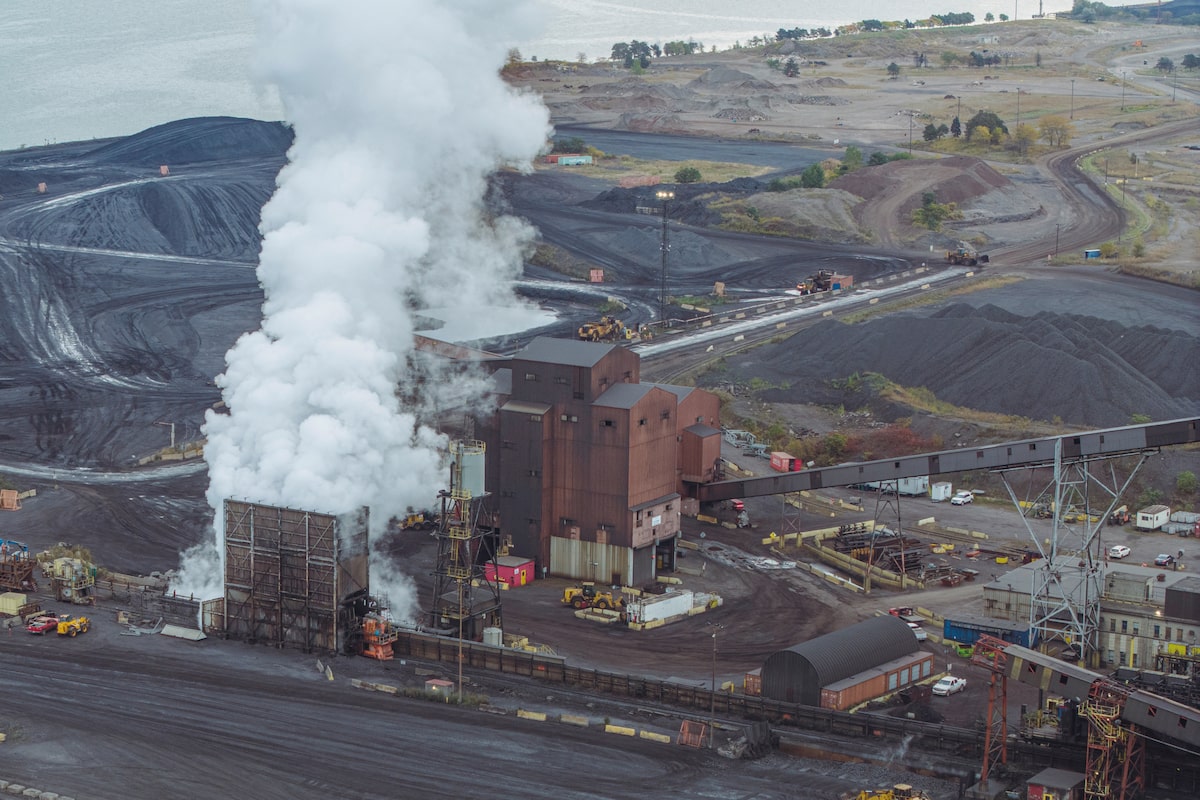
The Stelco Hamilton Works steel mill, owned by American steelmaker Cleveland-Cliffs, in Hamilton on Tuesday.Carlos Osorio/Reuters
Cleveland-Cliffs Inc. CEO Lourenco Goncalves says Ottawa’s potential lawsuit against the American steelmaker for allegedly violating employment commitments in Canada makes no business sense, promising that laid-off workers will be called back if the trade war ends soon.
On Monday, the Cleveland-based steelmaker said it plans to lay off a total of up to 500 workers at Stelco’s Hamilton plant and its Lake Erie Works operation in Nanticoke, Ont. The company said the layoffs were necessary to ensure its survival during the conflict.
When the federal government approved Cliffs’ $3.4-billion acquisition of Stelco Holdings Inc. in 2024, it imposed a series of legally binding conditions, including maintaining for five years at least the same number of unionized employees in Canada, and the vast majority of non-unionized workers.
At the time, Stelco employed approximately 2,400 people in Hamilton and Nanticoke, according to data from Ron Wells, president of United Steelworkers Local 1005, and that number remains roughly the same.
Six charts that explain Canada’s countertariffs on U.S. goods
Now with hundreds of layoffs imminent, Prime Minister Mark Carney said that the government is considering legal action against Cliffs for not living up to its employment guarantees.
“The company made representations, and has legal obligations for employment,” Mr. Carney said in a news conference on Wednesday. “We intend to use all powers that we have, and pursue them to the fullest extent of the law.”
There is legal precedent that the government can look to as it weighs suing Cliffs. After U.S. Steel acquired Stelco in 2007, it made promises under the Investment Canada Act around jobs and production levels. The federal government later sued the company for allegedly reneging on its legally binding commitments.
A settlement was reached in 2011, with the American steelmaker agreeing to new terms.
In an interview with The Globe and Mail on Thursday, Mr. Goncalves said that he takes the Prime Minister seriously. “He said that he will sue us. But is this a good business decision for Canada? I don’t think so.”
Prime Minister Mark Carney in North Vancouver, B.C., on Tuesday.DARRYL DYCK/The Canadian Press
Two years ago, Mr. Goncalves said the Canadian government “rolled out the red carpet” for the company when it announced its intentions to buy Stelco.
“I believed in Stelco. I believed in Canada. I believed in the USMCA,” said Mr. Goncalves, referring to the United States-Mexico-Canada Agreement, which saw Canada and the U.S. trade tariff-free in steel.
But since then, the market has changed dramatically. Owing to the 50-per-cent tariffs imposed last year by U.S. President Donald Trump, Stelco can’t sell galvanized steel into the U.S. any more because the business is uneconomic.
“The underlying condition of the market changed a lot, and it was beyond my control,” he said.
Ottawa launches $100-million steel shipping rebate program as U.S. tariffs weigh on industry
Meanwhile, if a trade pact on steel between Canada and the U.S. is reached soon, Cliffs intends to recall all the laid-off workers, Mr. Goncalves said.
The federal government, however, has been critical of Cliffs’ decision not to accept financial aid that was on the table for the company’s Canadian operations.
Gabrielle Landry, deputy director, media relations with the Office of Industry Minister Mélanie Joly, told The Globe earlier this week that Cliffs’ decision was “extremely disappointing.”
Mr. Goncalves said he declined the government’s offer because it wouldn’t have addressed the root problem, comparing the situation to a doctor offering a sick patient cash instead of prescribing a drug to cure their illness.
Accepting money from Ottawa would have not made sense, he said, because the company had no need for it for operating or capital expenditures.
Ford calls on Ottawa to do more to help tariff-hit steel and auto sectors
The medicine the company needs most, he said, is for Canada to reach an agreement with the U.S. that will see the steel tariffs reduced to 25 per cent, or lower, a level that would allow Stelco to once again compete in the U.S.
“I’m not asking for anything other than allow me to have a market to sell my galvanized steel,” he said. “That will resolve the problem.”
Mr. Carney made it clear on Wednesday that Mr. Goncalves’s public backing of Mr. Trump’s tariffs irked him, pointing out that he “applauded President Trump for putting those tariffs on.”
Indeed, the Brazilian-born Mr. Goncalves in a conference call last year thanked the Trump administration for having “the courage to implement these tariffs.”
But Mr. Goncalves said those comments shouldn’t be perceived as an attack on Canada, but rather as support for Mr. Trump’s policies to bolster the steel industry in the U.S., in part by cracking down on imports of cheap foreign steel.
G20 Steel forum calls for more tariffs, fewer subsidies to fight excess capacity
Mr. Goncalves said he was in favour of a “Fortress North America” approach that would see the U.S., Canada and Mexico band together to keep out cheap imports and bring more jobs and investment back to North America.
The federal and provincial governments have rolled out multiple initiatives to help the domestic steel industry, including providing hundreds of millions of dollars in funding, most notably a $500-million loan to Algoma Steel Group Inc.
Ottawa has also aggressively cracked down on the dumping of foreign steel into Canada through the imposition of tariff-rate quotas and mandated that publicly funded projects use Canadian steel wherever possible.
Mr. Goncalves said the Canadian government’s various moves have helped Stelco compete far better in the hot rolled steel segment, but more needs to be done in the galvanized segment.
“In galvanized steel, we don’t have a business,” he said.