
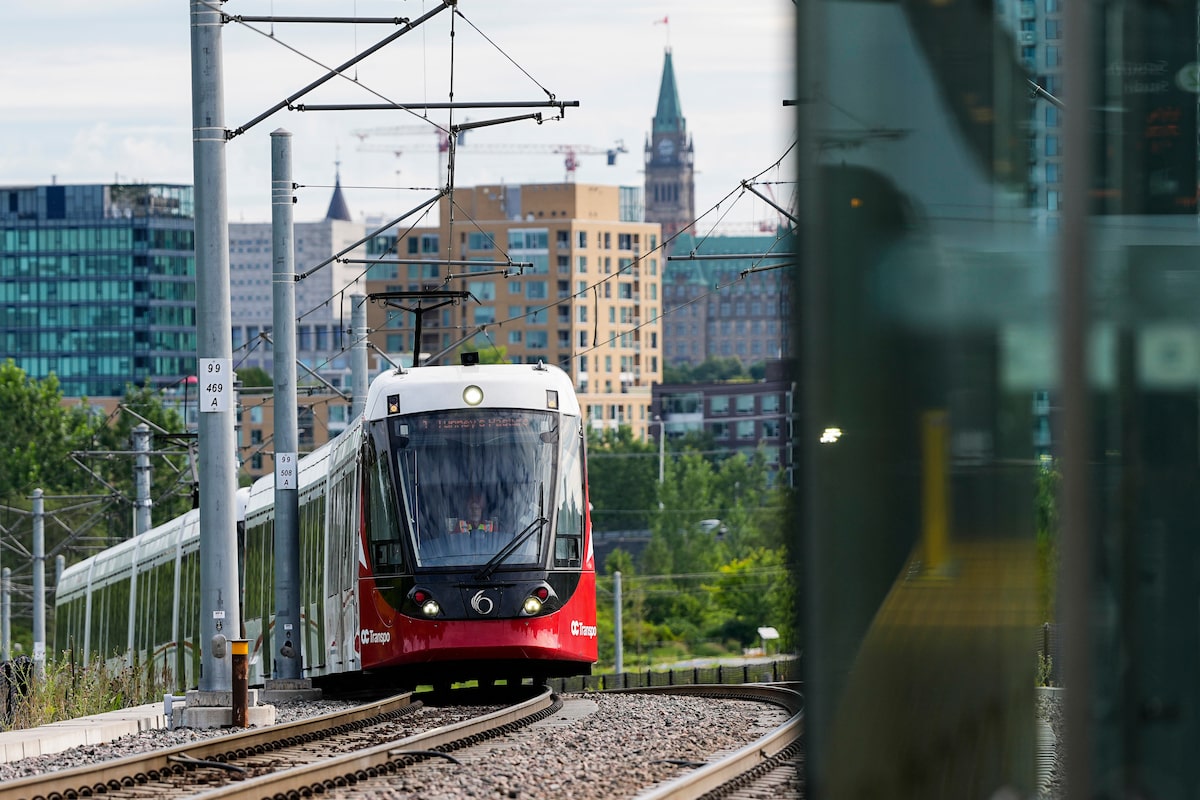
An OC Transpo light rail train makes its way along Line 1, in Ottawa, on Aug. 14. Transit is a top-of-mind issue for local voters ahead of the Oct. 26 election.Justin Tang/The Canadian Press
Federal politics and Parliament dominate the typical Canadian perspective on Ottawa, the nation’s capital. The phrase “Ottawa says” has long been synonymous with decisions by the federal government.
But, with municipal elections across Ontario on Oct. 26, Ottawa voters are getting set to make decisions of their own, including choosing who will be the next mayor of their city, the second-most populous in Ontario and home to more than one million people.
There’s a debate underway about who can best manage the issues that are top-of-mind for local voters, including crime, homelessness, public disorder, transit and municipal taxation.
Although there are 14 names on the mayoral ballot, polling shows that incumbent Mark Sutcliffe is facing a concerted challenge from at least three of the candidates: veteran city councillor Jeff Leiper; businessman Alex Lawson; and Neil Saravanamuttoo, a former senior economist with the federal Finance Department.
Pollster David Valentin, the principal at Liaison Strategies, says the mayoral race in Ottawa is one of the most interesting ones in Ontario right now.
“It seems more competitive,” he said in an interview. “I think, all things being equal, that [Sutcliffe] will probably get re-elected. The field is so split, it seems unlikely to me that that would not be the case.”
With a big field of candidates, Mr. Valentin said that Mr. Sutcliffe could win another term with 35 per cent or so of the vote.
“But the chemistry is there that something interesting could happen. There could be an upset.”
Ottawa Mayor Mark Sutcliffe in April. Polling ahead of the election shows incumbent Mr. Sutcliffe is facing a concerted challenge from at least three candidates.Keito Newman/The Canadian Press
Whoever wins on Oct. 26 gets to govern a municipal area created by the provincial government in 2001 to combine the former Regional Municipality of Ottawa-Carleton and 11 other municipalities into a single city.
Canada has many large cities, but only one national capital.
“It’s a city unlike any other in Canada,” said Mr. Sutcliffe, a former broadcaster who was new to politics when he was first elected in 2022. He succeeded Jim Watson who had a 14½-year run over two stints between 1997 and 2022.
The city faces Quebec on the other side of the Ottawa River. Key players that any mayor has to deal with include the federal government and the National Capital Commission, a federal Crown corporation that manages 11 per cent of all the land in the capital region, on both the Ontario and Quebec sides of the river. Ottawa is also home to scores of embassies and diplomatic residences.
“It’s a unique city with unique challenges, but it’s also a big city with many of the same challenges as other big cities in Canada,” said Mr. Sutcliffe.
Mr. Valentin has tracked traffic, transit and city spending affecting property taxes as issues in the mayoral race. And there’s crime. “Perceived, increased homelessness, whether it’s real or not. Graffiti. All of these things are feeding into a feedback loop now where people are increasingly telling us they feel unsafe in different parts of the city,” he said.
Key rivals for the mayor’s job are pushing the narrative that Mr. Sutcliffe has been idle, which he rejects by citing movement on a number of files.
“I think we have gotten a lot done in the last four years.”
He notes his administration has negotiated an agreement with the province that would see Ontario Premier Doug Ford’s government take on responsibility for the O-Train LRT; has ordered scores of new buses; enjoyed solid relations with the federal and provincial governments; hired more police officers; and committed to end youth homelessness by 2030.
Six Ottawa Liberal MPs, including Defence Minister David McGuinty and former treasury board president Mona Fortier, have issued a statement in support of him.
Five prominent conservatives, including former federal cabinet ministers John Baird and Lisa Raitt, did the same.
A homeless man sets up his tent outside the Bank of Canada in Ottawa in August, 2024. A 2024 city-led count found that 2,952 people were experiencing homelessness in the nation’s capital.Dave Chan/The Globe and Mail
In an interview, Mr. Sutcliffe acknowledged visible downtown homelessness, a concern for many. “I understand why residents feel that way because it does feel, at times, like the problem is growing faster than the solutions we are able to provide,” he said.
“That’s the reality, not just in Ottawa, but elsewhere,” he said. “It does feel, at times, like whenever we help one person, there’s another person who is in need of help and that’s why we need to step up our efforts.”
A 2024 city-led count found 2,952 people experiencing homelessness in the nation’s capital, up slightly from 2,612 in the previous count in 2021.
Mr. Leiper, a city councillor for 12 years, has pledged to boost crisis response in Ottawa to help tackle homelessness, and says he would build more supportive housing on city-owned land for people who are relying on shelters, as well as more affordable not-for-profit housing.
As part of a wider investment program in city services, he would restore bus routes cut under Mr. Sutcliffe’s tenure.
Mr. Leiper said he is “open to some affordable and predictable tax increases” to raise the $12-million required to pay for the buses, as well as to cover other costs. But he says the claim by Mr. Sutcliffe that he is planning 7-,8- or 9-per-cent tax increases is not true.
“My commitment is not to do that. My tax increase will be affordable, and my tax increase will be predictable,” he said, so there are not “big spikes.”
In an interview, Mr. Leiper says there is a currently a $10.8-billion funding gap to maintain the city’s infrastructure, including roads, sewers and community recreation centres. On top of tax rises, he would introduce an infrastructure levy, estimated at about $40 per Ottawa household a year, to maintain repairs, raising $25-million annually.
Mr. Leiper says bringing in money for infrastructure improvements will provide greater leverage with the federal and provincial governments when it comes to asking for funding.
Although their political styles may be different, Mr. Leiper believes he could work with Premier Ford.
He would seek to build a “productive and good” relationship with Mr. Ford but be “more vocally firm with Queen’s Park” than Mr. Sutcliffe has been about the needs of Ottawa residents, he said.
Ottawa’s intransigent homelessness and addiction problem is a focus of the mayoral campaign of Mr. Lawson, a 38-year-old carpenter who runs a company building wooden frames for houses in the capital.
His campaign headquarters is in the heart of Chinatown, near a now-shuttered safe injection site, with dozens of addicts milling about the streets nearby.
Not only do such clusters of addicts keep customers from downtown businesses, Mr. Lawson says, but drugs are fuelling crime and kids on their way to school are finding needles on the street. The failure to adequately address the problem is also a blight on the lives of addicts, who deserve help, he says.
Mr. Lawson has consulted addicts themselves and spent time with outreach teams, shelters and the police to try to find answers. If elected, he says he would build a rehab facility that would provide wrap-around supports, including training to get people back into the workplace and help to find housing.
Candidate Alex Lawson says his upbringing in a lower-income Ottawa neighbourhood and his business experience give him a multidimensional perspective on the city’s needs.Charlie Woolf/The Globe and Mail
He said, in an interview, that his upbringing in a lower-income Ottawa neighbourhood and his business experience give him a multidimensional perspective on the city’s needs, including on public transport. One of his first acts, if elected, would be to reintroduce express bus routes.
His most eye-catching policy has been his pledge to remove every on-street parking meter in the city, saying they are deterring residents from shopping on metered streets.
Mr. Lawson says he never saw himself getting into politics. He voted for Mr. Sutcliffe last time but was looking for an alternative after seeing no tangible improvements on crime, traffic, transit and affordability and “seeing nobody.”
“It started as a joke a couple of times. People saying, “Well, why don’t you do it? Eventually it was just like, you know what – why don’t I do it?”
Mr. Saravanamuttoo said he was driven to run for mayor after trying to influence municipal policy as a community organizer. But he found working from the outside just did not lead to the changes he wanted to see.
His flagship “buck a ride” policy for public transit will, he says, attract more people to use the system and cost the city $83-million a year.
To address Ottawa’s lack of affordable housing and prohibitively high rents, the economist wants the city to invest heavily in public housing not just for low-income residents but for middle-income residents as well. Rather than creating more suburban sprawl, with its attendant infrastructure costs, he believes more housing could be built on surplus municipal and federal land near the centre of the city.
And to address the capital’s homeless problem, Mr. Saravanamuttoo wants to build a “village” of micro homes made of shipping containers as a transitional fix until permanent housing can be found for unhoused people. He has yet to seize on a location for this but says such projects have been established successfully in New Brunswick and nearby in Gatineau.
“Location is going to be key,” he said in an interview. “It is something that needs to be quite frankly discussed and negotiated with residents of Ottawa.”