
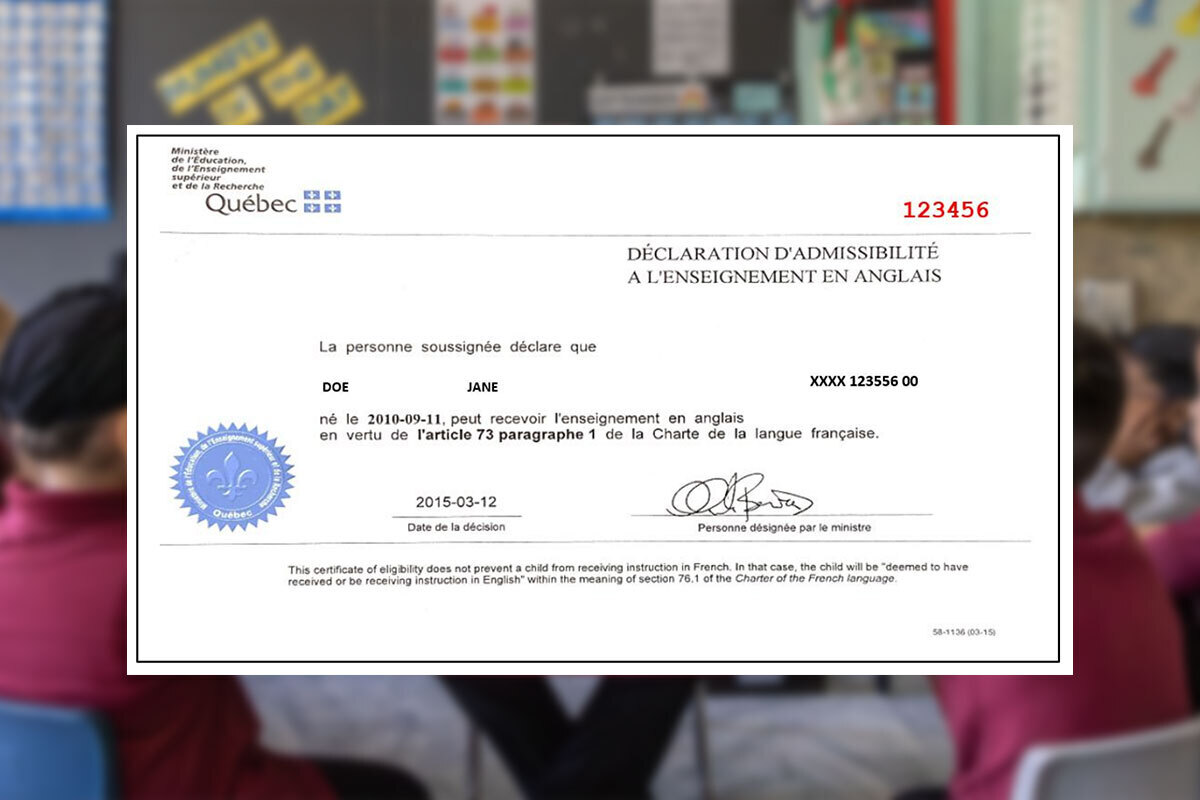
A legal category created almost 50 years ago to determine who can attend English schools has become one of the main ways Quebec decides who qualifies for government services in English.
But researchers, constitutional lawyers and language-rights advocates argue that eligibility for English schooling does not necessarily identify who speaks English, needs services in English or belongs to Quebec’s anglophone community.
“Number 1, it’s vague, and number 2, it’s impossible to properly implement,” said Michael Bergman, a constitutional lawyer involved in several legal battles over Quebec language laws.
“It’s an imperfect fit with who needs the services in English and who the anglophone community actually is,” added historian Patrick Donovan of the Quebec English-Speaking Communities Research Network.
The issue resurfaced last month when Élections Québec cited English-school eligibility as one criterion for receiving election-related services in English.
The controversy revived a debate that has simmered since the adoption of Bill 96 in 2022: whether a legal test designed for access to English schools should also determine who receives government services in English.
A school-rights category
Quebec created eligibility rules for English elementary and high school education in 1977 through the Charter of the French Language, commonly known as Bill 101.
The system was designed to limit access to English schools largely to children of parents who had attended English schools in Canada, while requiring most children of immigrants to study in French.
For decades, the eligibility test was used solely to determine access to English primary and secondary education.
That changed in 2022.
Through Bill 96, the Coalition Avenir Québec government amended the charter to limit access to English government services to certain categories of Quebecers. Among them are people “declared eligible to receive instruction in English.”
A notice on Quebec government websites says English content is intended only for certain groups, including those “declared eligible to receive instruction in English and who have been issued a certificate of eligibility for instruction in English.”
The restrictions are part of Quebec’s effort to ensure the government is “exemplary” in its use of French while reserving most English services for what it describes as the historic English-speaking community.
By communicating with immigrants in French, the CAQ argued, Quebec would emphasize that French is the province’s “official and common language.”
But Bergman argues the government repurposed an educational rights category for an entirely new purpose.
“Bill 96 had to figure out how to restrict English-language access to government services,” said Bergman, who is leading a Task Force on Linguistic Policy constitutional challenge to Bill 96.
“And they came up with this rather convoluted and complex and somewhat illogical mechanism.”
Why some say it misses the mark
When Bill 96 was adopted, Quebec argued that eligibility for English schooling provided an objective legal definition of historic anglophones rather than relying on self-identification.
At hearings, Simon Jolin-Barrette, Quebec’s justice minister, said the English eligibility requirement referred to people who already had “acquired rights.”
Critics, however, say school eligibility measures constitutional education rights, not language needs.
“School eligibility is a benchmark for education policy, but it’s not really a transferable benchmark for other services,” Donovan said.
“It’s a sort of bureaucratic school-rights category masquerading as an identity category.”
In a research brief published last year, Donovan found that many people who qualify for English schooling do not fit what most people would define as anglophones.
He found that 52 per cent of rights-holders under 18 did not have English as a mother tongue in 2021, while 37 per cent did not speak English at home.
Outside Montreal, provincial data showed that 36 per cent of certificate holders had French as their mother tongue.
Quebecers who attended English schools can pass those rights on to their children, regardless of the language spoken at home. That allows the children of some francophone parents and bicultural couples to study in English, for example.
As a result, Donovan said, people who hold English-school rights are not necessarily the people most likely to need government services in English.
“To call these people ‘historic anglophones’ is a misnomer.”
A recurring controversy
The practical difficulties of applying the eligibility test have re-emerged repeatedly since Bill 96 was enacted.
In 2024, Quebec issued a health-care directive widely interpreted as requiring proof of English school eligibility to receive services exclusively in English.
The move sparked a backlash. The National Assembly later unanimously passed a motion affirming that English speakers would not have to produce eligibility certificates to obtain health care in English.
Today, Quebec says it relies on a good-faith declaration system.
People seeking services in English are asked to attest that they fall into one of the eligible categories. The same principle applies to visitors accessing English-language government web pages.
“The CAQ came up with this kind of almost Monty Python-esque, Kafka-esque idea that if you said in good faith and on your honour that you were eligible, they would accept that,” Bergman said.
Amid the current election campaign, Élections Québec initially sent French-only voter information and instructed election workers that English services were reserved for Indigenous voters and people eligible for English schooling.
Anglophone groups argued the policy risked depriving some English speakers of important election information.
Unilingual French election mailouts would mean “English-speaking electors with no or limited proficiency in written French” might not understand “where, when, how and for whom to vote,” according to a lawsuit seeking a reversal of the policy.
A court later ordered Élections Québec to prepare one bilingual mailing, with the judge citing evidence that “a large number of anglophone seniors (would) be unable to exercise their right to vote due to a lack of understandable information.”
The certificate problem
Critics say the issues go beyond who the category identifies. They also question how the system works in practice.
Not everyone who was eligible to attend English schools actually possesses a certificate.
Eligibility certificates were created when Bill 101 came into force in 1977.
“Many people do not have such a document either because they went to school before these kinds of documents were issued or they went to school in the rest of Canada,” Bergman said.
Others may never have obtained certificates because they attended French schools despite being eligible for English ones.
Adding to the complexity, Quebec’s Education Ministry says the certificates exist for a specific purpose: granting access to English schooling.
Once someone has completed high school, the ministry says applications for declarations of eligibility are refused because the system was designed to provide access to English schooling, not to recognize a permanent status.
“A declaration of eligibility is intended to permit or confirm access to English-language primary or secondary education,” Education Ministry spokesperson Esther Chouinard said.
“It is not meant to retroactively recognize a status once a student’s educational pathway has already been completed.”
Could proof be required one day?
For now, Quebec accepts declarations made on honour.
But some Quebec anglophones worry future governments could toughen the rules.
A note displayed on English-language government web pages states that “a supporting document is not currently required” if visitors declare they qualify for services in a language other than French.
Bergman notes that the honour system is not set out in Bill 96 itself.
“This is the government saying as a matter of policy, we’ll accept that, but the government could change it,” he said. “It could be changed at any time.”
Eva Ludvig of the anglophone-rights group TALQ said the wording leaves the door open to stricter requirements in the future.
“It depends on the government, depends on their policies, depends on who’s in charge,” she said.
“A lot of people feel this would be an imposition, that it would be undemocratic. In a democracy, you don’t walk around with an identity paper to get government services.”
A certificate you may need later — but can’t get later
In January, Quebec’s English school boards urged anglophone parents who opted for the French school system to obtain English-school eligibility certificates for their children.
The reason: The certificates may be needed one day.
That day could come if the Parti Québécois wins the Oct. 5 election and follows through on its promise to extend Bill 101 to English CEGEPs. The PQ has not explained how Quebec would determine who could enrol in English CEGEPs. Eligibility certificates could be one option.
Since Quebec has strict rules about when the documents can be issued, that could pose a problem for some otherwise eligible students who attended French schools and never applied for a certificate.
The Education Ministry says that since declarations of eligibility exist only to permit or confirm access to English primary and secondary education, “any application will be refused” once those studies have been completed.
The practice has been in place since Bill 101 was adopted in 1977, according to the ministry.
Editor’s Picks

The Gazette’s On Quebec Politics newsletter by Andy Riga breaks down key election issues, from polling shifts to legislative manoeuvring to ideas circulating in francophone commentary that don’t make it into English-language coverage.
To sign up, visit this page and check the box labelled “On Quebec Politics” before providing your email address.

A Montreal native, Andy Riga has been with The Gazette since 1991. He covers politics, language and other Quebec issues, and writes the On Quebec Politics newsletter. Montréalais d’origine, Andy Riga travaille au Montreal Gazette depuis 1991. Il couvre la politique, les enjeux linguistiques et d’autres sujets, et est responsable de l’infolettre On Quebec Politics.
ariga@postmedia.com