

Listen to this article
Estimated 4 minutes
The audio version of this article is generated by AI-based technology. Mispronunciations can occur. We are working with our partners to continually review and improve the results.
Two orphaned bear cubs were recently rescued after their mother was involved in a fatal train incident and found deceased by the side of a railway on Sept. 19 near West Loon Lake in Shuniah, Ont., a municipality located just east of Thunder Bay.
The Ministry of Natural Resources said in a written statement that it received multiple reports of the cubs after their mother was involved in the incident.
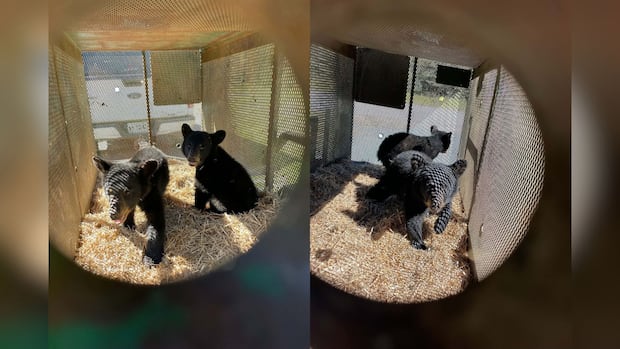
“Ministry staff determined the cubs were too young to survive on their own. On Sept. 22, staff safely captured the cubs and transferred them to a wildlife rehabilitation facility in Nipigon, [Ont.], where they will remain until they are ready to be released next year,” the ministry said.
Andrew Cotter, who was at his family’s cottage in the area for the weekend, says he first learned the bears were in the area from a friend who’d recorded video of the animals in their backyard directly behind the tracks the prior night.
Cotter said he was among those who called and reported the cubs to the ministry’s Bear Wise reporting line after he was informed the mother bear had been discovered and the cubs were seen climbing a tree nearby.
“It’s a good news story and a good ending. A lot of people had a vested interest [in West] Loon Lake, because we all love the wildlife that’s around us and we were very sad about the mother passing,” Cotter said.
Bears searching for food
During his last 30 years at the cottage, Cotter explained that there were “only a handful of years” when bears were sighted.
He said they’ll have significant sightings when the bears get “really friendly around humans,” noting how that likely only happened five or six times in the past three decades.
“I don’t think there’s any cycle to it, but where there’s food and there’s hungry bears and human interactions, that’s what happens,” Cotter said.
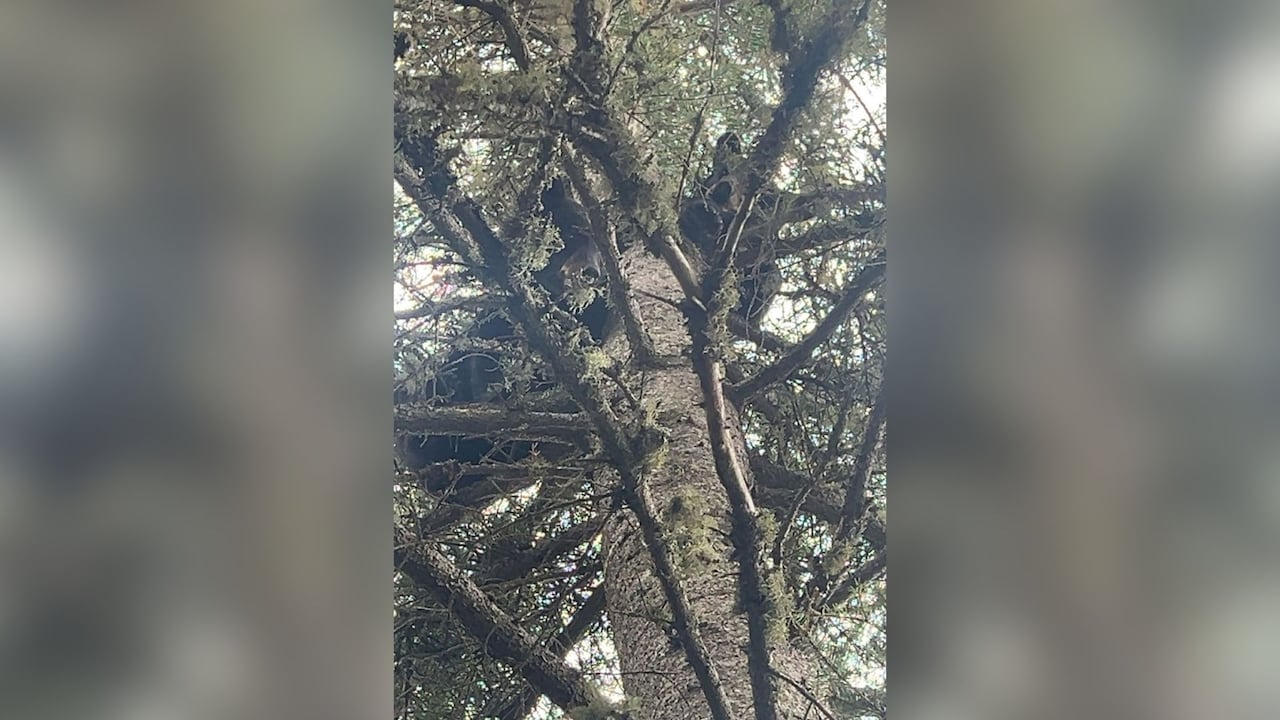 The bear cubs sit in a tree near where the mother bear was discovered. (Courtesy of Kaelah Cotter.)
The reality, Cotter added, is that railroad tracks also run through West Loon Lake.
“Engineers probably hit animals quite frequently, whether it’s bear, moose, deer [or] whenever you have humans interacting with wildlife it happens and there’s also [the] Trans-Canada Highway right there… So, you see it all the time. It’s unfortunate, but reality,” Cotter said.
Black bear sightings near communities can increase in the fall as bears actively seek food before hibernation, the ministry said.
At this time of year, it said cubs also still rely on their mother as they prepare for the winter months.
‘Lick barbecues, the grease, anything they can get at’
Everyone in the area is quite aware that they shouldn’t leave any attractants for bears, Cotter said, noting that they use social media and other platforms to spread wildlife awareness.
“When wildlife like bears are around, word travels fast through the community because there are children and other things. So people, I think, are quite wise about their garbage and things of that nature,” Cotter said.
“But when bears are very hungry … as the MNR technician told me … if it’s a really bad season for berries and their source of food, they will come looking for it.”
Cotter said his message to everyone is to be diligent about bears, especially in the fall, when they’re trying to fatten up before going into hibernation.
The northwestern region has not experienced an increase in urban bear activity this fall and reports are lower than in 2025, according to the ministry.
However, it said it continues to monitor bear activity across the region and work with local communities to promote Bear Wise practices that help reduce the risk of human-bear conflicts.
The ministry encourages residents to report non-emergency bear encounters through the Bear Wise reporting line at 1-866-514-2327 and call 911 if a bear poses an immediate threat to public safety.
It also urged the public to contact the reporting line if they observe cubs without their mother for an extended period so the situation can be assessed.