
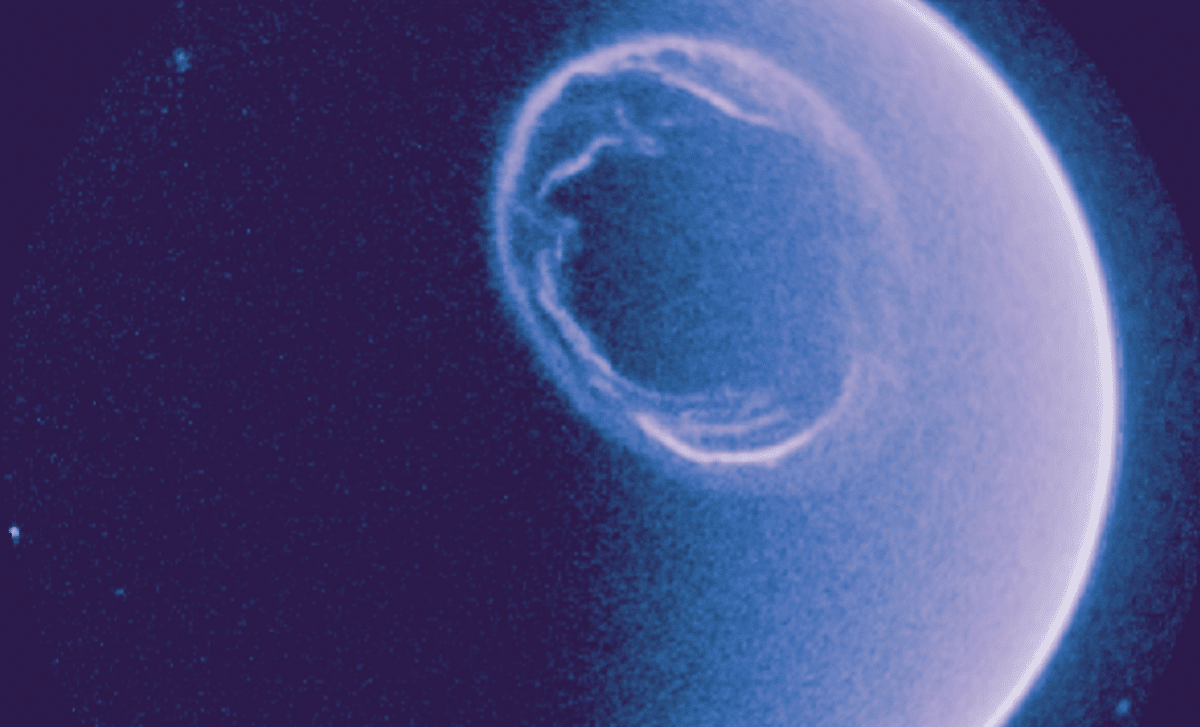
A European-Chinese spacecraft has captured the full ring of the northern lights around the North Pole in ultraviolet light, giving scientists a new way to follow how disturbances from the Sun interact with Earth’s magnetic environment. According to the European Space Agency (ESA), the observation was made by the Solar wind Magnetosphere Ionosphere Link Explorer, or Smile, shortly after its ultraviolet instrument was activated and before the mission was formally cleared to begin science operations. The footage represents the first time since 2008 that a camera has recorded the complete northern auroral oval in ultraviolet from space. More than a striking view of the aurora, the observation demonstrates that one of Smile’s main instruments can monitor the large-scale response of Earth’s upper atmosphere to changing conditions in the solar wind.
A New View Of The Aurora From Far Above Earth
The ultraviolet sequence was recorded on July 24, 2026, only about two weeks after Smile’s ultraviolet imager, or UVI, was switched on. Rather than concentrating on individual curtains or arcs of light visible from the ground, UVI is designed to observe the aurora on a planetary scale. From the spacecraft’s distant orbit, the instrument can see the broad ring of emission that encircles the magnetic pole, allowing researchers to follow how the entire auroral region changes as energy enters Earth’s magnetic system.
The footage released by ESA shows activity associated with an auroral substorm, a rapid reconfiguration of the magnetosphere that can intensify auroral emissions. ESA attributes the event to a disturbance in Earth’s magnetic field caused by an incoming rush of solar-wind particles. These particles continuously stream outward from the Sun, but variations in their density, speed and magnetic properties can strongly affect the space surrounding Earth.
One of UVI’s most useful capabilities is endurance. ESA says the camera is now able to record the auroras for as long as 45 hours continuously. That long observing window matters because magnetospheric changes can unfold over many hours, and short snapshots do not always show how one stage of an event develops into the next. Continuous ultraviolet imaging can reveal where auroral activity begins, how rapidly it expands and how the shape of the auroral oval responds to changing solar-wind conditions.
The instrument therefore provides more than imagery of the northern lights. Auroras are visible signatures of a much larger exchange of energy between the Sun and Earth. Charged particles guided through the magnetosphere eventually interact with gases in the upper atmosphere, producing emissions at wavelengths that include visible and ultraviolet light. Watching those emissions across an entire polar region can help scientists reconstruct how energy is being transferred through the magnetosphere and ionosphere.
Smile is intended to connect those observations with simultaneous measurements elsewhere around Earth. Instead of studying the aurora as an isolated phenomenon, the mission is designed to trace the physical sequence extending from the arriving solar wind, through the boundary of Earth’s magnetic field, and into the polar atmosphere.
 Smile’s first ultraviolet footage shows auroral substorm.
Credit: ESA
Smile Has Now Entered Its Science Phase
The new observations come at the end of an intensive commissioning period for the spacecraft. ESA announced on September 23, 2026, that Smile was ready to begin science operations, several months after the mission launched on May 19. The spacecraft reached the orbit intended for its scientific observations on June 20, after which European and Chinese teams began checking its systems in the conditions they would encounter away from Earth.
Commissioning involved deploying spacecraft mechanisms, turning equipment on, verifying communications between Smile and ground controllers and investigating technical issues that emerged in orbit. Spacecraft frequently behave somewhat differently after launch than they do during testing on Earth, where engineers cannot perfectly reproduce the thermal, radiation and illumination conditions encountered in space.
A major part of that work involved activating and testing Smile’s four scientific instruments: the soft X-ray imager (SXI), the ultraviolet imager (UVI), the magnetometer (MAG) and the light ion analyser (LIA). Together, those instruments are intended to examine different parts of the interaction between the solar wind and Earth.
“The Smile mission is a testament to the trust built between our teams, their dedication to excellence and their determination to find solutions whatever the challenge,” Professor Carole Mundell, ESA Director of Science, said in the release.
Mundell also said that Smile had been approved to start science operations and described the milestone as the beginning of a collaboration expected to deliver data to researchers around the world.
The spacecraft reached that point only a little over four months after launch. During that period, teams had to establish that each instrument could function in its operational environment and that data could be collected and transmitted reliably. UVI’s early observations of the aurora provide one of the clearest demonstrations so far that this process has begun producing usable scientific measurements.
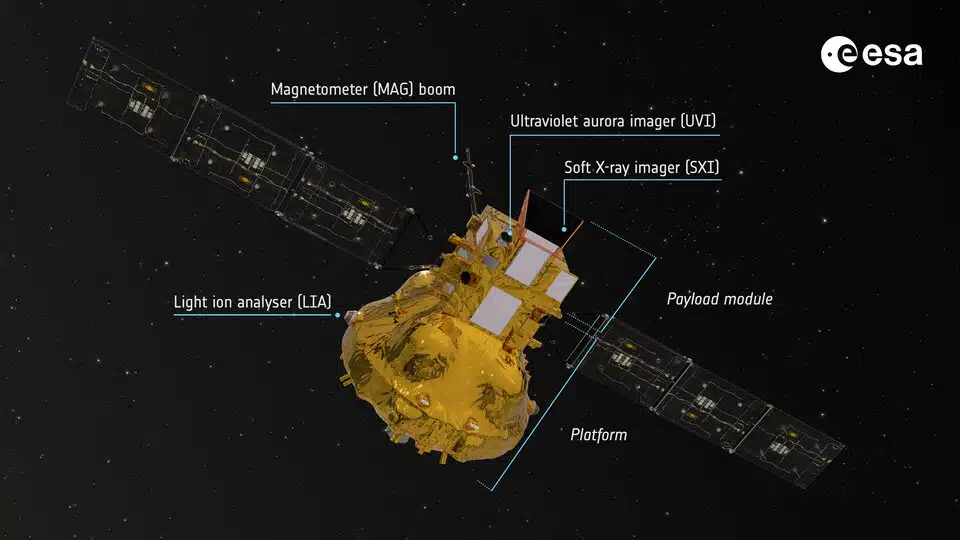 Labelled Smile spacecraft (artist impression)
Credit: ESA
Four Instruments Will Follow The Solar Wind To Earth
Smile’s scientific objective depends on combining measurements rather than relying on a single camera. The mission’s full name, Solar wind Magnetosphere Ionosphere Link Explorer, describes the chain of connected regions it is designed to investigate.
The solar wind is a flow of charged particles escaping continuously from the Sun. When it reaches Earth, most of that material is deflected by the planet’s magnetosphere, the vast region dominated by Earth’s magnetic field. The outer boundary of that region, called the magnetopause, shifts and changes shape depending on conditions in the solar wind.
Those interactions can inject energy into the magnetosphere, produce geomagnetic disturbances and help drive auroral displays. They are also part of the broader phenomenon known as space weather, which includes solar and magnetospheric conditions capable of affecting satellites, communications, navigation systems and other technology.
Smile is intended to observe several parts of this process at once. UVI watches the polar aurora. MAG measures magnetic fields around the spacecraft, while LIA examines charged particles in the solar wind. SXI is designed to image large-scale structures near Earth’s magnetic boundary using soft X-rays.
That combination could allow researchers to compare what is happening upstream in the solar wind with changes at the magnetopause and the response of the auroral regions. Instead of reconstructing the sequence from observations collected by unrelated missions at different times, scientists will be able to use measurements designed from the outset to complement one another.
The approach is particularly useful because Earth’s magnetic environment is constantly changing. Its shape depends not only on the strength of Earth’s magnetic field but also on the pressure and magnetic orientation of the incoming solar wind. Large-scale imaging can show how those boundaries move while local instruments measure the conditions accompanying those movements.