
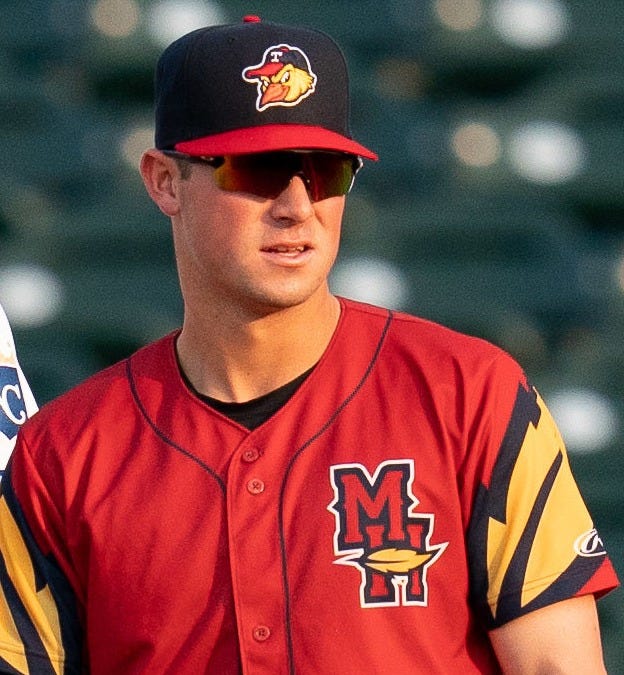
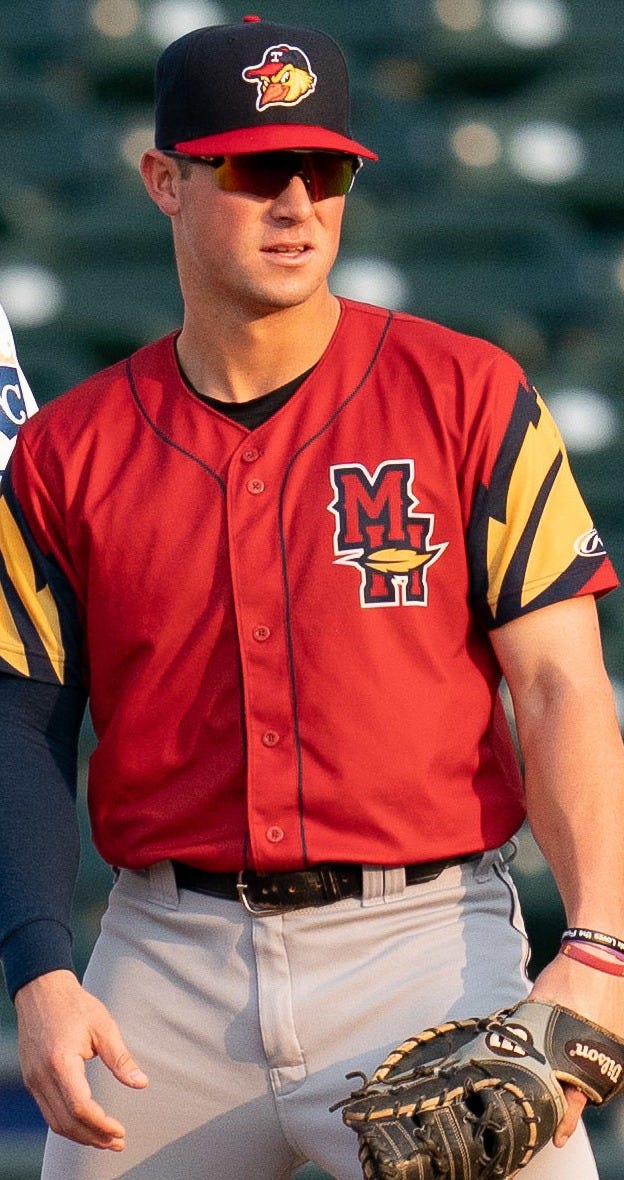
 Not so long ago, a first-overall draft pick was tuning up in Toledo for what figured to be a crackerjack career in Detroit. Now, some wonder what’s ahead for Spencer Torkelson, and where? (Photo by Minda Haas Kuhlmann)
Q — Great summary, on Monday’s Tigers press conference. Curious to see what the plan is at second base next year and if Max Anderson is ready to step up as a challenger.
Rick B
A — That’s a question, Rick, that will remain as long as Anderson sticks with the Tigers. And it isn’t confined to Anderson. People forget Jace Jung hit 22 home runs at Toledo with a .344 on-base average. So, there are questions that we’ve been asking for some time all because there is some serious roster congestion ahead.
Anderson is the kind of guy, as we’ve mentioned, who might be out of the picture in Detroit because Kevin McGonigle, who could be shifting toward the right side, will X-out Anderson, just as Lee has. Now, it wouldn’t be surprising to see Lee move more regularly to third base and McGonigle to second (McGonigle isn’t their primary desire, defensively, at short). That leaves out Anderson in any event.
They’re waiting for the right trade offer, it would certainly seem. Someone will get him. He hits too well. It’s just hard to see how he fits with the Tigers. The glove and range are just light enough to leave him on the outside.
Q — Monday’s press conference was about what I expected to hear from Scott Harris. I don’t agree on filling our back end bullpen with “in-house” pitchers, mainly because the only one I’ve seen with electric closer stuff is River Ryan. He would need lots of work on his command to fill the role.
Jan Warner
A — Oh, I think that’s the only way to go, Jan — with in-house arms. And for obvious reasons: Buying, or trading for, established back-end relievers is an expensive gamble that often doesn’t pay off. And in that context let me offer Exhibits A and B: Kenley Jansen and Kyle Finnegan. Let me offer other exhibits: Jose Valverde, Joe Nathan, Francisco Rodriguez, on and on.
The best bullpens tend to emerge from your own warehouse. Or, sure, in trades that tend to involve younger pitchers who are about to hatch, or who have bullpen potential. There’s your recipe.
River Ryan could be a closer but will, wisely, be used as a starter. As for how guys in your own bin tend to evolve, look at Drew Sommers. Where did you have him at the start of the year? But there was a reason the Tigers traded Mason Englert to get him from the Rays. A bunch of these kids, including some from the Skubal and Mize trades, will show up as bullpen pieces, and there will be a gold doubloon or two among them, guarantee you.
No — this is precisely how I’d approach a long-standing Tigers issue. And, of course, along the way you deal for some lower-celebrity arms that you know could be potential high-octane bullpen pieces. That approach will alter, entirely, and for the better, how these Tigers bullpens take shape.
Q — Scott Harris’ support of Spencer Torkelson is misguided. He is what he is, which is an average player AT BEST.
Jan Warner
A — Understand everyone’s frustrations with Torkelson, but look at it this way, Jan: He’s basic money in the bank. He gave the Tigers 26 bombs after having hit 31 in a pair of earlier seasons. He had a wRC+ of 113 — 13 points above the league-norm. He finished the season strong and began (mercy!) to use right field. He played okay defense and saved a bunch of runs on scoops at first. You could do a lot worse than Spencer Torkelson. He’ll be a place-sitter as Josue Briceno moves into the picture in 2027. Then, the Tigers can make assessments. But be careful about thinking that, say, Eduardo Valencia can play first base and not hurt you on defense in ways that Torkelson offers essential security.
Q — I wish someone would have asked your question about the 40-man roster jam, and why no question about the abysmal record against division rivals? Seems like a pretty significant failure to be overlooked.
Dave Roberts
A — I think the abysmal record against the Central Division teams was easily explained, Dave: The Tigers finished fourth because the other guys played better with emerging talent. It’s why the Tigers needed to make those Skubal and Mize trades: They needed a quick infusion of upper-tier farm/MLB talent to enhance the current cast and match what the Guardians, White Sox, and Twins have been amassing and now are unleashing.
In fact, the Tigers are in position to leap-frog all of the above in 2027 because they’re going to have the roster to do it, and definitely, a more sea-worthy bullpen. The Tigers (if the boys play baseball in 2027) could, and probably should, be one of MLB’s better teams and a serious threat in October.
That’s why I didn’t get down on them in 2026, which, to me, was both a weird year and a season that showed precisely where they’re heading: far into October in a lot of coming seasons. The kids are growing up in a hurry. This was a wobbly season, mostly because of May and the injuries, and youth. Don’t expect that to be anything more than, mostly, a wild aberration. In the meantime, they did absolutely the smart thing for the long haul in trading Skubal and Mize. Those moves were gallant and visionary.
Q — Total disagreement (with the words written below). Dumb. This is why Michigan professional sports teams can never win a championship because they lack the cojones to go for it. Fire Scott Harris!
(Here are words written here following Monday’s press conference)
Felix Culpa
A — Not in accord, Felix: Have the Lions been going for it? Yeah — but also they’re sensible about, for example, not trading for Joey Porter, Jr., when he’d kill their salary cap and cost them draft picks they shouldn’t, for a moment, be dealing (such as that second-rounder the Cowboys gave up).
Have the Pistons been going for it? You bet, and in a hurry they got there, but they did it sensibly, and aggressively, as the Duren contract just confirmed. The Red Wings are rudderless at the moment, but that’s specific to them.
I see the Tigers doing things, at last, on a line with what I’ve been advocating for literal decades: beefing up the farm with good drafts and (finally) some solid work in Latin America. Harris isn’t trading away talent that can benefit a team long-term for instant-gratification guys who — guess what? — don’t always leave you with much more than big bills to pay and too little production.
People who think the free-agent shelves are flush with goodies are walking the aisles with blindfolds. Not a lot of bargains or sure-fire saviors there, plus they force getting rid of good young talent that your current lineup or 40-man roster needs but, after a trade for a newcomer, is too limited to contain. And that can kill you for years to come. This team is doing things right, or at least right in my estimation, because I’ve been advocating this very approach for the past 40 years-plus.
A necessary follow-up question:
Just where was that Big Bat available and who would it have displaced? And what would it have cost? All the people who advocate for these deals rarely have a name or a practical answer for the roster realities that would come about. They also tend to conveniently forget past people they wanted, the costs absorbed, and the talent that would have been lost. They forget because they didn’t get stuck with some ugly moves.
So, those squeals tend more than not to be resisted here.
Q — I always read about the prowess of the Dodgers farm system, but isn’t that simply another by-product of the way they disproportionately spend on free agents? If the Tigers spent the way the Dodgers do they wouldn’t need to pull up guys like Clark, Peck, Valencia, etc. as early as they do and so these guys would linger in the minors, get even more seasoning and thus make our farm system look better. To me this is the bigger competitive balance issue and I rarely hear it discussed. Thoughts?
Ken Pachla
Shelby Township
A — In fact, the Dodgers bring up lots of homegrown talent, when it’s ready to help, all because they are terrific at talent identification in the draft and on the international side. They spend plenty on that front, as well, but not in prohibitive ways compared with lots of clubs that simply don’t match them in scouting and projecting. They then use that talent as a ground-floor for their rosters and use excess talent as trade bait, as a recently added stud named Skubal confirmed.
You call up farm talent when it’s ready to help at the big-league level. It’s of no benefit to allow it to over-ripen on the farm, and if it proves to be a bit early, sure, you can send guys back for more seasoning. But the Tigers didn’t pull the trigger too early on McGonigle, Clark, Lee, Valencia, Malgeri, or perhaps even Callahan or Peck. Rookie seasons are typically rough on kid talent, but Callahan was ready and Peck was, also, at least defensively, which was a big reason he was summoned.
I see the Dodgers as having no overwhelming financial edge in this context. But they’ve earned a definite prize for their ability to see future big-league talent when other teams aren’t always as sharp-eyed.
So many questions this week! We’ll need to get to the remainder on (probably) Monday. Thanks for all the vent-spleening and queries. As they say: Great stuff.
Email: lhenning@tigersintelligencereport.com