
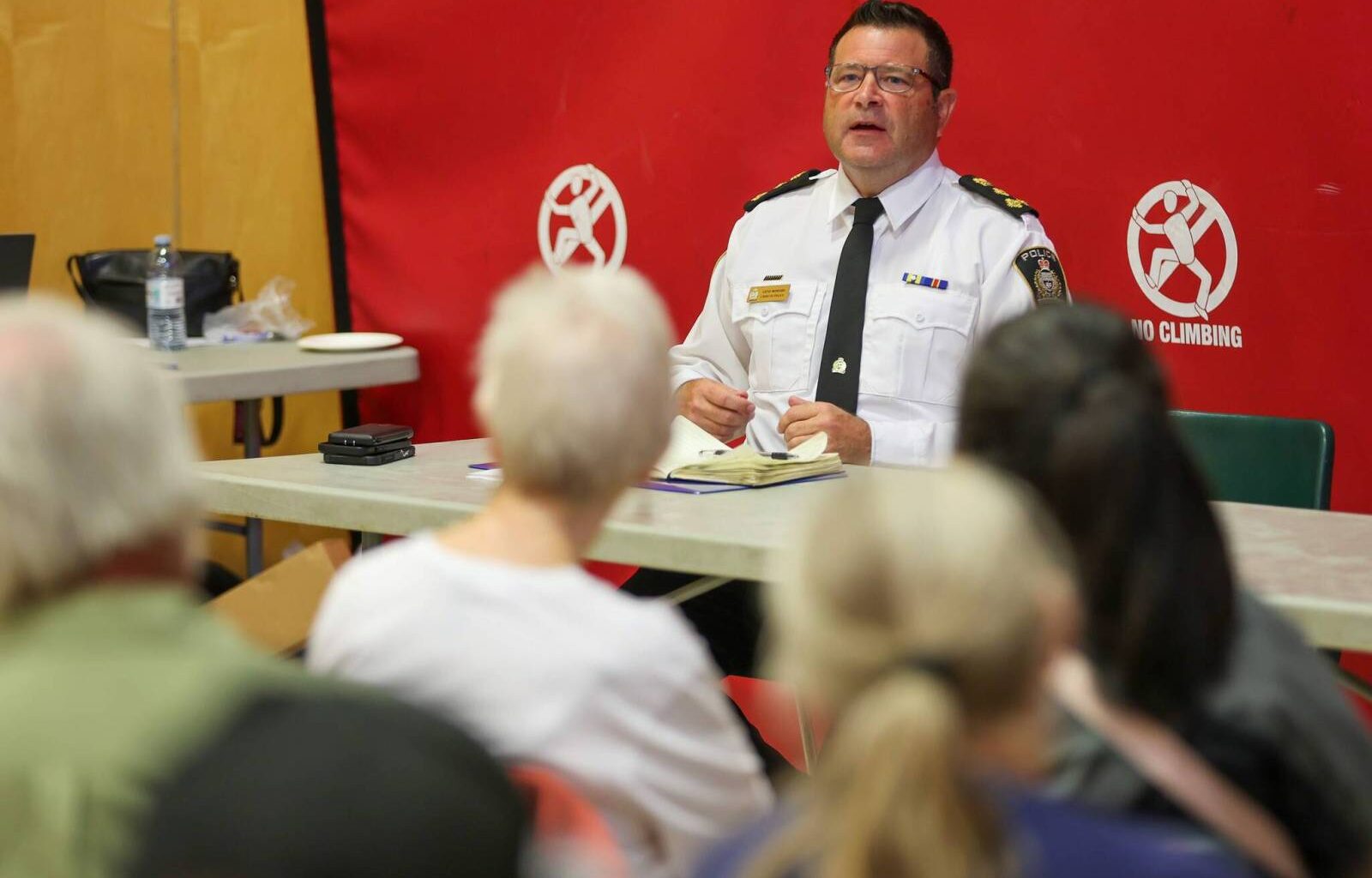
Weak bail reform and a lack of mental-health resources and addictions treatment beds are making it more difficult to tackle crime in inner-city neighbourhoods such as William Whyte, where there has been a significant increase in criminal behaviour compared to last year, the city’s top police officer says.
Winnipeg Police Services Chief Gene Bowers made the remarks Thursday night at an event hosted by the William Whyte Neighbourhood Association, where about two dozen residents gathered to share their concerns about crime in the North End community.
“Fentanyl and meth, that’s caused a strain on all our front lines and and all these agencies that are trying to help people,” Bowers told the room of people at Inner City Youth Alive on Aberdeen Avenue Thursday night.
BROOK JONES/FREE PRESS
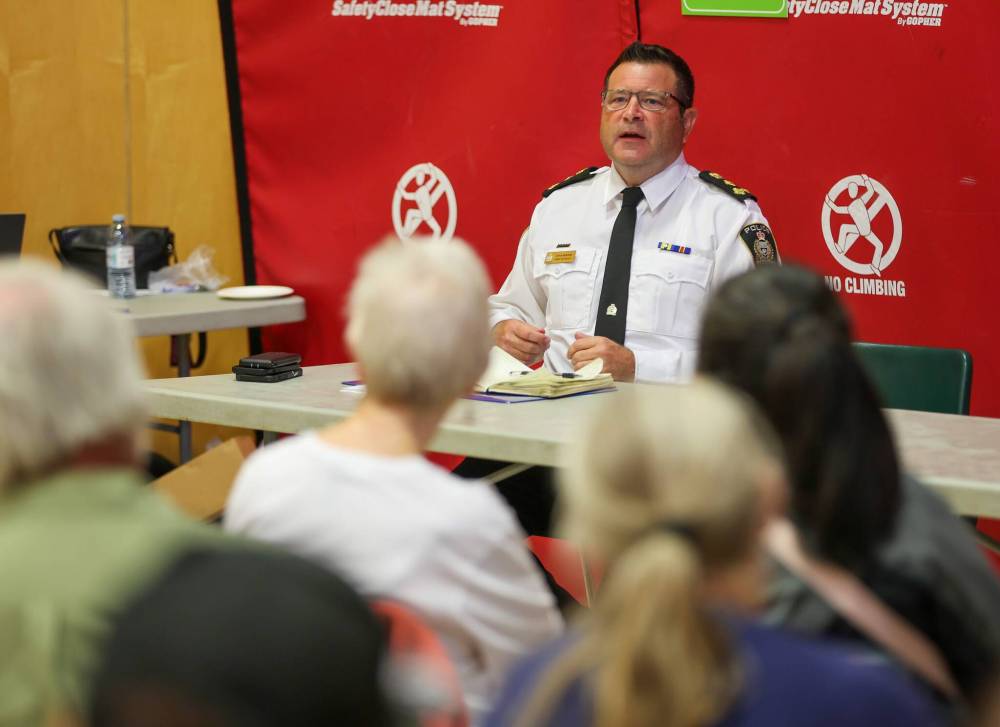
Winnipeg Police Services Chief Gene Bowers speaks to residents during a community engagement meeting hosted by the William Whyte Neighbourhood Association, Thursday.
“What really is the problem is there’s no treatment. That’s the gap, because (police and agencies) are all churning the same people through, and we’re all seeing them. We’re all frustrated that there’s no help.”
Getting individuals to organizations and shelters is easy, but ensuring they have long-term recovery plans is where the city and province are coming up short, he said.
“If we don’t have the help, if we don’t have that capacity to give them the help, I just don’t see how this is going to improve any time soon,” he said.
David Bowman, a data analyst and director of organizational development and support with the WPS, said crime in the neighbourhood was up 40 per cent between January and August compared to the same time last year. The rest of the city is trending downward, recording a four per cent decrease.
He said a part of the increase can be attributed to more reporting and the opening of the north district police station, but also said there’s been a “true” increase in crime on the street.
“We’re seeing increases across violent crimes, most notably in property crimes,” Bowman said. “It’s the crime types that impact the community the most. It’s the stuff that you’re seeing in your back lanes with your vehicles, the smashed windows, that is certainly going to create some anger and unrest in the community.”
Residents in the neighbourhood and surrounding area are experiencing “reporting fatigue” and don’t bother to call police sometimes, one resident said.
Ben Thiessen says he woke up a few months ago to someone trying to break into his home. He shooed the would-be intruder away, but didn’t think to report it to police until six hours later.
“I only called because we wanted the statistic recorded,” he said after the meeting ended. “How sad is it that our first thought isn’t to call the police anymore?”
Bowers sympathized with the resident fatigue and told the crowd the WPS was doing the best it could with its available resources and personnel, which he said are still at 2019 levels.
“I want to build capacity at the end of the day so that we’re less reactive and more proactive,” he said. “The more proactive and more visibility we have as a police service, then we’re going to have a safer community.”
The neighbourhood’s anonymous crime tip line, called the Powerline, received 192 calls in its first year. William Whyte Neighbourhood Association president Darrell Warren said the operation has been a success thus far, but there’s much more crime and disorder in the area yet to be addressed.
During the meeting, Coun. Ross Eadie, who is running for re-election in the Mynarski ward, which includes William Whyte, said if he reclaims his seat on council he’ll call on the city to add more police resources.
Eadie said he wants more community safety officers on the streets to do proactive policing, as well as enforcement. He would also like to be on the city’s police board to keep tabs on how the WPS is faring.
“I have a really good understanding of the street… and then you’re hearing what’s going on,” Eadie said Friday. “It’s good to be on there to make sure the police service is going in right direction.”
Bowers also underlined the number of people officers apprehend who are out on bail. Out of all the arrests made last year, about 42 per cent were out on conditions, according to police statistics.
In December 2025, the WPS introduced the bail compliance unit. So far in 2026, police conducted 3,000 bail compliance checks, 400 of which took place in William Whyte. Of that number, police discovered 81 breaches in the neighbourhood and made 36 arrests, he said.
Justice Minister Matt Wiebe was asked about the police chief’s comments and he pointed to the five-point bail plan the province implemented in 2024, money it spent to hire 12 new police officers, bail workers and expand reporting capacity.
Wiebe also pointed to the treatment beds the NDP government has funded since taking office in 2025, but wouldn’t commit to expanding their number. Addictions Minister Bernadette Smith was not made available for an interview.
As part of the WPS crackdown on open drug use and trafficking, officers were able to get several people into programming to free up resources elsewhere, north district commander Insp. Elton Hall said during Thursday’s presentation. The targeted enforcement ended Wednesday and police are expected to release statistics on the project in the coming weeks.
Winnipeg Free Press | Newsletter

Resources are being strained in dealing with the same people repeatedly, people who attended the meeting heard.
One woman had 45 interactions with police in a two-month period, Hall said.
“Let’s take these individuals, let’s get them into programming. Let’s get them into proper avenues, so police aren’t wasting our time sitting at the hospital for 48 hours with somebody with a mental-health issue when they should be in a community,” he said.
City council voted last month to adopt a Winnipeg Community Crisis Response model to divert some non-violent mental-health calls made to 911. Instead of a police, fire or ambulance response, those calls would be handled by community agencies.
nicole.buffie@freepress.mb.ca

Nicole Buffie
Multimedia producer
Nicole Buffie is a reporter for the Free Press city desk. Born and bred in Winnipeg, Nicole graduated from Red River College’s Creative Communications program in 2020 and worked as a reporter throughout Manitoba before joining the Free Press newsroom as a multimedia producer in 2023. Read more about Nicole.
Every piece of reporting Nicole produces is reviewed by an editing team before it is posted online or published in print — part of the Free Press‘s tradition, since 1872, of producing reliable independent journalism. Read more about Free Press’s history and mandate, and learn how our newsroom operates.
Our newsroom depends on a growing audience of readers to power our journalism. If you are not a paid reader, please consider becoming a subscriber.
Our newsroom depends on its audience of readers to power our journalism. Thank you for your support.